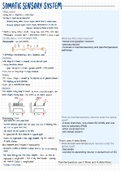
SOMATIC SENSORY SYSTEM
General features
•
sensory input → integration → motor output
•
two ways a
signal can be transmitted
specialised sensory neuron stimulus , receptor depolarisation of afferent neuron
-
-
,
-
specialised epithelial receptor
-
stimulus , receptor depolarisation
,
of ES cat
,
Nts
released t detected by receptor of afferent neuron
•
Examples of sensory systems include
-
hearing . touch , vision , smell ,
taste
,
balance
.
thermo reception nociceptive ( pain)
,
+
proprioception 1 perception of position in space )
First order neurons .
Dorsal root
ganglion neurons
What are first order neurons?
0 Pseudo unipolar -
two axon branches -dorsal root ganglion neurons
-pseudounipolar
-involved in mechanosensory and pain/temperature
pathways
• 2
pathways -
mech anos en s ony t paint temperature libres
Transduction
when stimulus
•
energy of a is converted into an electrical signal
transduction cascade
' '
sensory
o
signal transduction → current generator potential action potential
- →
0
stimulus must be strong enough to surpass threshold
Encoding
strength is encoded by
the stimulus the
amplitude of the
•
generator potential t
the
frequency of action potentials
o
affects rate of neurotransmitter release
Adaptation
o
tonic receptor slowly adapt to stimulus -
eg .
muscle stretch / pain receptors ,
static
aphasic receptor rapidly adapt t then produce an off response dynamic
,
Tonic phasic
How do mechanosensory neurons enter the spinal
mechano
sensory I touch
-
enters dorsal root t joins dorsal column cord?
two at on branches
-2 axon branches- one enters SC (CNS) and one
depart from the Soma one runs to
periphery IPNS) t
-
runs to periphery (PNS)
-
One runs to spinal cord ICNS)
-enter via dorsal root
cell bodies are all located in the DRG
-join dorsal column
-
for from the face , so mas trigeminal ganglion
signals are in
-
-
neurons aremyelinated t have large diameters very fast conduction ,
-
A- beta fibres Touch uses A-beta fibres
How do pain and temperature neurons enter the
paint temperature tbreslnocicep.to It thermo captors)
spinal cord?
de cuss atest makes a connection in dorsal horn of SC to an
ascending -decussate
-
neuron
-connect to ascending neuron in dorsal horn of SC
free nerve endings are the main receptors these can either be
-
-
have a small diameter
myelinated or un
myelinated t
very -
relatively
slow conduction (slowest it on
myelinated I Pain/temperature use C fibres and A-delta fibres
-
C fibres t AS fibres
, diftoentreceptorso
follicles detect
Hair a light brush
• encapsulated receptors , low thehold 1 high sensitivity innervated by large myelinated aeons
,
,
rapid central transmission
Meissner corpuscle dynamic deformation ( slipping objects)
-
-
→
connective tissue capsule
→ several lamellae of Schwann cells What’s the function of each of the types of receptor?
40% Of sensory receptor in the hand -meissner corpuscle- dynamic deformation (slipping
-
Pacini an corpuscle
-
vibration objects)
→ subcutaneous tissue
-pacinian corpuscle- vibration
-merkel cell neurite complex- indentation depth
→ Onion like capsule , lamella separated by fluid-filled space
-ruffini corpuscle- stretch
-
-1540 Of cutaneous in the hand
→ 10
receptor
-
mend on neurite complete -
indentation depth
25% Of me than one in the hand
captor
-
Ruffini corpuscle stretch .
→ 20% of methane receptor in the hand
→ also in ligaments t tendons
wee nerve
endings
-
C- fibre LTM -
touch
forces ( pain)
-
nociceptor -
injurious What are receptive fields?
Receptive fields 2 stimuli as distinct, spatial acuity -distinguish 2 simultaneously applied stimuli as
• the ability to
distinguish 2 simultaneously applied stimuli as distinct = 2- distinct
-measure of spatial acuity
point discrimination
-more nerve endings increases spatial acuity
o measure of
spatial acuity
o more nerve endings =
higher spatial acuity
Ascending pathways for so mate sensation What’s the ascending pathway for unconscious
0
Unconscious .
proprioception →
spin o cerebellar tract somatosensation?
°
Conscious -
mechanosensa.li on -spinocerebellar tract (proprioception)
→
body t
posterior portion of head Dorsal column medial
-
-
tennis contract What are the 4 ascending pathways for conscious
somatosensation?
→ face t anterior portion of head -
Trigeminal somatic
sensory
-dorsal column-medial lemniscal tract-
system
mechanosensation, body and posterior head
paint temp
-trigeminal somatic sensory system-
-
→ body t
posterior portion of head spin 0thalamic tract
mechanosensation, face and anterior head
-
→ facet anterior portion of head -
through spinal nucleolus -spinothalamatic tract- pain/temp, body and
of trigeminal complex posterior head
-spinal nucleolus of trigeminal complex- pain/temp,
Dermatome innervation
arising from a
single dorsal root
face and anterior head
-
ganglion t its spinal nerve ( some overlap) -
helps determine
how certain conditions affect specific regions of the
body
input is in
layer IV of Cottee ,
cortex Dermatome- determines how certain conditions affect
sends projections in turn to limbic
+ also
descending signals
structures
specific regions of the body
contains a
[relay station of
complete representation
somatic sensory periphery
i
\
1st order neurons
2nd Order neurons
3rd order neuron
General features
•
sensory input → integration → motor output
•
two ways a
signal can be transmitted
specialised sensory neuron stimulus , receptor depolarisation of afferent neuron
-
-
,
-
specialised epithelial receptor
-
stimulus , receptor depolarisation
,
of ES cat
,
Nts
released t detected by receptor of afferent neuron
•
Examples of sensory systems include
-
hearing . touch , vision , smell ,
taste
,
balance
.
thermo reception nociceptive ( pain)
,
+
proprioception 1 perception of position in space )
First order neurons .
Dorsal root
ganglion neurons
What are first order neurons?
0 Pseudo unipolar -
two axon branches -dorsal root ganglion neurons
-pseudounipolar
-involved in mechanosensory and pain/temperature
pathways
• 2
pathways -
mech anos en s ony t paint temperature libres
Transduction
when stimulus
•
energy of a is converted into an electrical signal
transduction cascade
' '
sensory
o
signal transduction → current generator potential action potential
- →
0
stimulus must be strong enough to surpass threshold
Encoding
strength is encoded by
the stimulus the
amplitude of the
•
generator potential t
the
frequency of action potentials
o
affects rate of neurotransmitter release
Adaptation
o
tonic receptor slowly adapt to stimulus -
eg .
muscle stretch / pain receptors ,
static
aphasic receptor rapidly adapt t then produce an off response dynamic
,
Tonic phasic
How do mechanosensory neurons enter the spinal
mechano
sensory I touch
-
enters dorsal root t joins dorsal column cord?
two at on branches
-2 axon branches- one enters SC (CNS) and one
depart from the Soma one runs to
periphery IPNS) t
-
runs to periphery (PNS)
-
One runs to spinal cord ICNS)
-enter via dorsal root
cell bodies are all located in the DRG
-join dorsal column
-
for from the face , so mas trigeminal ganglion
signals are in
-
-
neurons aremyelinated t have large diameters very fast conduction ,
-
A- beta fibres Touch uses A-beta fibres
How do pain and temperature neurons enter the
paint temperature tbreslnocicep.to It thermo captors)
spinal cord?
de cuss atest makes a connection in dorsal horn of SC to an
ascending -decussate
-
neuron
-connect to ascending neuron in dorsal horn of SC
free nerve endings are the main receptors these can either be
-
-
have a small diameter
myelinated or un
myelinated t
very -
relatively
slow conduction (slowest it on
myelinated I Pain/temperature use C fibres and A-delta fibres
-
C fibres t AS fibres
, diftoentreceptorso
follicles detect
Hair a light brush
• encapsulated receptors , low thehold 1 high sensitivity innervated by large myelinated aeons
,
,
rapid central transmission
Meissner corpuscle dynamic deformation ( slipping objects)
-
-
→
connective tissue capsule
→ several lamellae of Schwann cells What’s the function of each of the types of receptor?
40% Of sensory receptor in the hand -meissner corpuscle- dynamic deformation (slipping
-
Pacini an corpuscle
-
vibration objects)
→ subcutaneous tissue
-pacinian corpuscle- vibration
-merkel cell neurite complex- indentation depth
→ Onion like capsule , lamella separated by fluid-filled space
-ruffini corpuscle- stretch
-
-1540 Of cutaneous in the hand
→ 10
receptor
-
mend on neurite complete -
indentation depth
25% Of me than one in the hand
captor
-
Ruffini corpuscle stretch .
→ 20% of methane receptor in the hand
→ also in ligaments t tendons
wee nerve
endings
-
C- fibre LTM -
touch
forces ( pain)
-
nociceptor -
injurious What are receptive fields?
Receptive fields 2 stimuli as distinct, spatial acuity -distinguish 2 simultaneously applied stimuli as
• the ability to
distinguish 2 simultaneously applied stimuli as distinct = 2- distinct
-measure of spatial acuity
point discrimination
-more nerve endings increases spatial acuity
o measure of
spatial acuity
o more nerve endings =
higher spatial acuity
Ascending pathways for so mate sensation What’s the ascending pathway for unconscious
0
Unconscious .
proprioception →
spin o cerebellar tract somatosensation?
°
Conscious -
mechanosensa.li on -spinocerebellar tract (proprioception)
→
body t
posterior portion of head Dorsal column medial
-
-
tennis contract What are the 4 ascending pathways for conscious
somatosensation?
→ face t anterior portion of head -
Trigeminal somatic
sensory
-dorsal column-medial lemniscal tract-
system
mechanosensation, body and posterior head
paint temp
-trigeminal somatic sensory system-
-
→ body t
posterior portion of head spin 0thalamic tract
mechanosensation, face and anterior head
-
→ facet anterior portion of head -
through spinal nucleolus -spinothalamatic tract- pain/temp, body and
of trigeminal complex posterior head
-spinal nucleolus of trigeminal complex- pain/temp,
Dermatome innervation
arising from a
single dorsal root
face and anterior head
-
ganglion t its spinal nerve ( some overlap) -
helps determine
how certain conditions affect specific regions of the
body
input is in
layer IV of Cottee ,
cortex Dermatome- determines how certain conditions affect
sends projections in turn to limbic
+ also
descending signals
structures
specific regions of the body
contains a
[relay station of
complete representation
somatic sensory periphery
i
\
1st order neurons
2nd Order neurons
3rd order neuron