ATI MATERNAL HEALTH FINAL EXAM-LATEST RELIABLE STUDY GUIDE.UPDATED
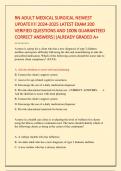
. Which nursing diagnosis has the highest priority for a postpartum client who has developed disseminated intravascular coagulopathy (DIC) A. Anticipating Grieving B. High risk for infection C. Risk for deficient fluid volume D. Spiritual Distress 2. A newly delivered 9lb 4 ounce baby boy exhibits of respiratory distress. The nurse obtains a blood sample to assess the infant for which of the following? A. Hypoglycemia B. Pneumonia C. Sepsis D. Hyperbilirubinemia 3. The nurse explains to the client in premature that betamethesome is given to: A. Stop uterine contractions B. Prevent infection C. Assist with fetal lung maturity D. Prevent cervical dilation 4. The onset of late decelerations on the fetal monitor should lead the nurse to suspect which condition? A. Head compression B. Cord compression C. Close uterine contractions D. Decreased uteroplacental blood flow 5. The nurse receives a call for postpartum who delivered 7 days ago. The client report having increase bleeding. The nurse suspect late postpartum hemorrhage, which is most commonly caused by which of the following? A. Uterine Atony B. Disseminated intravascular coagulopathy C. Retained Placental fragments D. Lacerations 6. Which of the following clients have the greatest risk for developing postpartum hemorrhage? A. A client who gave birth to a boy weighing 5lb 2 ounces B. A 17 year old client C. A client who is diagnosed with endometritis D. A client experimenting uterine atony 7. A client is ordered heparin 2,500 units SQQD for treatment of thrombophlebitis. On hand is Heparin 5,000 units/ml. How many millimeters will the nurse administer? A. 0.5 ml B. 1ml C. 2ml D. 2.5 ml 8. Which nursing intervention is appropriate in the care of an infant with respiratory distress syndrome? A. Perform a complete gestational age assessment B. Perform chest physiotherapy C. Suction mcconium from airway as needed D. Maintain a neutral thermal environment---- this answer is also correct 9. A client who baby is jaundice ask, “How will those lights help my baby? Which statement by the nurse is accurate? A. “The lights prevent more bilirubin from being released into your baby’s body” B. “Exposing the skin to the air helps get rid ofjaundice” C. “The lights help convert bilirubin to a form that the baby can get rid of” D. “The lights release a substance that attacks the bilirubin in the body and destroys it” 10. While feeding an infant the nurse notes white patches over the germsand buccal cavity, the nurse’s next best intervention would be” A. Document findings as normal B. Further evaluate to no yeast infection C. Prepare to give vitamin K D. Assess maternal history for Herpes 11. The nurse is evaluating a client receiving magnesium sulfate. What clinical manifestations indicate that the medication is working? A. Blood pressure 128/76 B. Serum magnesium level reaches 2.2 MEQ/L C. Contractions are steady at a frequency of every four minutes D. There is an absence of seizure activity NB. D is the correct answer but they gave credit for A too 12. A client in active labor is receiving an epidural, while it is being administered. Which of the following should the nurse consider as the highest priority? A. Checking uterine contractions for an increase in strength B. Positioning the mother flat in be, preventing spinal headache C. Telling the mother that she will have an increase in urinary output D. Monitoring mother’s blood pressure for hypotension 13. The post cesarean section client has the following for breakfast ½ grapefruit 4 ounces prune juice 1 pint cottage cheese ½ pint of skim milk 1 ounce of apple juice 2 ounce container of jello What is the total intake to be included on the intake and output sheet? A. 350 ml B. 450 ml C. 550 ml D. 650 ml 14. What are the expected findings of a second day postpartum client? A. Yellowish white lochia and fundus three fingerbreadths below the umbilicus B. Red lochia with small clots and fundus midline and two fingerbreadths below the umbilicus C. Pinkish brown lochia fundus midline and four fingerbreadths below the umbilicus D. A large amount of bright red lochia with large clots and fundus midline at the umbilicus 15. The postpartum client is being treated for a UTI. Determine the flow rate for the following IV being administered by the infusion pump, Ampicilin 1.5g in 50 ml, 0.9% NS over 30 minutes A. 75 ml/hr B. 133.3 ml/hr C. 150 ml/hr D. 100 ml/hr 16. A 15 year old female experiences a miscarriage at 12 weeks gestation. When she is informed about the miscarriage she begins to cry stating that she was upset about her pregnancy at first and now she is being punished for not her wanting her baby. Which of the following statements would be most therapeutic? A. “You are still young, you probably were not ready for a baby right now” B. “This must be so hard for you. I am here if you want to talk” C. “At least this happened early in your pregnancy before you felt your baby move” D. “There is a good reason why this happened, God knows best.” 17. A woman gave birth to twin girls, one of whom was stillborn. Which of the following nursing actions would be most helpful initially in supporting the woman as she copes with her loss? A. Remind her that she should be happy that one daughter survived and is healthy B. Have the client take pictures of the both babies C. Encourage the woman to hold the deceased twin in her arms to say good-bye D. Offer the opportunity for counseling to help her with her grief E. Inquire about the woman’s desire to hold the deceased twin 18. The nurse is reviewing a female client’s health care history prior to the planned cesarean section. The nurse notes that the Hematocrit is 30. Based on the observation, what action or change in the plan of care should be taken by the nurse, if any? A. Preoperative medications may need to be changed. B. No specific action is needed. C. The nurse may need to notify the surgeon of this low value. D. Preoperative vital signs will need to be taken with a greater frequency. 19. Infertility is defined as inability to conceive after months of unprotected intercourse with the same partner. A. 6 B. 12 C. 18 D. 24 20. A married woman presents to the clinic with complaints of grayish vaginal discharge with a “fishy”odor. Which of the following statements demonstrates that your teaching regarding bacterial vaginosis (BV) has been understood? Select all that apply. A. “I should avoid alcohol consumption during treatment with Flagyl” B. “It is not necessary to treat my partner.” C. “I should take scented bubble bath to get rid of the odor” D. “BV is a sexually transmitted disease” 21. The nurse is caring for a pregnant client who complains of new onset of aching, pulling, and stiffness to her lower back. Her pain sore is 5 out of 10 on the pain of the following is an appropriate working nursing diagnosis? A. Risk for dinse syndrome related to severe pain. B. Impaired physical inability related to numbness and weakness of the legs. C. Disturbed energy related to chronic pain as evidence by the pain of 5 out 10. D. Alteration in comfort, pain related to increase in the normal lumbosacral curvatureas evidence by numbness. 22. The nurse in the prenatal clinic assesses a 26 year old client at 13 weeks gestation. Which presumptive signs of pregnancy should the nurse anticipate? A. Hegar’s sign and quickening B. Ballouement and positive pregnancy test C. Chadwick’s sign and uterine shuffle D. Excessive fatigue and urinary frequency 23. The nurse in the prenatal clinic was planning care for a pregnant 15 year old client. The nurse knows that this adolescence is at greatest risk for which maternal complication? A. Postpartum hemorrhag e B. Hypoglycemia C. Cesarean birth D. Pre-eclampsia 24. The antepartum client tells the nurse her last period was May 18. The nurse uses Nagele’s rule to compute the client’s expected date of birth and tells the client that the correct date of birth will be: A. February 11 B. February 18 C. February 25 D. February 28 25. The nurse evaluation of a pregnant woman’s knowledge about urinary tract infection. The nurse recognizes that the patient understands the teaching when the patient states: Select all that apply A. “I will drink one quart of fluid weekly” B. “I have stopped using bubble baths and oils” C. “I have started wearing under panty with cotton crotch” D. “I try not to drink fluids after 5PM 26. On sterile spe................................................................................................................................................CONTINUED................................................................DOWNLOAD FOR BEST SCORES
Escuela, estudio y materia
Información del documento
- Subido en
- 6 de febrero de 2022
- Número de páginas
- 18
- Escrito en
- 2021/2022
- Tipo
- Examen
- Contiene
- Preguntas y respuestas
Temas
-
ati maternal health final exam
-
ati maternal health final exam latest reliable study guideupdated
-
which nursing diagnosis has the highest priority for a postpartum client who has developed disseminate