BIOM 500 QUIZ 2 TEST SOLUTION 2020 WITH ALL CORRECT ANSWERS (GRADED)
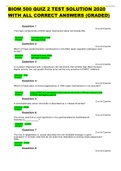
BIOM 500 QUIZ 2 TEST SOLUTION 2020 BIOM 500 QUIZ 2 TEST SOLUTION 2020 WITH ALL CORRECT ANSWERS (GRADED) • Question 1 The major components of DNA repair mechanism does not include this; 2 out of 2 points Selected Answer: Translocation of the damaged DNA • Question 2 2 out of 2 points Which of these protein/function combinations in the DNA repair regulation pathways is not correct? Selected Answer: PP2A/Activates DNA damage response • Question 3 2 out of 2 points In a patient diagnosed with a Squamous cell carcinoma that exhibits high Base Excision Repair activity, you can predict that the tumor will be very sensitive to PARP1 Inhibitors. Selected Answer: Tru e • Question 4 2 out of 2 points Which of these pairs of clinical applications of DNA repair mechanisms is not accurate? Selected Answer: Loss of BRCA2 correlates to decreased sensitivity of Breast cancer cells to DNA-damaging agents • Question 5 A transcriptionally active chromatin is described as a "closed chromatin". 2 out of 2 points Selected Answer: False • Question 6 The amino acid that is most significant in the posttranslational modification of histones is ? 2 out of 2 points Selected Answer: Lysine • Question 7 The role of epigenetics in cancer describes the non-heritable changes in gene 2 out of 2 points expression in somatic cells that do not arise from alterations to primary base sequence of DNA. Selected Answer: False • Question 8 2 out of 2 points The Mismatch Repair mechanism of DNA repair employs MSH2, MLH1 and PMS2 in removing DNA adducts from the genome of affected cells. Selected Answer: Tru e
Escuela, estudio y materia
- Institución
-
Liberty University
- Grado
-
BIOM 500 (BIOM500)
Información del documento
- Subido en
- 24 de enero de 2022
- Número de páginas
- 3
- Escrito en
- 2021/2022
- Tipo
- Examen
- Contiene
- Preguntas y respuestas
Temas
- biom500
-
the major components of dna repair mechanism does not include this
-
which of these proteinfunction combinations in the dna repair regulation pathways is not correct
-
in a patient diagnosed wit

Documento también disponible en un lote