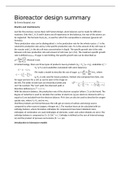
Bioreactor design summary
By Emma Burgwal, wur
Kinetics and stoichiometry
Just like the previous course, Basic Cell Factory Design, atom balances can be made for different
reactions. Only the C, H, O and N atoms are of importance in this balances, the rest of the atoms can
be neglected. The formula CH2O0.5N0.2 is used for cells if the composition is unknown (general cell
formula).
Three production rates can be distinguished: r i is the production rate for the whole reactor, r iv is the
volumetric production rate and qi is the specific production rate. Mx is the amount of dry cell mass in
the reactor and Cx is the dry cell mass concentration in liquid. The specific growth rate is the ratio
between cell mass production rate and amount of cell mass (μ=rx/Mx). The maximum specific growth
rate is defined as μmax. If sugar is rate-limiting, the specific growth rate can be described as:
μmax∗Cs
μ= (Monod’s law).
Ks+Cs
In biotechnology, there are three types of products: luxury products (q p = Ypx*μ + mp), anabolites (rpv =
Ypx*μ*Cx) and catabolites (calculated with atom balances).
μ qp
Pirt made a model to describe the use of sugar: q s= + +m s , where
Yxs Yps
qp/Yps is only used for luxury products. Herbert also composed two laws, one
for sugar and one for a cell, as can be seen in the image on
the left. The yields in both laws are theoretical yields and
can’t be reached. The ‘real’ yield, the observed yield, is
therefore defined as Yxsobs = rxx/-rsv.
With the electron balance, the production rate of the electron acceptor (often r ov) can be found. The
degree of reduction is used to calculate the number of electrons (γ) per electron. Elements with a γ
equal to 0 are excluded from the electron balance. Pirt’s law can also be used to describe the oxygen
uptake rate, where Yxs=Yxo and ms=mo.
Overflow products are formed because the cells get an excess of carbon and energy source
compared to other sources (oxygen, nitrogen etc.). The reaction heat can be calculated with an
enthalpy balance, where formation enthalpies for components have been tabulated. Here,
enthalpies of combustion are used (enthalpies of elements, water and carbon dioxide are zero). The
enthalpy balance is composed as 0 = ΣrivΔhc0 + rQv. Enthalpy is defined as the sum of internal energy
(u) and the product of pressure and volume (h = u + pv).
Introduction to bioreactor models
, For setting up component balances, we must know how components enter
and leave the reactor. This can be determined by drawing a
schematic picture of the reactor
with the input and output rates.
The standard component balance
is: 0 = FLinCLin – (FLCL + FGCG) + rivVL,
‘out’ is not written in the
subscript here, because everything is ideally mixed.
In the image, we have 13 unknowns and only 10 equations.
Therefore, the ideal gas law and the gas-liquid equilibrium can be
added (and μ = FL/VL, so μ = DL). These balances can now be
solved via substitution. This can only be solved by making
assumptions, like that everything is ideally mixed and that we have a steady state.
Often, only one component has a significant effect on μ, the rate-limiting component. You have to
check your calculations of the rate-limiting component, because other components can also be rate-
limiting.
If you have an ideally mixed aerated tank, all gas bubbles have the same composition and are
therefore drawn (in a schematic drawing) as a rectangle. This situation is a plug flow situation: there
is no mixing along the flow direction (vertical), but the gas in homogenous perpendicular to the flow
direction (horizontal). The rate changes over the height of the reactor.
To set up balances, men must decide which components to use (cells, rate-limiting component), how
many balances to compose and which system boundaries to use.
A microbalance is the balance over the whole reactor (cell, sugar balance etc.). A microbalance is
needed if a fluid moves in ideal plug flow and if the reaction rate varies along the flow direction or if
the transfer rate varies along the flow direction. The difference between a microbalance and a
microbalance is the volume; large for microbalance and infinitely small for the microbalance.
Sugar-limited reactors
The first rate-limiting component is sugar. A cell balance and sugar balance are needed. Sugar is the
carbon source and the energy source of cells. The most frequently used model for sugar-limited cell
growth is Monod’s law, where Ks is the sugar concentration that allows the cell to grow with 50% of
its maximum specific growth rate. Teissier’s and Blackman’s law (see
image) can also be used.
CSTR: ideally mixed reactor with continuous feed addition
and product removal. A chemostat is a CSTR in steady state.
The balances and the schematic drawing of the CSTR are shown on the right. Monod’s
and Pirt’s law are substituted in the balances here. C x can be removed from the cell
balances, if there are no cells in the feed stream.
Batch: no steady state, and no input and output
flow. The accumulation terms of the sugar and cell
balances must be included here. Note that also
here (image on the left), Monod’s and Pirt’s law are substituted. You
can neglect volume change, because there is no input or output.
Simplification is needed to solve these balances. Often, K s is very slow, and therefore μ = μmax. The cell
balance can be solved (integration) and substitution in the sugar balance is then possible.
Fed-batch: there is input, but no output. In comparison to a batch reactor, the liquids are ideally
mixed here. Two scenarios can be the case with a fed-batch; a constant μ or a constant sugar input
rate.
By Emma Burgwal, wur
Kinetics and stoichiometry
Just like the previous course, Basic Cell Factory Design, atom balances can be made for different
reactions. Only the C, H, O and N atoms are of importance in this balances, the rest of the atoms can
be neglected. The formula CH2O0.5N0.2 is used for cells if the composition is unknown (general cell
formula).
Three production rates can be distinguished: r i is the production rate for the whole reactor, r iv is the
volumetric production rate and qi is the specific production rate. Mx is the amount of dry cell mass in
the reactor and Cx is the dry cell mass concentration in liquid. The specific growth rate is the ratio
between cell mass production rate and amount of cell mass (μ=rx/Mx). The maximum specific growth
rate is defined as μmax. If sugar is rate-limiting, the specific growth rate can be described as:
μmax∗Cs
μ= (Monod’s law).
Ks+Cs
In biotechnology, there are three types of products: luxury products (q p = Ypx*μ + mp), anabolites (rpv =
Ypx*μ*Cx) and catabolites (calculated with atom balances).
μ qp
Pirt made a model to describe the use of sugar: q s= + +m s , where
Yxs Yps
qp/Yps is only used for luxury products. Herbert also composed two laws, one
for sugar and one for a cell, as can be seen in the image on
the left. The yields in both laws are theoretical yields and
can’t be reached. The ‘real’ yield, the observed yield, is
therefore defined as Yxsobs = rxx/-rsv.
With the electron balance, the production rate of the electron acceptor (often r ov) can be found. The
degree of reduction is used to calculate the number of electrons (γ) per electron. Elements with a γ
equal to 0 are excluded from the electron balance. Pirt’s law can also be used to describe the oxygen
uptake rate, where Yxs=Yxo and ms=mo.
Overflow products are formed because the cells get an excess of carbon and energy source
compared to other sources (oxygen, nitrogen etc.). The reaction heat can be calculated with an
enthalpy balance, where formation enthalpies for components have been tabulated. Here,
enthalpies of combustion are used (enthalpies of elements, water and carbon dioxide are zero). The
enthalpy balance is composed as 0 = ΣrivΔhc0 + rQv. Enthalpy is defined as the sum of internal energy
(u) and the product of pressure and volume (h = u + pv).
Introduction to bioreactor models
, For setting up component balances, we must know how components enter
and leave the reactor. This can be determined by drawing a
schematic picture of the reactor
with the input and output rates.
The standard component balance
is: 0 = FLinCLin – (FLCL + FGCG) + rivVL,
‘out’ is not written in the
subscript here, because everything is ideally mixed.
In the image, we have 13 unknowns and only 10 equations.
Therefore, the ideal gas law and the gas-liquid equilibrium can be
added (and μ = FL/VL, so μ = DL). These balances can now be
solved via substitution. This can only be solved by making
assumptions, like that everything is ideally mixed and that we have a steady state.
Often, only one component has a significant effect on μ, the rate-limiting component. You have to
check your calculations of the rate-limiting component, because other components can also be rate-
limiting.
If you have an ideally mixed aerated tank, all gas bubbles have the same composition and are
therefore drawn (in a schematic drawing) as a rectangle. This situation is a plug flow situation: there
is no mixing along the flow direction (vertical), but the gas in homogenous perpendicular to the flow
direction (horizontal). The rate changes over the height of the reactor.
To set up balances, men must decide which components to use (cells, rate-limiting component), how
many balances to compose and which system boundaries to use.
A microbalance is the balance over the whole reactor (cell, sugar balance etc.). A microbalance is
needed if a fluid moves in ideal plug flow and if the reaction rate varies along the flow direction or if
the transfer rate varies along the flow direction. The difference between a microbalance and a
microbalance is the volume; large for microbalance and infinitely small for the microbalance.
Sugar-limited reactors
The first rate-limiting component is sugar. A cell balance and sugar balance are needed. Sugar is the
carbon source and the energy source of cells. The most frequently used model for sugar-limited cell
growth is Monod’s law, where Ks is the sugar concentration that allows the cell to grow with 50% of
its maximum specific growth rate. Teissier’s and Blackman’s law (see
image) can also be used.
CSTR: ideally mixed reactor with continuous feed addition
and product removal. A chemostat is a CSTR in steady state.
The balances and the schematic drawing of the CSTR are shown on the right. Monod’s
and Pirt’s law are substituted in the balances here. C x can be removed from the cell
balances, if there are no cells in the feed stream.
Batch: no steady state, and no input and output
flow. The accumulation terms of the sugar and cell
balances must be included here. Note that also
here (image on the left), Monod’s and Pirt’s law are substituted. You
can neglect volume change, because there is no input or output.
Simplification is needed to solve these balances. Often, K s is very slow, and therefore μ = μmax. The cell
balance can be solved (integration) and substitution in the sugar balance is then possible.
Fed-batch: there is input, but no output. In comparison to a batch reactor, the liquids are ideally
mixed here. Two scenarios can be the case with a fed-batch; a constant μ or a constant sugar input
rate.