Erin Watson Topic 2
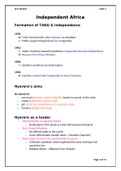
Independent Africa
Formation of TANU & independence
1954:
TANU formed with Julius Nyerere as president
TANU sought independence for Tanganyika
1961:
under relatively peaceful conditions Tanganyika became independent
Nyerere First Prime Minister
1963:
Zanzibar overthrew its Arab leaders
1964:
Zanzibar united with Tanganyika to form Tanzania
Nyerere’s aims
He aimed to:
construct a strong national identity based on power of the state
create a distinctly African state
get rid of any resemblance of a western state
Create a single-party state
Nyerere as a leader
Internationally recognised leader
o Dedicated to firm ideals & ruled with personal integrity
Had a large following
o He offered hope to the world
o Given affectionate Swahili name - Mwalimu (teacher)
Some argue that he was a good leader because:
o Criticised capitalism which exploited the poor and kept rich
countries rich
o Disliked elitism - different from Mobuto
Page 1 of 11
, Erin Watson Topic 2
o Did not take sides in Cold War - non-aligned - this meant Nyerere
was on good terms with both the USA and USSR
His generally good intentions brought him praise & support
This helped him to get a great deal of foreign aid
In the 1970s, Tanzania was receiving more foreign aid per capita than
any other African country.
However good intentions don’t necessarily make you a good leader
Nyerere as a leader
Although Nyerere was regarded as one of Africa’s best leaders:
He maintained unity and tribal harmony (believed by some to be his
greatest legacy)
Had moral integrity.
opposed corruption - His regime was not characterised by acts of
corruption
He lived in a modest home and earned a salary lower than that of his
ministers
advocated a return to simple and traditional values and the Swahili
language.
He was a committed Pan-Africanist and African Nationalist
His intellect and attempts to promote education and health care and
relieve poverty.
But:
1. He was authoritarian and imposed a one party state on the country.
2. He became increasingly tyrannical and was accused of having little faith
in his people's own initiative
3. His tendency to look to the East for aid caused deterioration in relations
with the West.
4. His policies were not successful - his experiment in agricultural socialism
was overly ambitious and ultimately unsuccessful
Page 2 of 11
Independent Africa
Formation of TANU & independence
1954:
TANU formed with Julius Nyerere as president
TANU sought independence for Tanganyika
1961:
under relatively peaceful conditions Tanganyika became independent
Nyerere First Prime Minister
1963:
Zanzibar overthrew its Arab leaders
1964:
Zanzibar united with Tanganyika to form Tanzania
Nyerere’s aims
He aimed to:
construct a strong national identity based on power of the state
create a distinctly African state
get rid of any resemblance of a western state
Create a single-party state
Nyerere as a leader
Internationally recognised leader
o Dedicated to firm ideals & ruled with personal integrity
Had a large following
o He offered hope to the world
o Given affectionate Swahili name - Mwalimu (teacher)
Some argue that he was a good leader because:
o Criticised capitalism which exploited the poor and kept rich
countries rich
o Disliked elitism - different from Mobuto
Page 1 of 11
, Erin Watson Topic 2
o Did not take sides in Cold War - non-aligned - this meant Nyerere
was on good terms with both the USA and USSR
His generally good intentions brought him praise & support
This helped him to get a great deal of foreign aid
In the 1970s, Tanzania was receiving more foreign aid per capita than
any other African country.
However good intentions don’t necessarily make you a good leader
Nyerere as a leader
Although Nyerere was regarded as one of Africa’s best leaders:
He maintained unity and tribal harmony (believed by some to be his
greatest legacy)
Had moral integrity.
opposed corruption - His regime was not characterised by acts of
corruption
He lived in a modest home and earned a salary lower than that of his
ministers
advocated a return to simple and traditional values and the Swahili
language.
He was a committed Pan-Africanist and African Nationalist
His intellect and attempts to promote education and health care and
relieve poverty.
But:
1. He was authoritarian and imposed a one party state on the country.
2. He became increasingly tyrannical and was accused of having little faith
in his people's own initiative
3. His tendency to look to the East for aid caused deterioration in relations
with the West.
4. His policies were not successful - his experiment in agricultural socialism
was overly ambitious and ultimately unsuccessful
Page 2 of 11