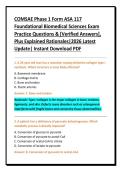
COMSAE Phase 1 Form ASA 113
Foundational Biomedical Sciences Exam
Practice Questions & [Verified Answers],
Plus Explained Rationales|2026 Latest
Update| Instant Download PDF
1. A 6-year-old boy presents with recurrent respiratory infections,
steatorrhea, and failure to thrive. Genetic testing reveals a
mutation causing defective chloride transport across epithelial
membranes. Which cellular process is primarily impaired?
A. Sodium-potassium ATPase activity
B. CFTR-mediated ion transport
C. Endocytosis of membrane proteins
D. Gap junction communication
E. Voltage-gated calcium influx
Answer: B
Rationale: Cystic fibrosis results from mutations in the CFTR gene,
causing defective chloride transport across epithelial cells. The
resulting thick secretions impair mucociliary clearance and pancreatic
enzyme delivery, leading to recurrent pulmonary infections and
malabsorption.
2. A researcher administers a drug that irreversibly inhibits
cyclooxygenase in platelets. Which mediator synthesis will be
most directly reduced?
,A. Leukotriene B4
B. Prostacyclin
C. Thromboxane A2
D. Histamine
E. Bradykinin
Answer: C
Rationale: Aspirin irreversibly inhibits COX enzymes in platelets,
decreasing thromboxane A2 production. Since platelets lack nuclei,
they cannot synthesize new COX enzymes, resulting in prolonged
antiplatelet effects.
3. A patient develops nephrotic syndrome. Which glomerular
structure is most responsible for preventing albumin filtration
under normal conditions?
A. Proximal tubule brush border
B. Collecting duct principal cells
C. Podocyte slit diaphragm
D. Loop of Henle epithelium
E. Juxtaglomerular apparatus
Answer: C
Rationale: Podocyte slit diaphragms and the negatively charged
basement membrane form the primary filtration barrier preventing
protein loss into urine. Damage leads to proteinuria and nephrotic
syndrome.
4. A woman develops megaloblastic anemia due to vitamin B12
deficiency. Which metabolic reaction is most impaired?
,A. Conversion of pyruvate to acetyl-CoA
B. Homocysteine to methionine
C. Glycogen to glucose-1-phosphate
D. Tyrosine to DOPA
E. Fructose metabolism
Answer: B
Rationale: Vitamin B12 serves as a cofactor for methionine synthase,
which converts homocysteine to methionine. Deficiency causes
elevated homocysteine and impaired DNA synthesis.
5. A patient experiences anaphylaxis after a bee sting. Which
immunoglobulin mediates mast cell degranulation?
A. IgA
B. IgD
C. IgE
D. IgG
E. IgM
Answer: C
Rationale: IgE binds Fc receptors on mast cells and basophils. Antigen
cross-linking triggers rapid degranulation and release of histamine
and other inflammatory mediators.
6. Which cranial nerve innervates the lateral rectus muscle?
A. CN III
B. CN IV
C. CN V1
, D. CN VI
E. CN VII
Answer: D
Rationale: The abducens nerve (CN VI) innervates the lateral rectus
muscle, which abducts the eye. Lesions cause medial deviation and
horizontal diplopia.
7. A patient develops hypercalcemia due to primary
hyperparathyroidism. Which renal effect is expected?
A. Increased phosphate reabsorption
B. Decreased calcium reabsorption
C. Increased calcium reabsorption
D. Increased bicarbonate excretion only
E. Increased potassium retention
Answer: C
Rationale: Parathyroid hormone increases calcium reabsorption in the
distal convoluted tubule while promoting phosphate excretion.
8. Which organism is the most common cause of lobar pneumonia in
otherwise healthy adults?
A. Mycoplasma pneumoniae
B. Staphylococcus aureus
C. Streptococcus pneumoniae
D. Legionella pneumophila
E. Chlamydia pneumoniae
Answer: C
Foundational Biomedical Sciences Exam
Practice Questions & [Verified Answers],
Plus Explained Rationales|2026 Latest
Update| Instant Download PDF
1. A 6-year-old boy presents with recurrent respiratory infections,
steatorrhea, and failure to thrive. Genetic testing reveals a
mutation causing defective chloride transport across epithelial
membranes. Which cellular process is primarily impaired?
A. Sodium-potassium ATPase activity
B. CFTR-mediated ion transport
C. Endocytosis of membrane proteins
D. Gap junction communication
E. Voltage-gated calcium influx
Answer: B
Rationale: Cystic fibrosis results from mutations in the CFTR gene,
causing defective chloride transport across epithelial cells. The
resulting thick secretions impair mucociliary clearance and pancreatic
enzyme delivery, leading to recurrent pulmonary infections and
malabsorption.
2. A researcher administers a drug that irreversibly inhibits
cyclooxygenase in platelets. Which mediator synthesis will be
most directly reduced?
,A. Leukotriene B4
B. Prostacyclin
C. Thromboxane A2
D. Histamine
E. Bradykinin
Answer: C
Rationale: Aspirin irreversibly inhibits COX enzymes in platelets,
decreasing thromboxane A2 production. Since platelets lack nuclei,
they cannot synthesize new COX enzymes, resulting in prolonged
antiplatelet effects.
3. A patient develops nephrotic syndrome. Which glomerular
structure is most responsible for preventing albumin filtration
under normal conditions?
A. Proximal tubule brush border
B. Collecting duct principal cells
C. Podocyte slit diaphragm
D. Loop of Henle epithelium
E. Juxtaglomerular apparatus
Answer: C
Rationale: Podocyte slit diaphragms and the negatively charged
basement membrane form the primary filtration barrier preventing
protein loss into urine. Damage leads to proteinuria and nephrotic
syndrome.
4. A woman develops megaloblastic anemia due to vitamin B12
deficiency. Which metabolic reaction is most impaired?
,A. Conversion of pyruvate to acetyl-CoA
B. Homocysteine to methionine
C. Glycogen to glucose-1-phosphate
D. Tyrosine to DOPA
E. Fructose metabolism
Answer: B
Rationale: Vitamin B12 serves as a cofactor for methionine synthase,
which converts homocysteine to methionine. Deficiency causes
elevated homocysteine and impaired DNA synthesis.
5. A patient experiences anaphylaxis after a bee sting. Which
immunoglobulin mediates mast cell degranulation?
A. IgA
B. IgD
C. IgE
D. IgG
E. IgM
Answer: C
Rationale: IgE binds Fc receptors on mast cells and basophils. Antigen
cross-linking triggers rapid degranulation and release of histamine
and other inflammatory mediators.
6. Which cranial nerve innervates the lateral rectus muscle?
A. CN III
B. CN IV
C. CN V1
, D. CN VI
E. CN VII
Answer: D
Rationale: The abducens nerve (CN VI) innervates the lateral rectus
muscle, which abducts the eye. Lesions cause medial deviation and
horizontal diplopia.
7. A patient develops hypercalcemia due to primary
hyperparathyroidism. Which renal effect is expected?
A. Increased phosphate reabsorption
B. Decreased calcium reabsorption
C. Increased calcium reabsorption
D. Increased bicarbonate excretion only
E. Increased potassium retention
Answer: C
Rationale: Parathyroid hormone increases calcium reabsorption in the
distal convoluted tubule while promoting phosphate excretion.
8. Which organism is the most common cause of lobar pneumonia in
otherwise healthy adults?
A. Mycoplasma pneumoniae
B. Staphylococcus aureus
C. Streptococcus pneumoniae
D. Legionella pneumophila
E. Chlamydia pneumoniae
Answer: C