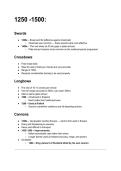
1250 -1500:
Swords
● 1300s – Broad and flat (effective against chainmail)
○ Chainmail was common — these swords were most effective
● 1400s – Thin and sharp (to fit into gaps in plate armour)
○ Plate armour became more common as the medieval period progressed
Crossbows
● Fired metal bolts
● Slow fire rate (2 bolts per minute) but very accurate
● Range of 100m
● Required considerable training to be used properly
Longbows
● Fire rate of 10–15 arrows per minute
● Very far range (accurate to 200m, can reach 350m)
● Able to pierce plate armour
● 1290 – Introduced in England
○ Much better than traditional bows
● 1298 – Used at Falkirk
○ Used to overwhelm schiltrons and kill deserting archers
Cannons
● 1320s – Gunpowder reaches Europe — cannon first used in Europe
● Scary and threatening to enemies
● Heavy and difficult to transport
● 1430–1500 – Improvements:
○ Metal cannonballs used rather than stone
○ Longer barrels used (increased accuracy, range, and power)
● Unreliable
○ 1460 – King James II of Scotland killed by his own cannon
,Army Composition (1250–1500)
c.1250
● Armies had between 5,000 and 10,000 soldiers
● Infantry : Cavalry ratio = 2:1
Cavalry
● Typically noblemen
● Positions depended on social status rather than ability
● Used mounted charges to break enemy lines
● Used rout and chase tactics to disperse enemy infantry
Infantry
● Used shield walls to block enemy attacks
● Used schiltrons
● Melee combat very common
⚠️ However, cavalry often did not listen to orders
● 1264 – Battle of Lewes
○ Prince Edward’s cavalry ignored instructions by raiding enemy supply wagons
○ Nobles often refused command
1400s
● Armies of similar size
● Ratio changed to 3:1 (infantry:cavalry)
● By 1500:
○ Cavalry declined as archers became more significant
○ Feudal duty declined
○ New methods of recruitment developed
Armour
Cavalry
, ● Most cavalrymen wore chainmail garments called hauberks
● Had a coif for the head that stretched as far as the knees
● Knights often wore colourful cloth surcoats
● Flat-topped metal helmets
● By 1250 had face guards with slits for ventilation
Infantry
● Most wore leather or padded linen jackets called gambesons
● Best-defended infantry wore short mail skirts
● Most infantry wore skull caps
Castles
Advantages
● Attackers had to divide their forces to besiege each castle
● Defenders had bases to launch counter-attacks
● Example (1266):
○ After the Battle of Evesham (1265), Henry III’s enemies took refuge in
Kenilworth Castle
○ It took Henry’s army 6 months to remove them
Tactical Formations
● Positioning an army was important
● High ground important (enemy attacks uphill)
● Flanks must be protected from cavalry
● Battle of Lewes (1264):
○ Simon de Montfort placed his army on Offham Hill
○ Flanks protected by steep banks
Tactics
, Cavalry
● Mounted charge
● Rout and chase (scatter infantry, then pursue and kill)
Infantry
● Shield wall (overlapping shields and spears)
● Archers used to weaken enemy but played a minor role
○ Example: limited impact at Lewes (1264)
Melee
● If archers and cavalry failed → infantry fought hand-to-hand
Recruitment & Training (1250–1500)
Cavalry Recruitment
Feudal Duty
● Kings rewarded supporters with land
● In return, nobles provided troops
● Knight service limited to 40 days/year
● A tenant might provide 1, 5, 20, or 100 knights
● In 1250, Henry III could call 5,000 knights’ fees
Assize of Arms
● Extra recruitment method
● Wealthier people had to supply arms
● Example: men with land worth £15 had to supply a mounted knight
Scutage
● Money paid instead of military service
Mercenaries
Swords
● 1300s – Broad and flat (effective against chainmail)
○ Chainmail was common — these swords were most effective
● 1400s – Thin and sharp (to fit into gaps in plate armour)
○ Plate armour became more common as the medieval period progressed
Crossbows
● Fired metal bolts
● Slow fire rate (2 bolts per minute) but very accurate
● Range of 100m
● Required considerable training to be used properly
Longbows
● Fire rate of 10–15 arrows per minute
● Very far range (accurate to 200m, can reach 350m)
● Able to pierce plate armour
● 1290 – Introduced in England
○ Much better than traditional bows
● 1298 – Used at Falkirk
○ Used to overwhelm schiltrons and kill deserting archers
Cannons
● 1320s – Gunpowder reaches Europe — cannon first used in Europe
● Scary and threatening to enemies
● Heavy and difficult to transport
● 1430–1500 – Improvements:
○ Metal cannonballs used rather than stone
○ Longer barrels used (increased accuracy, range, and power)
● Unreliable
○ 1460 – King James II of Scotland killed by his own cannon
,Army Composition (1250–1500)
c.1250
● Armies had between 5,000 and 10,000 soldiers
● Infantry : Cavalry ratio = 2:1
Cavalry
● Typically noblemen
● Positions depended on social status rather than ability
● Used mounted charges to break enemy lines
● Used rout and chase tactics to disperse enemy infantry
Infantry
● Used shield walls to block enemy attacks
● Used schiltrons
● Melee combat very common
⚠️ However, cavalry often did not listen to orders
● 1264 – Battle of Lewes
○ Prince Edward’s cavalry ignored instructions by raiding enemy supply wagons
○ Nobles often refused command
1400s
● Armies of similar size
● Ratio changed to 3:1 (infantry:cavalry)
● By 1500:
○ Cavalry declined as archers became more significant
○ Feudal duty declined
○ New methods of recruitment developed
Armour
Cavalry
, ● Most cavalrymen wore chainmail garments called hauberks
● Had a coif for the head that stretched as far as the knees
● Knights often wore colourful cloth surcoats
● Flat-topped metal helmets
● By 1250 had face guards with slits for ventilation
Infantry
● Most wore leather or padded linen jackets called gambesons
● Best-defended infantry wore short mail skirts
● Most infantry wore skull caps
Castles
Advantages
● Attackers had to divide their forces to besiege each castle
● Defenders had bases to launch counter-attacks
● Example (1266):
○ After the Battle of Evesham (1265), Henry III’s enemies took refuge in
Kenilworth Castle
○ It took Henry’s army 6 months to remove them
Tactical Formations
● Positioning an army was important
● High ground important (enemy attacks uphill)
● Flanks must be protected from cavalry
● Battle of Lewes (1264):
○ Simon de Montfort placed his army on Offham Hill
○ Flanks protected by steep banks
Tactics
, Cavalry
● Mounted charge
● Rout and chase (scatter infantry, then pursue and kill)
Infantry
● Shield wall (overlapping shields and spears)
● Archers used to weaken enemy but played a minor role
○ Example: limited impact at Lewes (1264)
Melee
● If archers and cavalry failed → infantry fought hand-to-hand
Recruitment & Training (1250–1500)
Cavalry Recruitment
Feudal Duty
● Kings rewarded supporters with land
● In return, nobles provided troops
● Knight service limited to 40 days/year
● A tenant might provide 1, 5, 20, or 100 knights
● In 1250, Henry III could call 5,000 knights’ fees
Assize of Arms
● Extra recruitment method
● Wealthier people had to supply arms
● Example: men with land worth £15 had to supply a mounted knight
Scutage
● Money paid instead of military service
Mercenaries