NURS 307 Exam – Questions With Proper Solutions
Save
Practice questions for this set
Learn 1 /7 Study using Learn
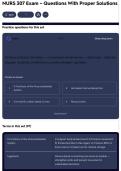
Nucleus pulposus herniates → compresses spinal nerves → back pain + radicular
leg pain (sciatica); confirmed by positive Straight Leg Raise
Choose an answer
5 Functions of the Musculoskeletal
1 2 Herniated Intervertebral Disc
System
3 Cervical & Lumbar Spinal Curves 4 Fibrous Joints
Don't know?
Terms in this set (97)
5 Functions of the Musculoskeletal 1) Support body & stand erect 2) Produce movement
System 3) Encase & protect vital organs 4) Produce RBCs in
bone marrow 5) Reservoir for mineral storage
Ligaments Fibrous bands connecting one bone to another —
strengthen joints and prevent movement in
undesirable directions
, Tendons Connect MUSCLE to BONE
Bursae Enclosed fluid-filled sacs that cushion and reduce
friction between tissues in areas of potential friction
Fibrous Joints Bones united by fibrous tissue; DO NOT MOVE —
example: skull sutures
Cartilaginous Joints Separated by fibrocartilaginous discs; SLIGHTLY
MOVEABLE — example: vertebrae
Synovial Joints Freely moveable; enclosed in cavity lined with
synovial membrane that secretes fluid; contains
avascular cartilage nourished by synovial fluid
Articular Disease Disease INSIDE the joint capsule (e.g., arthritis) —
swelling & tenderness around the WHOLE joint; limits
ALL planes of ROM in both active and passive
motion
Extra-Articular Disease Injury to tendon, ligament, or nerve OUTSIDE the
joint — affects only CERTAIN planes of movement;
swelling/tenderness at ONE spot
Crepitation Audible and palpable crunching or grating with
movement — caused by roughened articular surfaces
Nucleus Pulposus Soft, semifluid material at center of each
intervertebral disc — can herniate and compress
spinal nerves, causing pain
Number of Vertebrae 7 Cervical, 12 Thoracic, 5 Lumbar, 5 Sacral, 3-4
Coccygeal (33 total)
Cervical & Lumbar Spinal Curves CONCAVE (inward/anterior)
Thoracic & Sacrococcygeal Spinal CONVEX
Curves
Save
Practice questions for this set
Learn 1 /7 Study using Learn
Nucleus pulposus herniates → compresses spinal nerves → back pain + radicular
leg pain (sciatica); confirmed by positive Straight Leg Raise
Choose an answer
5 Functions of the Musculoskeletal
1 2 Herniated Intervertebral Disc
System
3 Cervical & Lumbar Spinal Curves 4 Fibrous Joints
Don't know?
Terms in this set (97)
5 Functions of the Musculoskeletal 1) Support body & stand erect 2) Produce movement
System 3) Encase & protect vital organs 4) Produce RBCs in
bone marrow 5) Reservoir for mineral storage
Ligaments Fibrous bands connecting one bone to another —
strengthen joints and prevent movement in
undesirable directions
, Tendons Connect MUSCLE to BONE
Bursae Enclosed fluid-filled sacs that cushion and reduce
friction between tissues in areas of potential friction
Fibrous Joints Bones united by fibrous tissue; DO NOT MOVE —
example: skull sutures
Cartilaginous Joints Separated by fibrocartilaginous discs; SLIGHTLY
MOVEABLE — example: vertebrae
Synovial Joints Freely moveable; enclosed in cavity lined with
synovial membrane that secretes fluid; contains
avascular cartilage nourished by synovial fluid
Articular Disease Disease INSIDE the joint capsule (e.g., arthritis) —
swelling & tenderness around the WHOLE joint; limits
ALL planes of ROM in both active and passive
motion
Extra-Articular Disease Injury to tendon, ligament, or nerve OUTSIDE the
joint — affects only CERTAIN planes of movement;
swelling/tenderness at ONE spot
Crepitation Audible and palpable crunching or grating with
movement — caused by roughened articular surfaces
Nucleus Pulposus Soft, semifluid material at center of each
intervertebral disc — can herniate and compress
spinal nerves, causing pain
Number of Vertebrae 7 Cervical, 12 Thoracic, 5 Lumbar, 5 Sacral, 3-4
Coccygeal (33 total)
Cervical & Lumbar Spinal Curves CONCAVE (inward/anterior)
Thoracic & Sacrococcygeal Spinal CONVEX
Curves