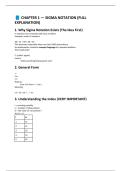
CHAPTER 1 — SIGMA NOTATION (FULL
EXPLANATION)
1. Why Sigma Notation Exists (The Idea First)
In statistics we constantly add many numbers.
Example: marks of students
48 + 71 + 69 + 56 + 67
This becomes impossible when we have 1000 observations.
So mathematics created a compact language for repeated addition.
The Greek letter:
Σ (called: sigma)
means:
“Add everything following the rule”
2. General Form
n
Σ xi
i=1
Read as:
Sum of xi from i = 1 to n
Meaning:
x1 + x2 + x3 + ... + xn
3. Understanding the Index (VERY IMPORTANT)
i = counting variable
n = number of observations
xi = the value of x at position i
So if n = 5:
i xi
1 x1
2 x2
3 x3
4 x4
5 x5
, 4. Examples
Example 1
7
Σ 2xi
i=4
Start at i=4 and stop at i=7:
2x4 + 2x5 + 2x6 + 2x7
Example 2
5
Σ xi yi²
i=1
Multiply x and y² for each observation:
x1y1² + x2y2² + x3y3² + x4y4² + x5y5²
RULES OF SIGMA NOTATION (MEMORISE — EXAM
QUESTIONS)
Rule 1 — Split a Sum
Σ (xi + yi) = Σ xi + Σ yi
Meaning: you can sum variables separately.
Rule 2 — Constant Multiple
Σ cxi = c Σ xi
You can move constants outside sigma.
Example:
Σ 5xi = 5 Σ xi
Rule 3 — Sum of a Constant
Σ c = nc
Because you add c exactly n times.
Example:
Σ 3 (5 terms) = 3 + 3 + 3 + 3 + 3 = 5(3) = 15
Combined Rule
Σ (axi + byi) = a Σ xi + b Σ yi
EXPLANATION)
1. Why Sigma Notation Exists (The Idea First)
In statistics we constantly add many numbers.
Example: marks of students
48 + 71 + 69 + 56 + 67
This becomes impossible when we have 1000 observations.
So mathematics created a compact language for repeated addition.
The Greek letter:
Σ (called: sigma)
means:
“Add everything following the rule”
2. General Form
n
Σ xi
i=1
Read as:
Sum of xi from i = 1 to n
Meaning:
x1 + x2 + x3 + ... + xn
3. Understanding the Index (VERY IMPORTANT)
i = counting variable
n = number of observations
xi = the value of x at position i
So if n = 5:
i xi
1 x1
2 x2
3 x3
4 x4
5 x5
, 4. Examples
Example 1
7
Σ 2xi
i=4
Start at i=4 and stop at i=7:
2x4 + 2x5 + 2x6 + 2x7
Example 2
5
Σ xi yi²
i=1
Multiply x and y² for each observation:
x1y1² + x2y2² + x3y3² + x4y4² + x5y5²
RULES OF SIGMA NOTATION (MEMORISE — EXAM
QUESTIONS)
Rule 1 — Split a Sum
Σ (xi + yi) = Σ xi + Σ yi
Meaning: you can sum variables separately.
Rule 2 — Constant Multiple
Σ cxi = c Σ xi
You can move constants outside sigma.
Example:
Σ 5xi = 5 Σ xi
Rule 3 — Sum of a Constant
Σ c = nc
Because you add c exactly n times.
Example:
Σ 3 (5 terms) = 3 + 3 + 3 + 3 + 3 = 5(3) = 15
Combined Rule
Σ (axi + byi) = a Σ xi + b Σ yi