ATI
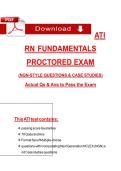
RN FUNDAMENTALS
PROCTORED EXAM
(NGN-STYLE QUESTIONS & CASE STUDIES)
Actual Qs & Ans to Pass the Exam
This ATI test contains:
\ \ \ \
passing\score\Guarantee
70\Ques\and\Ans
Format\Set\of\Multiple-choice
questions\with\incorporating\Next\Generation\NCLEX\(NGN)\a
nd\Case\studies\questions
, Expert-Verified\Explanations\&\Solutions
───────────────────────────────────────────────────────
─
1.\NGN-Style\Clinical\Scenario
───────────────────────────────────────────────────────
─
A\nurse\is\caring\for\a\client\who\is\postoperative\following\abdominal\surgery.\The\nurse\h
as\gathered\the\following\assessment\data:
•\Urinary\output:\20\mL/hr
•\Client\reports\pain\level:\6\on\a\0–10\scale
•\Vital\signs:\Temperature\37.2°C\(99.0°F),\Pulse\84/min,\Respirations\18/min,\Blood\pres
sure\118/74\mm\Hg
Question:\Which\of\the\following\findings\is\the\priority\finding\that\the\nurse\should\report\t
o\the\provider?
A.\Urinary\output\of\20\mL/hr
B.\Reported\pain\level\of\6\on\a\0–10\scale
C.\Temperature\of\37.2°C\(99.0°F)
D.\Blood\pressure\of\118/74\mm\Hg
Correct\Answer:\A\\
Expert\Explanation/Rationale:\An\adult\client’s\urinary\output\should\be\at\least\30\mL/h
r\to\maintain\adequate\kidney\perfusion.\A\rate\of\20\mL/hr\may\indicate\decreased\renal\p
erfusion\and\necessitates\immediate\provider\notification.\The\other\findings\(pain\of\6/10,
\mild\elevation\in\temperature,\and\blood\pressure\within\normal\limits)\are\not\as\urgent.
───────────────────────────────────────────────────────
─
,2.\A\nurse\is\caring\for\a\client\who\reports\difficulty\falling\asleep\at\night.\Which\of\the\foll
owing\recommendations\should\the\nurse\make?
A.\Take\a\daytime\nap\to\catch\up\on\rest.\\
B.\Consume\a\caffeinated\beverage\before\bedtime.\\
C.\Maintain\a\consistent\time\to\wake\up\each\day.\\
D.\Increase\fluid\intake\right\before\bedtime.\\
Correct\Answer:\C\\
Expert\Explanation/Rationale:\Maintaining\a\consistent\wake-
up\time\helps\regulate\the\sleep-
wake\cycle\and\improves\overall\sleep\hygiene.\Daytime\naps,\consuming\stimulants\befo
re\bed,\and\ingesting\fluids\close\to\bedtime\can\negatively\affect\the\ability\to\fall\asleep.
───────────────────────────────────────────────────────
─
3.\A\nurse\is\caring\for\a\client\who\has\diarrhea\secondary\to\a\Shigella\infection.\Which\of
\the\following\precautions\should\the\nurse\implement?
A.\Airborne\precautions\\
B.\Droplet\precautions\\
C.\Contact\precautions\(wear\a\gown)\\
D.\Standard\precautions\only\\
Correct\Answer:\C\\
Expert\Explanation/Rationale:\Shigella\transmission\occurs\via\the\fecal-
oral\route\and\requires\contact\precautions.\Healthcare\workers\should\wear\gloves\and\a\
gown\when\coming\into\contact\with\the\client’s\environment\or\secretions.\Airborne\preca
utions\(e.g.,\N95\mask)\apply\to\pathogens\such\as\tuberculosis,\and\droplet\precautions\
apply\to\infections\spread\via\large\respiratory\droplets\(e.g.,\influenza).
───────────────────────────────────────────────────────
─
, 4.\A\nurse\is\assessing\a\client\who\reports\increased\pain\after\completing\physical\thera
py.\Which\of\the\following\questions\by\the\nurse\assesses\the\QUALITY\of\the\client’s\pai
n?
A.\“Where\is\your\pain\located?”\\
B.\“Is\your\pain\sharp\or\dull?”\\
C.\“How\severe\is\your\pain\on\a\scale\from\0\to\10?”\\
D.\“When\did\your\pain\start?”\\
Correct\Answer:\B\\
Expert\Explanation/Rationale:\Asking\if\the\pain\is\“sharp\or\dull”\addresses\the\qualitati
ve\aspect\or\character\of\the\pain.\Location,\severity,\and\onset\are\also\important\aspects\
of\pain\assessment\but\do\not\directly\address\the\quality.
───────────────────────────────────────────────────────
─
5.\A\nurse\is\caring\for\a\client\who\has\a\serum\sodium\level\of\125\mEq/L.\Which\of\the\fo
llowing\findings\should\the\nurse\expect?
A.\Ecchymosis\\
B.\Abdominal\cramping\\
C.\Polyuria\\
D.\Tachycardia\\
Correct\Answer:\B\\
Expert\Explanation/Rationale:\Hyponatremia\(low\sodium)\often\presents\with\gastroint
estinal\manifestations\such\as\abdominal\cramping\and\nausea.\Tachycardia\can\occur,\b
ut\abdominal\cramping\is\more\specifically\linked\to\hyponatremia;\ecchymosis\and\polyur
ia\are\not\primary\signs\of\hyponatremia.
───────────────────────────────────────────────────────
─
6.\NGN-Style\Clinical\Scenario
RN FUNDAMENTALS
PROCTORED EXAM
(NGN-STYLE QUESTIONS & CASE STUDIES)
Actual Qs & Ans to Pass the Exam
This ATI test contains:
\ \ \ \
passing\score\Guarantee
70\Ques\and\Ans
Format\Set\of\Multiple-choice
questions\with\incorporating\Next\Generation\NCLEX\(NGN)\a
nd\Case\studies\questions
, Expert-Verified\Explanations\&\Solutions
───────────────────────────────────────────────────────
─
1.\NGN-Style\Clinical\Scenario
───────────────────────────────────────────────────────
─
A\nurse\is\caring\for\a\client\who\is\postoperative\following\abdominal\surgery.\The\nurse\h
as\gathered\the\following\assessment\data:
•\Urinary\output:\20\mL/hr
•\Client\reports\pain\level:\6\on\a\0–10\scale
•\Vital\signs:\Temperature\37.2°C\(99.0°F),\Pulse\84/min,\Respirations\18/min,\Blood\pres
sure\118/74\mm\Hg
Question:\Which\of\the\following\findings\is\the\priority\finding\that\the\nurse\should\report\t
o\the\provider?
A.\Urinary\output\of\20\mL/hr
B.\Reported\pain\level\of\6\on\a\0–10\scale
C.\Temperature\of\37.2°C\(99.0°F)
D.\Blood\pressure\of\118/74\mm\Hg
Correct\Answer:\A\\
Expert\Explanation/Rationale:\An\adult\client’s\urinary\output\should\be\at\least\30\mL/h
r\to\maintain\adequate\kidney\perfusion.\A\rate\of\20\mL/hr\may\indicate\decreased\renal\p
erfusion\and\necessitates\immediate\provider\notification.\The\other\findings\(pain\of\6/10,
\mild\elevation\in\temperature,\and\blood\pressure\within\normal\limits)\are\not\as\urgent.
───────────────────────────────────────────────────────
─
,2.\A\nurse\is\caring\for\a\client\who\reports\difficulty\falling\asleep\at\night.\Which\of\the\foll
owing\recommendations\should\the\nurse\make?
A.\Take\a\daytime\nap\to\catch\up\on\rest.\\
B.\Consume\a\caffeinated\beverage\before\bedtime.\\
C.\Maintain\a\consistent\time\to\wake\up\each\day.\\
D.\Increase\fluid\intake\right\before\bedtime.\\
Correct\Answer:\C\\
Expert\Explanation/Rationale:\Maintaining\a\consistent\wake-
up\time\helps\regulate\the\sleep-
wake\cycle\and\improves\overall\sleep\hygiene.\Daytime\naps,\consuming\stimulants\befo
re\bed,\and\ingesting\fluids\close\to\bedtime\can\negatively\affect\the\ability\to\fall\asleep.
───────────────────────────────────────────────────────
─
3.\A\nurse\is\caring\for\a\client\who\has\diarrhea\secondary\to\a\Shigella\infection.\Which\of
\the\following\precautions\should\the\nurse\implement?
A.\Airborne\precautions\\
B.\Droplet\precautions\\
C.\Contact\precautions\(wear\a\gown)\\
D.\Standard\precautions\only\\
Correct\Answer:\C\\
Expert\Explanation/Rationale:\Shigella\transmission\occurs\via\the\fecal-
oral\route\and\requires\contact\precautions.\Healthcare\workers\should\wear\gloves\and\a\
gown\when\coming\into\contact\with\the\client’s\environment\or\secretions.\Airborne\preca
utions\(e.g.,\N95\mask)\apply\to\pathogens\such\as\tuberculosis,\and\droplet\precautions\
apply\to\infections\spread\via\large\respiratory\droplets\(e.g.,\influenza).
───────────────────────────────────────────────────────
─
, 4.\A\nurse\is\assessing\a\client\who\reports\increased\pain\after\completing\physical\thera
py.\Which\of\the\following\questions\by\the\nurse\assesses\the\QUALITY\of\the\client’s\pai
n?
A.\“Where\is\your\pain\located?”\\
B.\“Is\your\pain\sharp\or\dull?”\\
C.\“How\severe\is\your\pain\on\a\scale\from\0\to\10?”\\
D.\“When\did\your\pain\start?”\\
Correct\Answer:\B\\
Expert\Explanation/Rationale:\Asking\if\the\pain\is\“sharp\or\dull”\addresses\the\qualitati
ve\aspect\or\character\of\the\pain.\Location,\severity,\and\onset\are\also\important\aspects\
of\pain\assessment\but\do\not\directly\address\the\quality.
───────────────────────────────────────────────────────
─
5.\A\nurse\is\caring\for\a\client\who\has\a\serum\sodium\level\of\125\mEq/L.\Which\of\the\fo
llowing\findings\should\the\nurse\expect?
A.\Ecchymosis\\
B.\Abdominal\cramping\\
C.\Polyuria\\
D.\Tachycardia\\
Correct\Answer:\B\\
Expert\Explanation/Rationale:\Hyponatremia\(low\sodium)\often\presents\with\gastroint
estinal\manifestations\such\as\abdominal\cramping\and\nausea.\Tachycardia\can\occur,\b
ut\abdominal\cramping\is\more\specifically\linked\to\hyponatremia;\ecchymosis\and\polyur
ia\are\not\primary\signs\of\hyponatremia.
───────────────────────────────────────────────────────
─
6.\NGN-Style\Clinical\Scenario