Calculus:
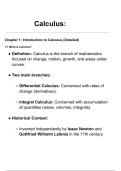
Chapter 1: Introduction to Calculus (Detailed)
1.1 What is Calculus?
●Definition: Calculus is the branch of mathematics
focused on change, motion, growth, and areas under
curves.
●Two main branches:
○Differential Calculus: Concerned with rates of
change (derivatives).
○Integral Calculus: Concerned with accumulation
of quantities (areas, volumes, integrals).
●Historical Context:
○Invented independently by Isaac Newton and
Gottfried Wilhelm Leibniz in the 17th century.
, ○Development for physics (motion), astronomy, and
engineering problems.
●Applications in Real Life:
○Physics: Motion, forces, energy
○Engineering: Stress, strain, electrical circuits
○Economics: Cost, profit, optimization
○Data Science: Modeling growth, trend analysis
1.2 Functions and Graphs
●Definition of Function: A relation between inputs (x)
and outputs (f(x)) such that each input has exactly one
output.
●Types of Functions:
○Linear: f(x)=mx+cf(x) = mx + cf(x)=mx+c
, ○Quadratic: f(x)=ax2+bx+cf(x) = ax^2 + bx +
cf(x)=ax2+bx+c
○Polynomial: f(x)=anxn+⋯+a1x+a0f(x) = a_n x^n +
\dots + a_1 x + a_0f(x)=anxn+⋯+a1x+a0
○Exponential: f(x)=axf(x) = a^xf(x)=ax
○Logarithmic: f(x)=logaxf(x) = \log_a xf(x)=logax
●Domain and Range:
○Domain: all possible x-values
○Range: all possible y-values
●Graphing Functions:
○Plot points, identify symmetry, intercepts,
increasing/decreasing intervals
Example: Graph f(x)=x2−4x+3f(x) = x^2 - 4x +
3f(x)=x2−4x+3
, Exercise: Find domain, range, and graph f(x)=x−1f(x) =
\sqrt{x-1}f(x)=x−1
1.3 Limits and Continuity (Introduction)
●Definition of Limit: limx→af(x)=L\lim_{x \to a} f(x) =
Llimx→af(x)=L means as x approaches a, f(x)
approaches L
●Right-Hand & Left-Hand Limits:
○Right-hand: limx→a+f(x)\lim_{x \to a^+}
f(x)limx→a+f(x)
○Left-hand: limx→a−f(x)\lim_{x \to a^-}
f(x)limx→a−f(x)
●Continuity: A function is continuous at x = a if:
○f(a) exists
○limx→af(x)\lim_{x \to a} f(x)limx→af(x) exists
Chapter 1: Introduction to Calculus (Detailed)
1.1 What is Calculus?
●Definition: Calculus is the branch of mathematics
focused on change, motion, growth, and areas under
curves.
●Two main branches:
○Differential Calculus: Concerned with rates of
change (derivatives).
○Integral Calculus: Concerned with accumulation
of quantities (areas, volumes, integrals).
●Historical Context:
○Invented independently by Isaac Newton and
Gottfried Wilhelm Leibniz in the 17th century.
, ○Development for physics (motion), astronomy, and
engineering problems.
●Applications in Real Life:
○Physics: Motion, forces, energy
○Engineering: Stress, strain, electrical circuits
○Economics: Cost, profit, optimization
○Data Science: Modeling growth, trend analysis
1.2 Functions and Graphs
●Definition of Function: A relation between inputs (x)
and outputs (f(x)) such that each input has exactly one
output.
●Types of Functions:
○Linear: f(x)=mx+cf(x) = mx + cf(x)=mx+c
, ○Quadratic: f(x)=ax2+bx+cf(x) = ax^2 + bx +
cf(x)=ax2+bx+c
○Polynomial: f(x)=anxn+⋯+a1x+a0f(x) = a_n x^n +
\dots + a_1 x + a_0f(x)=anxn+⋯+a1x+a0
○Exponential: f(x)=axf(x) = a^xf(x)=ax
○Logarithmic: f(x)=logaxf(x) = \log_a xf(x)=logax
●Domain and Range:
○Domain: all possible x-values
○Range: all possible y-values
●Graphing Functions:
○Plot points, identify symmetry, intercepts,
increasing/decreasing intervals
Example: Graph f(x)=x2−4x+3f(x) = x^2 - 4x +
3f(x)=x2−4x+3
, Exercise: Find domain, range, and graph f(x)=x−1f(x) =
\sqrt{x-1}f(x)=x−1
1.3 Limits and Continuity (Introduction)
●Definition of Limit: limx→af(x)=L\lim_{x \to a} f(x) =
Llimx→af(x)=L means as x approaches a, f(x)
approaches L
●Right-Hand & Left-Hand Limits:
○Right-hand: limx→a+f(x)\lim_{x \to a^+}
f(x)limx→a+f(x)
○Left-hand: limx→a−f(x)\lim_{x \to a^-}
f(x)limx→a−f(x)
●Continuity: A function is continuous at x = a if:
○f(a) exists
○limx→af(x)\lim_{x \to a} f(x)limx→af(x) exists