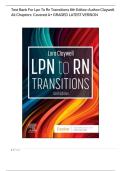
TEST BANK – LPN to RN Transitions, 6th Edition Author:
Lora Claywell | Updated 2025/2026 100% Complete A+ Study
Guide Latest Version
FULL TEST BANK!!!
1|Page
, TEST BANK FOR LPN TO RN TRANSITIONS 6th EDITION BY CLAYWELL
Chapter 01: Honoring Your Past, Planning Your FutureClaywell: LPN to
RN TrAnsitions, 6th Edition
MULTIPLE CHOICE
1. A nursing advisor is meeting with a student who is interested in earning her RN degree. Sheknows that
licensed practical nurse/license vocational nurse (LPN/LVNs) who enter nursingschool to become RNs
come into the learning environment with prior knowledge and understanding. Which statement by the
nursing advisor best describes her understanding of the effect experience may have on learning?
a. “Experience may be a source of insight and motivation, or a barrier.”
b. “Experience is usually a stumbling block for LPN/LVNs.”
c. “Experience never makes learning more difficult.”
d. “Once something is learned, it can never be truly modified.”
ANS: A
Experience accentuates differences among learners and serves as a source of insight and motivation, but it
can also be a barrier. Experience can serve as a foundation for defining theself.
DIF: Cognitive Level: Application
OBJ: Identify how experiences influence learning in adults. TOP: Adult Learning
2. There is a test on the cardiovascular system on Friday morning, and it is now Wednesday night. The
student has already taken a vacation day from work Thursday night so that she cAnstay home and study.
She is considering skipping her exercise class on Thursday morning to go to the library to prepare for the test.
Which
response best identifies the student’s outcome priority?
a. Exercise class
b. Going to the library
c. Avoiding work by taking a vacation
d. Doing well on the test on Friday
ANS: D
The outcome priority is the essential issue or need to be addressed at any given time within aset of
conditions or circumstances.
, TEST BANK FOR LPN TO RN TRANSITIONS 6th EDITION BY CLAYWELL
DIF: Cognitive Level: Application
OBJ: Identify motivations and personal outcome priorities for returning to
school.TOP: Motivation to Learn
3. A nurse who has been an LPN/LVN for 10 years is meeting with an advisor to discuss the
possibility of taking classes to become an RN. The advisor interprets which statement by thenurse as
the driving force for returning to school?
a. “I’ll need to schedule time to attend classes.”
b. “I’ll have to budget for paying tuition.”
c. “I’ll have to rearranging my schedule.”
d. “There is a possibility of advancement into administration.”
ANS: D
, TEST BANK FOR LPN TO RN TRANSITIONS 6th EDITION BY CLAYWELL
Driving forces are those that push toward making the change, as opposed to restraining forces,which are
those that usually present a challenge that needs to be overcome for the change to take place or present a
negative effect the change may initiate.
DIF: Cognitive Level: Application
OBJ: Identify motivations and personal outcome priorities for returning to
school.TOP: Motivations for Change
4. An RN is caring for a diabetic patient. The patient appears interested in changing her lifestyleand has been
asking questions about eating better. The nurse can interpret this behavior as which stage of Lewin’s
Change Theory?
a. Moving
b. Unfreezing
c. Action
d. Refreezing
ANS: B
The patient is in the first phase of Lewin’s Change Theory, known as unfreezing. This phase involves
determining that a change needs to occur and deciding to take action. Moving is the second phase and
involves actively planning changes and taking action on them. Refreezing isthe last stage, and it occurs
when the change has become a part of the person’s life.
DIF: Cognitive Level: Analysis
OBJ: Understand Change Theory and how it applies to becoming an RN.TOP:
Change Theory
5. An LPN is talking with her clinical instructor about her decision to return to school to becomean RN. The
clinical instructor iNnte r p r et s the LPNs outcome priority based on which statement?
a. “My family wanted me to go back to school.”
b. “I want to better my financial situation.”
c. “I really enjoy school.”
d. “I would like to advance to a teaching role someday.”
ANS: B
The outcome priority is the essential need that must be addressed, determined by internal andexternal
factors, such as needing to better a financial situation. The other statements indicate reasons for returning
to school, but they are not essential needs or issues to be addressed.
DIF: Cognitive Level: Analysis
OBJ: Identify how experiences influence learning in adults. TOP: Adult Learning
6. A nurse notices a posting for a management position for which she is qualified. If the nurse isin the moving
phase of Lewin’s Change Theory, which statement reflects the action she is most likely to take?
Lora Claywell | Updated 2025/2026 100% Complete A+ Study
Guide Latest Version
FULL TEST BANK!!!
1|Page
, TEST BANK FOR LPN TO RN TRANSITIONS 6th EDITION BY CLAYWELL
Chapter 01: Honoring Your Past, Planning Your FutureClaywell: LPN to
RN TrAnsitions, 6th Edition
MULTIPLE CHOICE
1. A nursing advisor is meeting with a student who is interested in earning her RN degree. Sheknows that
licensed practical nurse/license vocational nurse (LPN/LVNs) who enter nursingschool to become RNs
come into the learning environment with prior knowledge and understanding. Which statement by the
nursing advisor best describes her understanding of the effect experience may have on learning?
a. “Experience may be a source of insight and motivation, or a barrier.”
b. “Experience is usually a stumbling block for LPN/LVNs.”
c. “Experience never makes learning more difficult.”
d. “Once something is learned, it can never be truly modified.”
ANS: A
Experience accentuates differences among learners and serves as a source of insight and motivation, but it
can also be a barrier. Experience can serve as a foundation for defining theself.
DIF: Cognitive Level: Application
OBJ: Identify how experiences influence learning in adults. TOP: Adult Learning
2. There is a test on the cardiovascular system on Friday morning, and it is now Wednesday night. The
student has already taken a vacation day from work Thursday night so that she cAnstay home and study.
She is considering skipping her exercise class on Thursday morning to go to the library to prepare for the test.
Which
response best identifies the student’s outcome priority?
a. Exercise class
b. Going to the library
c. Avoiding work by taking a vacation
d. Doing well on the test on Friday
ANS: D
The outcome priority is the essential issue or need to be addressed at any given time within aset of
conditions or circumstances.
, TEST BANK FOR LPN TO RN TRANSITIONS 6th EDITION BY CLAYWELL
DIF: Cognitive Level: Application
OBJ: Identify motivations and personal outcome priorities for returning to
school.TOP: Motivation to Learn
3. A nurse who has been an LPN/LVN for 10 years is meeting with an advisor to discuss the
possibility of taking classes to become an RN. The advisor interprets which statement by thenurse as
the driving force for returning to school?
a. “I’ll need to schedule time to attend classes.”
b. “I’ll have to budget for paying tuition.”
c. “I’ll have to rearranging my schedule.”
d. “There is a possibility of advancement into administration.”
ANS: D
, TEST BANK FOR LPN TO RN TRANSITIONS 6th EDITION BY CLAYWELL
Driving forces are those that push toward making the change, as opposed to restraining forces,which are
those that usually present a challenge that needs to be overcome for the change to take place or present a
negative effect the change may initiate.
DIF: Cognitive Level: Application
OBJ: Identify motivations and personal outcome priorities for returning to
school.TOP: Motivations for Change
4. An RN is caring for a diabetic patient. The patient appears interested in changing her lifestyleand has been
asking questions about eating better. The nurse can interpret this behavior as which stage of Lewin’s
Change Theory?
a. Moving
b. Unfreezing
c. Action
d. Refreezing
ANS: B
The patient is in the first phase of Lewin’s Change Theory, known as unfreezing. This phase involves
determining that a change needs to occur and deciding to take action. Moving is the second phase and
involves actively planning changes and taking action on them. Refreezing isthe last stage, and it occurs
when the change has become a part of the person’s life.
DIF: Cognitive Level: Analysis
OBJ: Understand Change Theory and how it applies to becoming an RN.TOP:
Change Theory
5. An LPN is talking with her clinical instructor about her decision to return to school to becomean RN. The
clinical instructor iNnte r p r et s the LPNs outcome priority based on which statement?
a. “My family wanted me to go back to school.”
b. “I want to better my financial situation.”
c. “I really enjoy school.”
d. “I would like to advance to a teaching role someday.”
ANS: B
The outcome priority is the essential need that must be addressed, determined by internal andexternal
factors, such as needing to better a financial situation. The other statements indicate reasons for returning
to school, but they are not essential needs or issues to be addressed.
DIF: Cognitive Level: Analysis
OBJ: Identify how experiences influence learning in adults. TOP: Adult Learning
6. A nurse notices a posting for a management position for which she is qualified. If the nurse isin the moving
phase of Lewin’s Change Theory, which statement reflects the action she is most likely to take?