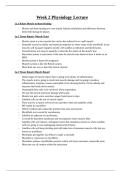
Week 2 Physiology Lecture
2a.1 Relate Muscle to Bone Healing
- Muscle and bone healing are very similar find the similarities and difference between
them both during the phases.
2a.2 Tissue Repair- Muscle Tears
- Muscle strain is a torn muscle but can be also referred to as a pull muscle.
- Demands exceed its ability and material properties to where some of the myofibrils in our
muscles will rip apart; happens mostly with sudden acceleration and deceleration.
- Classifications are setup to quantify or describe the nature of the muscle tear.
- Barcelona system is used most of the time for muscle tears based on how it looks on an
MRI.
- British system is based off symptoms.
- Munich system is like the British system.
- More than one way to describe muscle injuries.
2a.3 Tissue Repair-Muscle Repair
- Initial stages of muscle injury there’s going to be plenty of inflammation.
- The muscle torn is going to result into muscle damage and its going to produce
inflammatory response; causes neutrophils to be releasing bunch of free radicals and
enzymes that break down muscle.
- Neutrophils first cells to be involved. (First responders)
- We tear the muscle and more damage afterwards.
- Muscle tear gets worse overtime ranges from hours to days.
- Satellite cells are the star of muscle repair
- They wait for a muscle cell to be torn and that’s their job (satellite cells)
- MF stands for myofibril
- Which is filled with contractile proteins like actin and myosin
- Myofibrils are covered by sarcolemma.
- Satellite are adjacent to sarcolemma.
- Covered by basement membrane and encompasses entire muscle fiber.
- Satellite cells will release a mitogenic factor that stimulates mitosis to where satellite
cells are going to start undergoing mitosis/cell division
- Satellite cells will keep dividing and will make lots of immature muscle cells that are
known as myoblasts.
- Myoblasts get together and effuse to make a myotube.
- Myotube is a precursor to myofibrils.
- Myoblasts produce myofibrillar proteins which will form sarcomere contractile units.
- Myocytes are all contain within the syncytium
, - This is all connected by the capillaries
- Tear muscle rip apart the capillaries first step of process is inflammation.
- We’re going to have bleeding which forms hematoma
- Hematoma stars with platelets and others cells like stem cells and fibroblasts and
inflammatory cells.
- Hematoma is going to be a gelatinous clot-like structure which is going to connect the
two torn ends to one another by making a bridge.
- This bridge is important to stabilize the torn muscle fiber and these cells we have in the
hematoma will start secreting growth factor and as start having the satellite cells be ready
to activate to start the muscle repair process.
- After initial hematoma formation we have more inflammation process,
- Neutrophils come to area and create damage to clean up the dead tissue
- Macrophages take over and are responsible to clean up dead cells in the area
- There will be remanent of hematoma in the muscle.
- Hematoma is a band-aid to connect everything together
- Inflammatory cells are declining that’s when satellite cells will fully shine
- Where they start their mitosis and go on to become immature muscle cells and the
eventually mature muscle cells myocytes.
- Some hematoma or some connective tissue or inflammatory cells that are still in their
connecting it together.
- Mature skeletal muscle is a syncytium
- Basement membrane will start forming in the area during the regeneration process
- We will start looking like the beginning with having a capillary connecting both ends of
the torn muscle and the myoblasts are becoming more mature
- The injury site will be thinner in the remodeling process
- Satellite cells are either myoblasts or myocytes, but they don’t have the same magnitude
of contractile proteins yet.
- Remodeling process:
- The cells we start with aren’t as strong here and not as capable producing as much force
as the cells prior to the injury.
- We will continue putting load that physiologic stress and mechanical stress on our
myoblasts developing them into myocytes.
- Which then we will continue making more contractile proteins to grow and become fully
mature muscle cells
- Myoblasts will become myocytes
- There’re still nuclei so that doesn’t mean we aren’t done yet.
- Muscle cells we lost when our muscle getas torn and eaten up by phagocytes they will be
replaced with new muscle cells that are capable of contracting.
- Scar tissue could form during this process.
- Volumetric loss is a bigger muscle tear
- Necrotic fibers will be invaded by inflammatory cells.
2a.1 Relate Muscle to Bone Healing
- Muscle and bone healing are very similar find the similarities and difference between
them both during the phases.
2a.2 Tissue Repair- Muscle Tears
- Muscle strain is a torn muscle but can be also referred to as a pull muscle.
- Demands exceed its ability and material properties to where some of the myofibrils in our
muscles will rip apart; happens mostly with sudden acceleration and deceleration.
- Classifications are setup to quantify or describe the nature of the muscle tear.
- Barcelona system is used most of the time for muscle tears based on how it looks on an
MRI.
- British system is based off symptoms.
- Munich system is like the British system.
- More than one way to describe muscle injuries.
2a.3 Tissue Repair-Muscle Repair
- Initial stages of muscle injury there’s going to be plenty of inflammation.
- The muscle torn is going to result into muscle damage and its going to produce
inflammatory response; causes neutrophils to be releasing bunch of free radicals and
enzymes that break down muscle.
- Neutrophils first cells to be involved. (First responders)
- We tear the muscle and more damage afterwards.
- Muscle tear gets worse overtime ranges from hours to days.
- Satellite cells are the star of muscle repair
- They wait for a muscle cell to be torn and that’s their job (satellite cells)
- MF stands for myofibril
- Which is filled with contractile proteins like actin and myosin
- Myofibrils are covered by sarcolemma.
- Satellite are adjacent to sarcolemma.
- Covered by basement membrane and encompasses entire muscle fiber.
- Satellite cells will release a mitogenic factor that stimulates mitosis to where satellite
cells are going to start undergoing mitosis/cell division
- Satellite cells will keep dividing and will make lots of immature muscle cells that are
known as myoblasts.
- Myoblasts get together and effuse to make a myotube.
- Myotube is a precursor to myofibrils.
- Myoblasts produce myofibrillar proteins which will form sarcomere contractile units.
- Myocytes are all contain within the syncytium
, - This is all connected by the capillaries
- Tear muscle rip apart the capillaries first step of process is inflammation.
- We’re going to have bleeding which forms hematoma
- Hematoma stars with platelets and others cells like stem cells and fibroblasts and
inflammatory cells.
- Hematoma is going to be a gelatinous clot-like structure which is going to connect the
two torn ends to one another by making a bridge.
- This bridge is important to stabilize the torn muscle fiber and these cells we have in the
hematoma will start secreting growth factor and as start having the satellite cells be ready
to activate to start the muscle repair process.
- After initial hematoma formation we have more inflammation process,
- Neutrophils come to area and create damage to clean up the dead tissue
- Macrophages take over and are responsible to clean up dead cells in the area
- There will be remanent of hematoma in the muscle.
- Hematoma is a band-aid to connect everything together
- Inflammatory cells are declining that’s when satellite cells will fully shine
- Where they start their mitosis and go on to become immature muscle cells and the
eventually mature muscle cells myocytes.
- Some hematoma or some connective tissue or inflammatory cells that are still in their
connecting it together.
- Mature skeletal muscle is a syncytium
- Basement membrane will start forming in the area during the regeneration process
- We will start looking like the beginning with having a capillary connecting both ends of
the torn muscle and the myoblasts are becoming more mature
- The injury site will be thinner in the remodeling process
- Satellite cells are either myoblasts or myocytes, but they don’t have the same magnitude
of contractile proteins yet.
- Remodeling process:
- The cells we start with aren’t as strong here and not as capable producing as much force
as the cells prior to the injury.
- We will continue putting load that physiologic stress and mechanical stress on our
myoblasts developing them into myocytes.
- Which then we will continue making more contractile proteins to grow and become fully
mature muscle cells
- Myoblasts will become myocytes
- There’re still nuclei so that doesn’t mean we aren’t done yet.
- Muscle cells we lost when our muscle getas torn and eaten up by phagocytes they will be
replaced with new muscle cells that are capable of contracting.
- Scar tissue could form during this process.
- Volumetric loss is a bigger muscle tear
- Necrotic fibers will be invaded by inflammatory cells.