SIGMUND FREUD
Freud was born in 1856 and moved to Vienna when he was 4. After obtaining his medical degree,
he started out as a researcher in neurology. He quit this to start a private practice, treating
patients with ‘nervous disorders’. During that time, he began developing the idea that portions of
the human mind were outside conscious awareness. The unconscious is the part of the mind
about which the conscious mind has no awareness. Freud devoted the rest of his career to
exploring the nature and logic of the unconscious mind. From a small group of followers, he
gained more followers but also some critics. He has been referred to as the original archeologist
of the human mind.
BASICS
• Psychic energy = the source of energy motivating all human activity
➡Law of conservation of energy: the amount of psychic energy remains the same throughout
life (closed energy system)
➡Personality change: redirection of psychic energy
• Instincts = strong, innate forces providing all energy in the psychic system
➡Self-preservation instincts / sexual instincts (Darwin) > life instinct
➡Libido = life instinct = need satisfying, life-sustaining, pleasure-oriented urges
➡Thanatos = death instinct = destroying, harming, aggressive urges
➡Life and death instincts can be combined in various ways
CONSCIOUS / UNCONSCIOUS
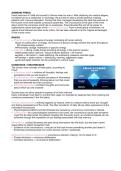
The human mind consists of three parts, according to
Freud
• Conscious mind = contains all thoughts, feelings and
perceptions that you are aware of
• Preconscious mind = contains any piece of information
that you are not presently thinking about, but that could
easily be retrieved and mad conscious
• Unconscious mind = contains thoughts and memories
about which you are unaware
Society does not allow people to express all of their instincts
freely; individuals must learn to control their urges, for example by keeping them from entering the
conscious awareness in the rst place.
Psychic determinism = nothing happens by chance, there is a reason behind every act, thought
and feeling (expressions of the mind). The little ‘accidents’ of daily life are often expressions of the
motivated unconscious.
• Psychological problems (mental illnesses) are caused by unconscious memories or desires
• Talking cure: for a psychological symptom to be cured, the unconscious cause path symptom
must rst be discovered. By patients recalling the traumatic event, an emotional release can be
achieved through the expression of any feelings associated with that memory.
Blindsight = cortical blindness; the eyes bring information into the brain, but the brain centre
responsible for object recognition fails.
• Evidence of the unconscious > one part of the brain knows something another part doesn’t.
• Emotional processing does not involve primary center / awareness
Deliberation without awareness = unconscious decision making, ‘let me sleep on it’.
• Simple decisions > conscious deliberation
• Complex decisions > unconscious deliberation
fi fi
, STRUCTURE OF PERSONALITY
Sexual and aggressive instincts often lead to drives and urges that con ict
with society or reality. The mind has several parts that work together to
form personality.
• ID = the most primitive part of the human mind, the source of all drives
and urges
➡The id dominates during infancy
➡Pleasure principle: desire for immediate grati cation, can’t tolerate
any delays in satisfying its urges
➡Primary process thinking: thinking without logical rules of
conscious thought or reality
• Ego = the part of the mind that limits the id to reality
➡Develops within the rst two or three years of life
➡Reality principle: urges of the id are often in con ict with social and physical reality, direct
expression of impulses from the id must be avoided, redirected or postponed
➡Secondary process thinking: development of strategies for solving problems and obtaining
satisfaction
• Superego = the part of the mind that internalizes the values, morals and ideals of society
(morality police / conscience)
➡Determines right and wrong / good or bad by setting moral goals and ideals of perfection
➡The emotion of guilt is the main tool of the superego in enforcing right and wrong
The ego faces a di cult task in attempting to balance the impulses of the id, the demands of the
superego and the realities of the external world. Sometimes the con icts between the id, ego and
superego are expressed in a disguised way in various thoughts, feelings and behaviors.
Ego depletion = the mind is a closed energy system. Because of this, energy put into one self-
control activity leaves less energy for another self-control activity. Recent evidence is coming in
that people can, with some e ort or external motivation, increase their intentions to exert self-
control and overcome multiple temptations > self-control can be trained through practice.
Wish ful llment = when an urge from the id requires an unavailable object or person, the id may
create a mental image or fantasy of that objet or person to (temporarily) satisfy its needs, for
example in (day)dreaming.
ANXIETY AND DEFENSE MECHANISMS
• Objective anxiety = occurs in response to a real, external threat to the person (fear)
• Neurotic anxiety = occurs when there is a direct con ict between the id and the ego; the ego
may lose control over an unacceptable desire to the id (internal)
• Moral anxiety = occurs when there is a con ict between the ego and the superego (internal)
In all types of anxiety, the ego has to cope with threats and defend against the dangers they pose
in order to reduce anxiety. The ego uses various defense mechanisms to complete this task.
These mechanisms serve two functions; to protect the ego and to minimize anxiety and distress.
Symptoms of defense mechanisms help people avoid anxiety. They can seem useful when
someone does not have the resources to directly deal with the problem, but they become
problematic when they cause an inability to be productive and/or maintain healthy relationships.
• Repression = preventing unacceptable thoughts, feelings or urges from reaching conscious
awareness
➡Forerunner of all other defense mechanisms
• Denial = insisting that things are not the way they are (refusing to see the facts)
➡Fundamental attribution error: the tendency to blame events outside one’s control for failure
but to accept responsibility for success
• Displacement = redirecting a threatening or unacceptable impulse from its original source to a
non (less) threatening target
fi ffifi ff fl fi fl fl fl fl
Freud was born in 1856 and moved to Vienna when he was 4. After obtaining his medical degree,
he started out as a researcher in neurology. He quit this to start a private practice, treating
patients with ‘nervous disorders’. During that time, he began developing the idea that portions of
the human mind were outside conscious awareness. The unconscious is the part of the mind
about which the conscious mind has no awareness. Freud devoted the rest of his career to
exploring the nature and logic of the unconscious mind. From a small group of followers, he
gained more followers but also some critics. He has been referred to as the original archeologist
of the human mind.
BASICS
• Psychic energy = the source of energy motivating all human activity
➡Law of conservation of energy: the amount of psychic energy remains the same throughout
life (closed energy system)
➡Personality change: redirection of psychic energy
• Instincts = strong, innate forces providing all energy in the psychic system
➡Self-preservation instincts / sexual instincts (Darwin) > life instinct
➡Libido = life instinct = need satisfying, life-sustaining, pleasure-oriented urges
➡Thanatos = death instinct = destroying, harming, aggressive urges
➡Life and death instincts can be combined in various ways
CONSCIOUS / UNCONSCIOUS
The human mind consists of three parts, according to
Freud
• Conscious mind = contains all thoughts, feelings and
perceptions that you are aware of
• Preconscious mind = contains any piece of information
that you are not presently thinking about, but that could
easily be retrieved and mad conscious
• Unconscious mind = contains thoughts and memories
about which you are unaware
Society does not allow people to express all of their instincts
freely; individuals must learn to control their urges, for example by keeping them from entering the
conscious awareness in the rst place.
Psychic determinism = nothing happens by chance, there is a reason behind every act, thought
and feeling (expressions of the mind). The little ‘accidents’ of daily life are often expressions of the
motivated unconscious.
• Psychological problems (mental illnesses) are caused by unconscious memories or desires
• Talking cure: for a psychological symptom to be cured, the unconscious cause path symptom
must rst be discovered. By patients recalling the traumatic event, an emotional release can be
achieved through the expression of any feelings associated with that memory.
Blindsight = cortical blindness; the eyes bring information into the brain, but the brain centre
responsible for object recognition fails.
• Evidence of the unconscious > one part of the brain knows something another part doesn’t.
• Emotional processing does not involve primary center / awareness
Deliberation without awareness = unconscious decision making, ‘let me sleep on it’.
• Simple decisions > conscious deliberation
• Complex decisions > unconscious deliberation
fi fi
, STRUCTURE OF PERSONALITY
Sexual and aggressive instincts often lead to drives and urges that con ict
with society or reality. The mind has several parts that work together to
form personality.
• ID = the most primitive part of the human mind, the source of all drives
and urges
➡The id dominates during infancy
➡Pleasure principle: desire for immediate grati cation, can’t tolerate
any delays in satisfying its urges
➡Primary process thinking: thinking without logical rules of
conscious thought or reality
• Ego = the part of the mind that limits the id to reality
➡Develops within the rst two or three years of life
➡Reality principle: urges of the id are often in con ict with social and physical reality, direct
expression of impulses from the id must be avoided, redirected or postponed
➡Secondary process thinking: development of strategies for solving problems and obtaining
satisfaction
• Superego = the part of the mind that internalizes the values, morals and ideals of society
(morality police / conscience)
➡Determines right and wrong / good or bad by setting moral goals and ideals of perfection
➡The emotion of guilt is the main tool of the superego in enforcing right and wrong
The ego faces a di cult task in attempting to balance the impulses of the id, the demands of the
superego and the realities of the external world. Sometimes the con icts between the id, ego and
superego are expressed in a disguised way in various thoughts, feelings and behaviors.
Ego depletion = the mind is a closed energy system. Because of this, energy put into one self-
control activity leaves less energy for another self-control activity. Recent evidence is coming in
that people can, with some e ort or external motivation, increase their intentions to exert self-
control and overcome multiple temptations > self-control can be trained through practice.
Wish ful llment = when an urge from the id requires an unavailable object or person, the id may
create a mental image or fantasy of that objet or person to (temporarily) satisfy its needs, for
example in (day)dreaming.
ANXIETY AND DEFENSE MECHANISMS
• Objective anxiety = occurs in response to a real, external threat to the person (fear)
• Neurotic anxiety = occurs when there is a direct con ict between the id and the ego; the ego
may lose control over an unacceptable desire to the id (internal)
• Moral anxiety = occurs when there is a con ict between the ego and the superego (internal)
In all types of anxiety, the ego has to cope with threats and defend against the dangers they pose
in order to reduce anxiety. The ego uses various defense mechanisms to complete this task.
These mechanisms serve two functions; to protect the ego and to minimize anxiety and distress.
Symptoms of defense mechanisms help people avoid anxiety. They can seem useful when
someone does not have the resources to directly deal with the problem, but they become
problematic when they cause an inability to be productive and/or maintain healthy relationships.
• Repression = preventing unacceptable thoughts, feelings or urges from reaching conscious
awareness
➡Forerunner of all other defense mechanisms
• Denial = insisting that things are not the way they are (refusing to see the facts)
➡Fundamental attribution error: the tendency to blame events outside one’s control for failure
but to accept responsibility for success
• Displacement = redirecting a threatening or unacceptable impulse from its original source to a
non (less) threatening target
fi ffifi ff fl fi fl fl fl fl