Lecture 1 – Change Management & Leadership | The
Individual
Introduction to change management
- Change management is a trending topic not only in the real world but also in the
scientific world
- Change Management:
o Process of continually renewing an organizations direction, structure, and
capabilities to serve the ever-changing needs of external and internal customers
- Leadership:
o Process of influencing others in a manner that enhances their contribution to the
realization of group goals
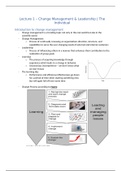
- Learning:
o The process of acquiring knowledge through
experience which leads to a change in behavior
o Unconscious incompetence – we don’t know what
we don’t know
- The learning dip:
o Performance and efficiency/effectiveness go down
for a period of time when starting something new,
but will again fall off over some time
- Change Process according to Hayes:
,o 1. Recognize need and start change process
1. Factors that may cause change:
External factors; political, economic, technological, etc.
Internal factors; creativity, direction, coordination, etc.
Recognition of change by methods such as stakeholder analysis,
continuous big data analysis and performance indicators
2 start the change process
Translate the need for change into a desire for change
Determine who to involve and make people responsible
o 2. Diagnosis and formulate vision
Know where you’re going
Review present state
Problems/opportunities
Establish baseline
Past history & environment
Helps define future state
Identify desired future state
Define end point
Who initiates change?
Helps to predict impact on organization
Formulate change vision
Provides direction and focus
Commitment/motivation
o 3. Plan and prepare for change
1. Define your strategy for change
Radical change
Incremental change
2. Develop a change plan
Appoint a transition manager
Identify change activities
Produce implementation plan
Schedule activities
Allocate resources
Implement reward system
o 4. Implement change
Two main approaches for implementation
Blueprint change – fully thorough planned
Emergent change – there in one time
Key questions to ask
Are interventions being implemented as intended
Are interventions producing the desired effect
Is the change plan still valid?
o 5. Sustain the change
, New ways of working and improved outcomes become the norm
Consolidation/Institutionalizing phase
Making change permanent
Anchor change in organizations culture
Feedback mechanisms
Reward system
Storytelling (success stories)
- Critical site of the model:
o Not always step-by-step
Steps can be interchanged and followed in different order
- Learning and managing people issues
o We do not learn from experience; we learn from reflecting on experience
Change at the individual level
- Kolb’s Learning Cycle – model explaining how learning occurs/what stages and
individual goes through in order to learn
- Different individuals have different sets of preferences in the way they learn:
o Theorists – research various models (try to make connections/similarities)
o Pragmatists – desire to relate what is happening to their own circumstance (find
purpose)
o Activists – encourage experimentation (trying out)
o Reflector – causing reflection through questioning (watch others/conduct
reviews)
Four approaches to look at individual change
o External vs Internal psychological change
- 1. Behavioral Approach – changing behaviors
o Changing behaviors of others through rewards and punishment
Financial rewards
Non-financial rewards
Individual
Introduction to change management
- Change management is a trending topic not only in the real world but also in the
scientific world
- Change Management:
o Process of continually renewing an organizations direction, structure, and
capabilities to serve the ever-changing needs of external and internal customers
- Leadership:
o Process of influencing others in a manner that enhances their contribution to the
realization of group goals
- Learning:
o The process of acquiring knowledge through
experience which leads to a change in behavior
o Unconscious incompetence – we don’t know what
we don’t know
- The learning dip:
o Performance and efficiency/effectiveness go down
for a period of time when starting something new,
but will again fall off over some time
- Change Process according to Hayes:
,o 1. Recognize need and start change process
1. Factors that may cause change:
External factors; political, economic, technological, etc.
Internal factors; creativity, direction, coordination, etc.
Recognition of change by methods such as stakeholder analysis,
continuous big data analysis and performance indicators
2 start the change process
Translate the need for change into a desire for change
Determine who to involve and make people responsible
o 2. Diagnosis and formulate vision
Know where you’re going
Review present state
Problems/opportunities
Establish baseline
Past history & environment
Helps define future state
Identify desired future state
Define end point
Who initiates change?
Helps to predict impact on organization
Formulate change vision
Provides direction and focus
Commitment/motivation
o 3. Plan and prepare for change
1. Define your strategy for change
Radical change
Incremental change
2. Develop a change plan
Appoint a transition manager
Identify change activities
Produce implementation plan
Schedule activities
Allocate resources
Implement reward system
o 4. Implement change
Two main approaches for implementation
Blueprint change – fully thorough planned
Emergent change – there in one time
Key questions to ask
Are interventions being implemented as intended
Are interventions producing the desired effect
Is the change plan still valid?
o 5. Sustain the change
, New ways of working and improved outcomes become the norm
Consolidation/Institutionalizing phase
Making change permanent
Anchor change in organizations culture
Feedback mechanisms
Reward system
Storytelling (success stories)
- Critical site of the model:
o Not always step-by-step
Steps can be interchanged and followed in different order
- Learning and managing people issues
o We do not learn from experience; we learn from reflecting on experience
Change at the individual level
- Kolb’s Learning Cycle – model explaining how learning occurs/what stages and
individual goes through in order to learn
- Different individuals have different sets of preferences in the way they learn:
o Theorists – research various models (try to make connections/similarities)
o Pragmatists – desire to relate what is happening to their own circumstance (find
purpose)
o Activists – encourage experimentation (trying out)
o Reflector – causing reflection through questioning (watch others/conduct
reviews)
Four approaches to look at individual change
o External vs Internal psychological change
- 1. Behavioral Approach – changing behaviors
o Changing behaviors of others through rewards and punishment
Financial rewards
Non-financial rewards