Hominid studies
Like all other organisms, we have evolved over time from earlier species, and share a genetic
relationship to all other forms of life on earth.
(Our evolution was not linear)
The study of human evolution involves understanding the similarities and differences between
humans and other species in their genetic make up, body form, physiology and behaviour.
Humans are mammals and members of the mammalian order, known as primates.
Mammals:
- Endothermic
- Mothers lactate
- Have similar basic skeletons
- Have hair or fur
- Lower jaws are hinged to the skull
The order Primates
Has 300 or more species, making it the third most diverse order of mammals.
They can be divided into 6 subgroups: lemurs, lorises, tarsiers, New world monkeys, Old world
monkeys and humans.
They all share anatomical and functional characteristics showing their common ancestry, which
began about 85 million years ago.
Evidence that primates have a common ancestor:
There is biogeographical evidence of a common ancestor as all wild primates are found in lands
that previously were a part of the southern continent, Gondwanaland.
Most present-day primates are arboreal, i.e. live in trees, this characteristic suggests that they
evolved from an ancestor that was arboreal.
This ancestral group then diversified in arboreal habitats.
Many have remained arboreal, while others have become at least partially terrestrial.
Primates have many characteristics that are adaptations to this arboreal way of life.
- They have kept the clavicle or collarbone, which forms an important part of the shoulder joint.
- This bone helps to stabilise the shoulder, allowing a primate to support its weight by hanging
- from its arms alone.
- They have strong, slender limbs that can rotate freely at the shoulders and hips. This helps
- their range of motion and movement in the trees.
- Many have mobile opposable thumbs. Hands with this and separate fingers are able to grasp
- and hold on to branches effectively - have precision grip.
- NOTE: Using your hands stimulates brain development.
, Other primate characteristics:
1. An enlarged and complex brain relative to body size.
2. A flattened face and reduced snout with a reduced sense of smell. (Not a prognathic snout)
2. This is possibly because primates have come to rely on vision.
3. Eyes that face forwards so that the eyes’ visual field overlap to give stereoscopic or binocular
3. vision.
4. Digits with flat nails.
5. Molar and premolar teeth with cusps that are low and rounded.
6. Complex social behaviour, usually only one offspring at a time and extended care for the
6. young. (K strategy animals)
Genetic evidence of a common ancestor for primates is slowly emerging, they:
- Share a large percentage of their DNA.
- Have a larger number of olfactory (smell) receptor pseudo-genes that non-primates.
- Pseudo-genes, remnants of genes that are no longer functional.
- Have full stereoscopic trichromatic colour vision.
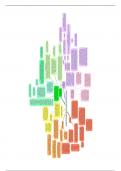
The Hominini tribe
split into the
genera, Homo,
australopithecines
and Pan about 6
million years ago.
Hominoids - “Great apes” Old and New Prosimians
world monkeys
Anthropoids
,Prosimians
The lower primates and most primitive.
Most have long, bushy tails and long, narrow muzzles, wet noses and flat nails.
The lower front teeth point forward to form a ‘comb’ for grooming.
Many are active at night.
Anthropoids
The higher primates and less primitive.
Active during the day and have dry noses.
- Old and New world monkeys
- New: Found in the forests of Central and South America. Most have a prehensile tail that
- New: serves as an extra limb when in the trees or carrying food.
- New: They have round, widely spaced nostrils that usually face sideways rather than
- New: downwards.
- Old: Live in Africa and Asia and have downward facing nostrils that are close together.
Old: - They have hard ‘sitting pads’ and most are active during the day, as well as highly
Old: - sociable.
- Hominoids - “Great apes”
- These are larger than monkeys, have downward facing nostrils, broader chests, a larger and
- more complex brain and no tail.
Classification of Humanity
Kingdom: Animalia
Phylum: Vertebrata
Class: Mammalia
Order: Primates
Sub-Order: - Prosimians such as bush babies, lemurs and tarsiers. Have pointed faces and
Sub-Order: - drink by lapping.
Sub-Order: - Anthropoids, higher primates.
Family: Hominoids or Hominidae - New and Old World monkeys
Family: Hominoids or Hominidae - Apes
Family: Hominoids or Hominidae - Humans
Sub-Family: Ponginae, orangutans
Homininae, gorillas, chimps and humans
Tribe: Hominini, human’s fossil ancestors
Genus: Homo
Australopithecus
Species: Sapiens
,
Like all other organisms, we have evolved over time from earlier species, and share a genetic
relationship to all other forms of life on earth.
(Our evolution was not linear)
The study of human evolution involves understanding the similarities and differences between
humans and other species in their genetic make up, body form, physiology and behaviour.
Humans are mammals and members of the mammalian order, known as primates.
Mammals:
- Endothermic
- Mothers lactate
- Have similar basic skeletons
- Have hair or fur
- Lower jaws are hinged to the skull
The order Primates
Has 300 or more species, making it the third most diverse order of mammals.
They can be divided into 6 subgroups: lemurs, lorises, tarsiers, New world monkeys, Old world
monkeys and humans.
They all share anatomical and functional characteristics showing their common ancestry, which
began about 85 million years ago.
Evidence that primates have a common ancestor:
There is biogeographical evidence of a common ancestor as all wild primates are found in lands
that previously were a part of the southern continent, Gondwanaland.
Most present-day primates are arboreal, i.e. live in trees, this characteristic suggests that they
evolved from an ancestor that was arboreal.
This ancestral group then diversified in arboreal habitats.
Many have remained arboreal, while others have become at least partially terrestrial.
Primates have many characteristics that are adaptations to this arboreal way of life.
- They have kept the clavicle or collarbone, which forms an important part of the shoulder joint.
- This bone helps to stabilise the shoulder, allowing a primate to support its weight by hanging
- from its arms alone.
- They have strong, slender limbs that can rotate freely at the shoulders and hips. This helps
- their range of motion and movement in the trees.
- Many have mobile opposable thumbs. Hands with this and separate fingers are able to grasp
- and hold on to branches effectively - have precision grip.
- NOTE: Using your hands stimulates brain development.
, Other primate characteristics:
1. An enlarged and complex brain relative to body size.
2. A flattened face and reduced snout with a reduced sense of smell. (Not a prognathic snout)
2. This is possibly because primates have come to rely on vision.
3. Eyes that face forwards so that the eyes’ visual field overlap to give stereoscopic or binocular
3. vision.
4. Digits with flat nails.
5. Molar and premolar teeth with cusps that are low and rounded.
6. Complex social behaviour, usually only one offspring at a time and extended care for the
6. young. (K strategy animals)
Genetic evidence of a common ancestor for primates is slowly emerging, they:
- Share a large percentage of their DNA.
- Have a larger number of olfactory (smell) receptor pseudo-genes that non-primates.
- Pseudo-genes, remnants of genes that are no longer functional.
- Have full stereoscopic trichromatic colour vision.
The Hominini tribe
split into the
genera, Homo,
australopithecines
and Pan about 6
million years ago.
Hominoids - “Great apes” Old and New Prosimians
world monkeys
Anthropoids
,Prosimians
The lower primates and most primitive.
Most have long, bushy tails and long, narrow muzzles, wet noses and flat nails.
The lower front teeth point forward to form a ‘comb’ for grooming.
Many are active at night.
Anthropoids
The higher primates and less primitive.
Active during the day and have dry noses.
- Old and New world monkeys
- New: Found in the forests of Central and South America. Most have a prehensile tail that
- New: serves as an extra limb when in the trees or carrying food.
- New: They have round, widely spaced nostrils that usually face sideways rather than
- New: downwards.
- Old: Live in Africa and Asia and have downward facing nostrils that are close together.
Old: - They have hard ‘sitting pads’ and most are active during the day, as well as highly
Old: - sociable.
- Hominoids - “Great apes”
- These are larger than monkeys, have downward facing nostrils, broader chests, a larger and
- more complex brain and no tail.
Classification of Humanity
Kingdom: Animalia
Phylum: Vertebrata
Class: Mammalia
Order: Primates
Sub-Order: - Prosimians such as bush babies, lemurs and tarsiers. Have pointed faces and
Sub-Order: - drink by lapping.
Sub-Order: - Anthropoids, higher primates.
Family: Hominoids or Hominidae - New and Old World monkeys
Family: Hominoids or Hominidae - Apes
Family: Hominoids or Hominidae - Humans
Sub-Family: Ponginae, orangutans
Homininae, gorillas, chimps and humans
Tribe: Hominini, human’s fossil ancestors
Genus: Homo
Australopithecus
Species: Sapiens
,