2.1 CELL STRUCTURE
2.1.1 Structure of EUKARYOTIC cells
EUKARYOTIC – DNA is contained in a nucleus, contains membrane bound specialised
organelles that are more complex
SPECIALISED CELLS – eukaryotic cells become specialised to perform specific functions >
make up tissues > tissues make up organs > organs work together make up organ systems
(cells > tissues > organs > organ system) in multicellular organisms
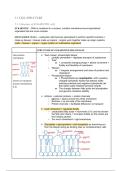
STRUCTURE OF EUKARYOTES ORGANELLES
cell-surface ➢ ‘fluid mosaic’ phospholipid bilayer
membrane ○ partially permeable = regulates transport of substances
○ ‘fluid’
■ = constantly changing shape = allows movement +
fluidity and flexibility of membrane
○ ‘Mosaic’
■ = irregular arrangements and sizes of proteins and
cholesterol
○ Phospholipid bilayer
■ = Phospholipids are amphipathic, with a positive
(more on transport charged hydrophilic heads that attracts water
across membranes pointing outwards and negative hydrophobic tail
2.3) that repels water shielded pointing inwards
■ The charges between fatty acids and phosphates
and glycerol maintains stability
➢ intrinsic + extrinsic proteins + protein channels
○ Intrinsic = spans across the whole membrane
○ Extrinsic = on one side of the membrane
○ Protein channels = facilitated diffusions/ co transport
➢ Lipid cholesterol = regulates fluidity
○ unsaturated fatty acids = more kinks C=C and the shorter
the fatty acid chains = increases fluidity as the chains are
less closely packed
○ Too much cholesterol = rigid membrane
➢ Glycolipids + glycoproteins = cell recognition as branching out
from the bilayer acting as binding sites w/ complementary cells
,nucleus ➢ Double membrane with nuclear envelope
➢ Nuclear pores allow small substances and enter and exit (eg.
- Control mRNA)
- Contain
➢ CONTAINS genetic material in chromatin coiled into
chromosomes + nucleolus
○ Dense nucleoli that with DNA make up mRNA and rRNA
for transcription that carries out of nucleus
➢ CONTROLS cellular processes like gene expression, protein
synthesis with mRNA transcription, DNA replication, mitosis etc
○ ribosomes and rER attached to make proteins quick for
translation
mitochondria ➢ Double membrane
➢ AEROBIC RESPIRATION LINK = ENERGY
➢ CRISTAE – Folded inner membranes = increase SA
○ Where oxidative phosphorylation (ETC) takes place
➢ MATRIX – the fluid that contains mitochondrial DNA, 70s
ribosomes, enzymes for respiration, lipids and proteins
○ Where link reaction and krebs cycle takes place
, rough endoplasmic (2 types of ER)
reticulum RER ➢ Stacks of membrane bounded flattened sacs form cisternae,
extending and connecting to nucleus’ nuclear envelope (rER)
➢ Large SA for chemical reactions
+
smooth endoplasmic ROUGH = many ribosomes > protein synthesis > transport to golgi >
reticulum SER attached to nuclear envelope (more dense)
SMOOTH = no ribosomes present > lipid synthesis > golgi (less dense)
- absorption of lipids ! recombine long chain fatty acids and
monoglycerides into triglycerides
Golgi apparatus and ➢ Close to ER = MODIFY the proteins and lipids produced by ER +
Golgi vesicles PACKAGE products into vesicles that are pinched off cisternaes
via exocytosis
○ Modify proteins > glycoproteins
○ Modify lipids > glycolipids > stores
○ Produces digestive enzymes
➢ Stacks of membrane bounded flattened SACS (cisternaes)
➢ GOLGI VESICLES – smaller sacs are filled of fluid and modified
products that are pinched off the cisternaes via exocytosis
(Similar to SER but more complex)
lysosomes ➢ a single membrane-bound organelle that contains JUST
hydrolase enzymes
○ Isolated these enzymes to prevent hydrolysing other
organelles within the cell
○ Hydrolase enzymes
■ digests waste from phagocytosis,
■ any worn out organelles + dead cells from autolysis
○ Exocytosis of
enzymes to break
down substances
outside of cells
2.1.1 Structure of EUKARYOTIC cells
EUKARYOTIC – DNA is contained in a nucleus, contains membrane bound specialised
organelles that are more complex
SPECIALISED CELLS – eukaryotic cells become specialised to perform specific functions >
make up tissues > tissues make up organs > organs work together make up organ systems
(cells > tissues > organs > organ system) in multicellular organisms
STRUCTURE OF EUKARYOTES ORGANELLES
cell-surface ➢ ‘fluid mosaic’ phospholipid bilayer
membrane ○ partially permeable = regulates transport of substances
○ ‘fluid’
■ = constantly changing shape = allows movement +
fluidity and flexibility of membrane
○ ‘Mosaic’
■ = irregular arrangements and sizes of proteins and
cholesterol
○ Phospholipid bilayer
■ = Phospholipids are amphipathic, with a positive
(more on transport charged hydrophilic heads that attracts water
across membranes pointing outwards and negative hydrophobic tail
2.3) that repels water shielded pointing inwards
■ The charges between fatty acids and phosphates
and glycerol maintains stability
➢ intrinsic + extrinsic proteins + protein channels
○ Intrinsic = spans across the whole membrane
○ Extrinsic = on one side of the membrane
○ Protein channels = facilitated diffusions/ co transport
➢ Lipid cholesterol = regulates fluidity
○ unsaturated fatty acids = more kinks C=C and the shorter
the fatty acid chains = increases fluidity as the chains are
less closely packed
○ Too much cholesterol = rigid membrane
➢ Glycolipids + glycoproteins = cell recognition as branching out
from the bilayer acting as binding sites w/ complementary cells
,nucleus ➢ Double membrane with nuclear envelope
➢ Nuclear pores allow small substances and enter and exit (eg.
- Control mRNA)
- Contain
➢ CONTAINS genetic material in chromatin coiled into
chromosomes + nucleolus
○ Dense nucleoli that with DNA make up mRNA and rRNA
for transcription that carries out of nucleus
➢ CONTROLS cellular processes like gene expression, protein
synthesis with mRNA transcription, DNA replication, mitosis etc
○ ribosomes and rER attached to make proteins quick for
translation
mitochondria ➢ Double membrane
➢ AEROBIC RESPIRATION LINK = ENERGY
➢ CRISTAE – Folded inner membranes = increase SA
○ Where oxidative phosphorylation (ETC) takes place
➢ MATRIX – the fluid that contains mitochondrial DNA, 70s
ribosomes, enzymes for respiration, lipids and proteins
○ Where link reaction and krebs cycle takes place
, rough endoplasmic (2 types of ER)
reticulum RER ➢ Stacks of membrane bounded flattened sacs form cisternae,
extending and connecting to nucleus’ nuclear envelope (rER)
➢ Large SA for chemical reactions
+
smooth endoplasmic ROUGH = many ribosomes > protein synthesis > transport to golgi >
reticulum SER attached to nuclear envelope (more dense)
SMOOTH = no ribosomes present > lipid synthesis > golgi (less dense)
- absorption of lipids ! recombine long chain fatty acids and
monoglycerides into triglycerides
Golgi apparatus and ➢ Close to ER = MODIFY the proteins and lipids produced by ER +
Golgi vesicles PACKAGE products into vesicles that are pinched off cisternaes
via exocytosis
○ Modify proteins > glycoproteins
○ Modify lipids > glycolipids > stores
○ Produces digestive enzymes
➢ Stacks of membrane bounded flattened SACS (cisternaes)
➢ GOLGI VESICLES – smaller sacs are filled of fluid and modified
products that are pinched off the cisternaes via exocytosis
(Similar to SER but more complex)
lysosomes ➢ a single membrane-bound organelle that contains JUST
hydrolase enzymes
○ Isolated these enzymes to prevent hydrolysing other
organelles within the cell
○ Hydrolase enzymes
■ digests waste from phagocytosis,
■ any worn out organelles + dead cells from autolysis
○ Exocytosis of
enzymes to break
down substances
outside of cells