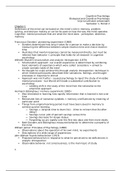
Cognitive Psychology
Biological and Cognitive Psychology
Vrije Universiteit Amsterdam
Semester 1, Period 2
Chapter 1
Definitions of the mind can be based on the mind’s role in memory, problem
solving, and decision making or can be focused on how the way the mind operates
Cognition: mental processes that are what the mind does – perception, attention,
memory
Franciscus Donders’ pioneering experiment (1968)
Donders determined how long it takes for a person to make a decision by
measuring the difference between simple reaction time and choice reaction
time
Illustrates that mental responses cannot be measured directly, but must be
inferred from behavior < principle that holds for all research in cognitive
psychology
Wilhelm Wundt’s structuralism and analytic introspection (1879)
Structuralism approach: our overall experience is determined by combining
basic elements of experience which were called sensations > aimed to
create ‘periodic table of the mind’
He thought he could achieve this through analytic introspection: technique in
which trained participants described their sensations, feelings, and thought
processes in response to stimuli
Approach was not fruitful – caused psychology to reject the study of invisible
mental processes – but Wundt still made a substantial contribution to
psychology
Leading shift in the study of the mind from the rationalist to the
empiricist approach
Hermann Ebbinghaus’ memory experiment (1885)
Was interested in learning how rapidly information that is learned is lost over
time
Memorized lists of nonsense syllables < memory uninfluenced by meaning of
particular word
Things from original learning period must have been saved in memory to
achieve quicker learning
Savings = (original time to learn list) – (time to re-learn that list after
delay)
Savings curve: plot of percent savings versus time
Savings decrease for longer delays
Forgetting occurs rapidly over the first two days and then more slowly
Both Donders and Ebbinghaus measured behavior to determine a property of
the mind
William James’ Principles of Psychology (1890)
Observations about the operation of his own mind, no experiments
Descriptions of a wide range of experiences
John Watson founds behaviorism (1913)
Proposed behaviorism in response to what he perceived to be deficiencies in
analytic introspection
Observable behavior, not consciousness, is the main topic of study
1
, Ideas closely associated with classical conditioning
B.F. Skinner’s operant conditioning (1938)
Operant conditioning: focuses on how behavior is strengthened by positive
and negative reinforcement
General critique to stimulus-response theory is that it cannot explain that
people often respond to different aspects of the same stimulus event, and
which aspect that is, is not known until the response is made
Edward Tolman’s rats in maze experiment (1948)
Determined that rats develop a cognitive map when initially experiencing a
maze, which is a conception of the maze’s layout > placed Tolman outside of
mainstream behaviorism
Contributed to re-emergence of the mind in psychology
Skinner: language is learned through operant conditioning
Chomsky: language development is determined by an inborn biological
program that holds across cultures
Led psychologists to reconsider the idea that language and complex
behaviors can be explained by operant conditioning
Cognitive revolution (1950s): shift from stimulus-response relationships to approach
whose main thrust was to understand the operation of the mind
Introduction of digital computer
Information-processing approach to studying the mind: traces sequences of
mental operations involved in cognition
Dichotic listening experiment (Cherry): when people focus on an attended
message, they can hear the sounds of the unattended message but are
unaware of its contents
Result led to first flow diagram of the mind (Donald Broadbent, 1958)
Artificial intelligence: making a machine behave in ways that would be called
intelligent if a human were so behaving (John McCarthy)
Logic theorist: program created by Newell and Simon that was able to create proofs
of mathematical theorems that involved principles of logic
George Miller (1965): because perceptual judgements can represent just a few bits,
in order to enable further processing, memory processes must actively recode
information that is carried in complex stimuli into smaller units
Modern research in cognitive psychology – role of models and benefits for science
and society
Structural models: representations of physical structures involved in specific
functions
Process models: represent the processes that are involved in cognitive mechanisms,
with boxed usually indicating specific processes and arrows indicating connections
between them – boxes do not represent specific brain structures
Models become more detailed as researchers study the different components
of a model – holds for structural and process models
Chapter 2
Levels of analysis: idea that a topic can be studies in a number of different ways,
with each approach contributing its own dimension to our understanding
2
, Nerve net: network seen when viewing stained brain tissue under a microscope,
proposed that signals could be transmitted throughout the net in all directions
Golgi staining technique: selectively stained cells were stained completely, so it was
possible to see their structure
Neuron doctrine: idea that individual cells transmit signals in the nervous system,
and that these cells are not continuous with other cells as proposed by the nerve
net theory
Cell body: metabolic center of the neuron
Dendrites: receive signals from other neurons
Axons/nerve fibers: transmit signals to other neurons
Synapse: small gap between axon and cell body or dendrites of another neuron
Neurons only form connections to specific other neurons
Neural circuits: formed by groups of interconnected neurons
Receptors: neurons specialized to pick up information from the environment
Resting potential: difference in potential between the inside and outside of an axon
when it is at rest – 70 mv
Action potential: nerve impulse that travels down the axon and depolarizes the
inside of the cell relative to the outside
Throughout its journey, there is no loss of information or energy
Rate of neural firing is related to the intensity of simulation, which is related
to the magnitude of an experience
Principle of natural representation: everything a person experiences is based not on
direct contact with stimuli, but on representations in the person’s nervous system
Quality of the senses: refers to the different experience associated with each of the
senses
Feature detectors: neurons that respond to different stimulus features such as
orientation, movement and length
Hierarchical processing: through selectivity, each receptor responds to a narrow
range of stimuli, across time, space, frequency, and so on. After passing through
several neurons, signals from numerous receptors are simultaneously taken into
account. This allows increasingly complex patterns to be detected in the stimulus.
Problem of neural representation for the senses has been called the problem of
sensory coding
Sensory code: refers to how neurons represent various characteristics of the
environment
Specificity coding: idea that an object could be represented by the firing of a
specialized neuron that responds only to that object – grandmother cells
Vulnerable, unlikely
Population coding: representation of a particular object by the pattern of firing of a
large number of neurons
Large number of stimuli can be represented
Large number of neurons isn’t always necessary for some functions > sparse
coding
Sparse coding: object is represented by a pattern of firing of only a small group of
neurons with majority of neurons remaining silent
> Difference between representation of memories and perceptions
Organization: neuropsychology
3
Biological and Cognitive Psychology
Vrije Universiteit Amsterdam
Semester 1, Period 2
Chapter 1
Definitions of the mind can be based on the mind’s role in memory, problem
solving, and decision making or can be focused on how the way the mind operates
Cognition: mental processes that are what the mind does – perception, attention,
memory
Franciscus Donders’ pioneering experiment (1968)
Donders determined how long it takes for a person to make a decision by
measuring the difference between simple reaction time and choice reaction
time
Illustrates that mental responses cannot be measured directly, but must be
inferred from behavior < principle that holds for all research in cognitive
psychology
Wilhelm Wundt’s structuralism and analytic introspection (1879)
Structuralism approach: our overall experience is determined by combining
basic elements of experience which were called sensations > aimed to
create ‘periodic table of the mind’
He thought he could achieve this through analytic introspection: technique in
which trained participants described their sensations, feelings, and thought
processes in response to stimuli
Approach was not fruitful – caused psychology to reject the study of invisible
mental processes – but Wundt still made a substantial contribution to
psychology
Leading shift in the study of the mind from the rationalist to the
empiricist approach
Hermann Ebbinghaus’ memory experiment (1885)
Was interested in learning how rapidly information that is learned is lost over
time
Memorized lists of nonsense syllables < memory uninfluenced by meaning of
particular word
Things from original learning period must have been saved in memory to
achieve quicker learning
Savings = (original time to learn list) – (time to re-learn that list after
delay)
Savings curve: plot of percent savings versus time
Savings decrease for longer delays
Forgetting occurs rapidly over the first two days and then more slowly
Both Donders and Ebbinghaus measured behavior to determine a property of
the mind
William James’ Principles of Psychology (1890)
Observations about the operation of his own mind, no experiments
Descriptions of a wide range of experiences
John Watson founds behaviorism (1913)
Proposed behaviorism in response to what he perceived to be deficiencies in
analytic introspection
Observable behavior, not consciousness, is the main topic of study
1
, Ideas closely associated with classical conditioning
B.F. Skinner’s operant conditioning (1938)
Operant conditioning: focuses on how behavior is strengthened by positive
and negative reinforcement
General critique to stimulus-response theory is that it cannot explain that
people often respond to different aspects of the same stimulus event, and
which aspect that is, is not known until the response is made
Edward Tolman’s rats in maze experiment (1948)
Determined that rats develop a cognitive map when initially experiencing a
maze, which is a conception of the maze’s layout > placed Tolman outside of
mainstream behaviorism
Contributed to re-emergence of the mind in psychology
Skinner: language is learned through operant conditioning
Chomsky: language development is determined by an inborn biological
program that holds across cultures
Led psychologists to reconsider the idea that language and complex
behaviors can be explained by operant conditioning
Cognitive revolution (1950s): shift from stimulus-response relationships to approach
whose main thrust was to understand the operation of the mind
Introduction of digital computer
Information-processing approach to studying the mind: traces sequences of
mental operations involved in cognition
Dichotic listening experiment (Cherry): when people focus on an attended
message, they can hear the sounds of the unattended message but are
unaware of its contents
Result led to first flow diagram of the mind (Donald Broadbent, 1958)
Artificial intelligence: making a machine behave in ways that would be called
intelligent if a human were so behaving (John McCarthy)
Logic theorist: program created by Newell and Simon that was able to create proofs
of mathematical theorems that involved principles of logic
George Miller (1965): because perceptual judgements can represent just a few bits,
in order to enable further processing, memory processes must actively recode
information that is carried in complex stimuli into smaller units
Modern research in cognitive psychology – role of models and benefits for science
and society
Structural models: representations of physical structures involved in specific
functions
Process models: represent the processes that are involved in cognitive mechanisms,
with boxed usually indicating specific processes and arrows indicating connections
between them – boxes do not represent specific brain structures
Models become more detailed as researchers study the different components
of a model – holds for structural and process models
Chapter 2
Levels of analysis: idea that a topic can be studies in a number of different ways,
with each approach contributing its own dimension to our understanding
2
, Nerve net: network seen when viewing stained brain tissue under a microscope,
proposed that signals could be transmitted throughout the net in all directions
Golgi staining technique: selectively stained cells were stained completely, so it was
possible to see their structure
Neuron doctrine: idea that individual cells transmit signals in the nervous system,
and that these cells are not continuous with other cells as proposed by the nerve
net theory
Cell body: metabolic center of the neuron
Dendrites: receive signals from other neurons
Axons/nerve fibers: transmit signals to other neurons
Synapse: small gap between axon and cell body or dendrites of another neuron
Neurons only form connections to specific other neurons
Neural circuits: formed by groups of interconnected neurons
Receptors: neurons specialized to pick up information from the environment
Resting potential: difference in potential between the inside and outside of an axon
when it is at rest – 70 mv
Action potential: nerve impulse that travels down the axon and depolarizes the
inside of the cell relative to the outside
Throughout its journey, there is no loss of information or energy
Rate of neural firing is related to the intensity of simulation, which is related
to the magnitude of an experience
Principle of natural representation: everything a person experiences is based not on
direct contact with stimuli, but on representations in the person’s nervous system
Quality of the senses: refers to the different experience associated with each of the
senses
Feature detectors: neurons that respond to different stimulus features such as
orientation, movement and length
Hierarchical processing: through selectivity, each receptor responds to a narrow
range of stimuli, across time, space, frequency, and so on. After passing through
several neurons, signals from numerous receptors are simultaneously taken into
account. This allows increasingly complex patterns to be detected in the stimulus.
Problem of neural representation for the senses has been called the problem of
sensory coding
Sensory code: refers to how neurons represent various characteristics of the
environment
Specificity coding: idea that an object could be represented by the firing of a
specialized neuron that responds only to that object – grandmother cells
Vulnerable, unlikely
Population coding: representation of a particular object by the pattern of firing of a
large number of neurons
Large number of stimuli can be represented
Large number of neurons isn’t always necessary for some functions > sparse
coding
Sparse coding: object is represented by a pattern of firing of only a small group of
neurons with majority of neurons remaining silent
> Difference between representation of memories and perceptions
Organization: neuropsychology
3