Hamlet - Act 3 - Climax
Scene 1:
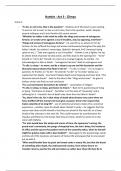
- “To be, or not to be, that is the question” - Reduces all of life down to just existing.
To exist or not to exist, to live or not to live, that is the question, which, despite
several soliloquys and 3 acts Hamlet still cannot answer
- “Whether tis nobler in the mind to suffer the slings and arrows of outrageous
fortune, or to take arms against a sea of troubles, and, by opposing, end them” -
“Slings and arrows of outrageous fortune” - he sees life as an attack on him by
fortune. He has suffered the slings and arrows continuously throughout the play (his
father’s death, his mother’s remarriage, Ophelia’s betrayal, R+G’s betrayal, being
spied on etc.). “Take arms against a sea of troubles” - Hamlet is not a fighter. He has
to almost break character to take action, and links back to the opening line - “to be”
himself or “not to be” himself. As a hero of a revenge tragedy, he will die – he
acknowledges his fate as death - “outrageous fortunes” dealt an outrageous end
- “To die, to sleep – no more: and by a sleep to say we end the heartache and the
thousand natural shocks that flesh is heir to” - “To die, to sleep” - it is no longer a
question, he finishes on “to die”. He amends “to die” to “to sleep” (sleep as a
euphemism for death) - less harsh? Makes death more forgiving and more kind. ”The
thousand natural shocks” - back to the idea of the “slings and arrows” - he goes in
aimless circles and finds no real conclusion
- “Tis a consummation devoutly to be wished.” - connotation of religion
- “To die, to sleep, to sleep, perchance to dream.” - Back to his questioning of living
or dying. “Perchance to dream” - his father is in the state of “dreaming” and is
suffering for it – Hamlet's fear of death may come from his father’s death?
- “Ay, there’s the rub, for in that sleep of death what dreams may come when we
have shuffled off this mortal coil must give us pause: there’s the respect that
makes calamity of so long life” - use of collective pronouns makes this a universal
experience – another cause for doubt about Hamlet’s sanity – he suggests that the
reason man does not kill himself is that they are afraid of the next life, or at least
afraid of the unknown in the next life. This could however be a performance for
Claudius and Polonius if he knows that they are there, which he seems to in this
scene with Ophelia
- “For who would bear the whips and scorns of time, the oppressor’s wrong, the
proud man’s contumely, the pangs of despised love, the law’s delay, the insolence
of office and the spurns that patient merit of the unworthy takes, when he himself
might his quietus make with a bare bodkin?” - Back again to the questioning, names
and lists all of the injustices and spurns of human life and argues that no one would
put up with it
- “Who would fardels bear to grunt and sweat under a weary life, but that the dread
of something after death, the undiscovered country, from whose bourn no
traveller returns, puzzles the will and makes us rather bear those ills than fly to
, others that we know not of?” - Hamlet’s question is a philosophical one, and one
that proves him to be a man of words and thoughts rather than action
- “Thus conscience does make cowards of us all and thus the native hue of
resolution is sicklied o’er with the pale cast of thought and enterprises of great
pitch and moment with this regard their currents turn awry and lose the name of
action” - His loss of faith is a factor of his suicidal ideation – the only thing stopping
him now is not God and religion, but his fear of his life after death. He is a man of
inaction even in his own death – he seems to want to be a man of action even if the
action is his death – he overthinks and is caught up in his own conscience
- This soliloquy may have been for the sake of maintaining his “antic disposition”
because he might have known that he was being spied on. Some productions have
Hamlet search behind the curtains for Polonius and Claudius, some make him
completely ignorant of their spying.
After his soliloquy, Ophelia enters on Polonius’ orders:
- “The fair Ophelia – Nymph, in thy orisons be all my sins remembered”: This is
spoken to the audience and to Polonius and Claudius – 2 interpretations: he does it
to maintain his “antic disposition” and to make them believe the cause of his
madness is “neglected love” or he doesn’t know Polonius and Claudius are behind
the arras and he genuinely does love Ophelia
- “My lord, I have remembrances of yours that I have longed long to re-deliver. I
pray you now receive them / No, not I, I never gave you aught”: Pretending to be
mad? Is actually mad? Trying to maintain his antic disposition before Claudius and
Polonius? Different productions create different impressions of Hamlet in this scene
and assume different amounts of knowledge – some present him as being aware
that he is being spied on, some present him as being paranoid that he is but not
being able to confirm it. Each production’s presentation creates a different
impression of Hamlet’s madness
- “I did love you once...I loved you not” - Again, another show of his madness?
- “Get thee to a nunnery” - This somewhat seems to be a warning to Ophelia –
Hamlet is aware of the political environment of Elsinore, and he may want to protect
her from it. A nunnery is a place of peace and solace as much as it is a place of purity,
and Hamlet may want both for Ophelia
- “Why wouldst thou be a breeder of sinners? I am myself indifferent honest but yet
I could accuse me of such things, that it were better my mother had not borne me.
I am very proud, revengeful, ambitious, with more offences at my beck than I have
thoughts to put them in, imagination to give them shape or time to act them in.
What should such fellows as I do crawling between earth and heaven? We are
arrant knaves, all, believe none of us. Go thy ways to a nunnery”: Hamlet himself
admits to his faults, and it might make us believe that he is somewhat sane – he is
able to assess his own character and maintain some sort of self-awareness. Then
“What should such fellows as I do crawling between earth and heaven?” - his tone is
one of confusion and even anger. He may fear that he too will be like his father,
crawling between heaven and earth. “We are arrant knaves all, believe none of us.
Scene 1:
- “To be, or not to be, that is the question” - Reduces all of life down to just existing.
To exist or not to exist, to live or not to live, that is the question, which, despite
several soliloquys and 3 acts Hamlet still cannot answer
- “Whether tis nobler in the mind to suffer the slings and arrows of outrageous
fortune, or to take arms against a sea of troubles, and, by opposing, end them” -
“Slings and arrows of outrageous fortune” - he sees life as an attack on him by
fortune. He has suffered the slings and arrows continuously throughout the play (his
father’s death, his mother’s remarriage, Ophelia’s betrayal, R+G’s betrayal, being
spied on etc.). “Take arms against a sea of troubles” - Hamlet is not a fighter. He has
to almost break character to take action, and links back to the opening line - “to be”
himself or “not to be” himself. As a hero of a revenge tragedy, he will die – he
acknowledges his fate as death - “outrageous fortunes” dealt an outrageous end
- “To die, to sleep – no more: and by a sleep to say we end the heartache and the
thousand natural shocks that flesh is heir to” - “To die, to sleep” - it is no longer a
question, he finishes on “to die”. He amends “to die” to “to sleep” (sleep as a
euphemism for death) - less harsh? Makes death more forgiving and more kind. ”The
thousand natural shocks” - back to the idea of the “slings and arrows” - he goes in
aimless circles and finds no real conclusion
- “Tis a consummation devoutly to be wished.” - connotation of religion
- “To die, to sleep, to sleep, perchance to dream.” - Back to his questioning of living
or dying. “Perchance to dream” - his father is in the state of “dreaming” and is
suffering for it – Hamlet's fear of death may come from his father’s death?
- “Ay, there’s the rub, for in that sleep of death what dreams may come when we
have shuffled off this mortal coil must give us pause: there’s the respect that
makes calamity of so long life” - use of collective pronouns makes this a universal
experience – another cause for doubt about Hamlet’s sanity – he suggests that the
reason man does not kill himself is that they are afraid of the next life, or at least
afraid of the unknown in the next life. This could however be a performance for
Claudius and Polonius if he knows that they are there, which he seems to in this
scene with Ophelia
- “For who would bear the whips and scorns of time, the oppressor’s wrong, the
proud man’s contumely, the pangs of despised love, the law’s delay, the insolence
of office and the spurns that patient merit of the unworthy takes, when he himself
might his quietus make with a bare bodkin?” - Back again to the questioning, names
and lists all of the injustices and spurns of human life and argues that no one would
put up with it
- “Who would fardels bear to grunt and sweat under a weary life, but that the dread
of something after death, the undiscovered country, from whose bourn no
traveller returns, puzzles the will and makes us rather bear those ills than fly to
, others that we know not of?” - Hamlet’s question is a philosophical one, and one
that proves him to be a man of words and thoughts rather than action
- “Thus conscience does make cowards of us all and thus the native hue of
resolution is sicklied o’er with the pale cast of thought and enterprises of great
pitch and moment with this regard their currents turn awry and lose the name of
action” - His loss of faith is a factor of his suicidal ideation – the only thing stopping
him now is not God and religion, but his fear of his life after death. He is a man of
inaction even in his own death – he seems to want to be a man of action even if the
action is his death – he overthinks and is caught up in his own conscience
- This soliloquy may have been for the sake of maintaining his “antic disposition”
because he might have known that he was being spied on. Some productions have
Hamlet search behind the curtains for Polonius and Claudius, some make him
completely ignorant of their spying.
After his soliloquy, Ophelia enters on Polonius’ orders:
- “The fair Ophelia – Nymph, in thy orisons be all my sins remembered”: This is
spoken to the audience and to Polonius and Claudius – 2 interpretations: he does it
to maintain his “antic disposition” and to make them believe the cause of his
madness is “neglected love” or he doesn’t know Polonius and Claudius are behind
the arras and he genuinely does love Ophelia
- “My lord, I have remembrances of yours that I have longed long to re-deliver. I
pray you now receive them / No, not I, I never gave you aught”: Pretending to be
mad? Is actually mad? Trying to maintain his antic disposition before Claudius and
Polonius? Different productions create different impressions of Hamlet in this scene
and assume different amounts of knowledge – some present him as being aware
that he is being spied on, some present him as being paranoid that he is but not
being able to confirm it. Each production’s presentation creates a different
impression of Hamlet’s madness
- “I did love you once...I loved you not” - Again, another show of his madness?
- “Get thee to a nunnery” - This somewhat seems to be a warning to Ophelia –
Hamlet is aware of the political environment of Elsinore, and he may want to protect
her from it. A nunnery is a place of peace and solace as much as it is a place of purity,
and Hamlet may want both for Ophelia
- “Why wouldst thou be a breeder of sinners? I am myself indifferent honest but yet
I could accuse me of such things, that it were better my mother had not borne me.
I am very proud, revengeful, ambitious, with more offences at my beck than I have
thoughts to put them in, imagination to give them shape or time to act them in.
What should such fellows as I do crawling between earth and heaven? We are
arrant knaves, all, believe none of us. Go thy ways to a nunnery”: Hamlet himself
admits to his faults, and it might make us believe that he is somewhat sane – he is
able to assess his own character and maintain some sort of self-awareness. Then
“What should such fellows as I do crawling between earth and heaven?” - his tone is
one of confusion and even anger. He may fear that he too will be like his father,
crawling between heaven and earth. “We are arrant knaves all, believe none of us.