Hamlet – Act 1 - Exposition
Hamlet:
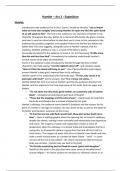
- Introduced to the audience first in Act 1 Scene 1 briefly by Horatio; “Let us impart
what we have seen tonight/ unto young Hamlet: for upon my life/ this spirit dumb
to us will speak to him”. This line is the audience’s one real view of Hamlet’s true
character throughout the play, before he is mad and affected by the ghost. Horatio,
who hasn’t seen him since before his dad died, and is close to him, presents to the
audience the sensible, pragmatic and capable thinker that Hamlet was before his
father died. This view suggests, alongside some of Hamlet’s speech, that his
madness, whether artificial or not, is a result of his father’s death,
- Personally introduced to the audience in Scene 2, his first line being “A little more
than kin and less than kind”. Immediately the audience understands Hamlet’s
current nature to be angry and disjointed.
- Scene 2, the audience is also introduced to Hamlet through the lens of other
characters; Gertrude saying, “cast thy nighted colour off”, and Claudius saying,
“How is it that the clouds still hang on you”. Use of personification and imagery
present Hamlet’s deep grief, explored later in his soliloquy.
- Hamlet’s grief is first understood after Gertrude says, “If it be, why seems it so
particular with thee?” and he answers that “it is, I know not seems...”.
- Hamlet (A1S2L76): First true look at Hamlet’s grief by the audience directly from
Hamlet, and the audience’s first true impression of him aside from his anger and
disdain.
o “Tis not alone my inky cloak, good mother, no customary suits of solemn
black” - metaphorical and physical portrayal of his grief
o “These but the trappings and the suits of woe” - Hamlet asks for help from
Gertrude and Claudius but is instead attacked for his grief.
- Hamlet’s soliloquy: the audience learns Hamlet’s problems and the reasons for his
grief; his mother’s marriage to Claudius, his own desire to die, as well as the death of
his father and Claudius’ ascension to the crown.
o “O that this too too solid flesh would melt, thaw and resolve itself into a
dew” - There is nothing graphic about the opening line to Hamlet’s soliloquy,
despite the theme, making it more sorrowful and melancholy than depressive
and manic. The imagery of water and evaporation creates a sense of
desperation about his soliloquy; it is almost futile and meaningless that he is
saying this, as all powerful sadness is gone from him and all that is left is a
tired misery. The imagery of water also mirrors Ophelia’s own death and may
make a motif around water as a symbol of death. (Note - “solid” - in some
versions of the text it was sullied – the church maintained that the human
body was unclean – Hamlet may see fault in his grief)
o “Or that the everlasting had not fixed his canon ‘gainst self-slaughter" -
Hamlet at this point in the play does have some sense of morality based
around religion – his future actions are not due to a villainous nature or an
, immorality in his character, they are a result of circumstance. His villainy,
religion and morality are later brought into question, but through this line the
audience understands his character to have some sense of a moral compass
o “How weary, stale, flat and unprofitable seem to me all the uses of this
world! Fie on’t, ah fie, tis an unweeded garden that grows to seed, things
rank and gross in nature possess it merely” - This lifeless, hopeless, almost
nihilistic view is seen commonly throughout the play, particularly in Hamlet’s
monologue (“...what a piece of work is a man”). He has an objective
understanding of the world (he acknowledges “the uses of the world”) but
cannot find joy or meaning in them.
o “So excellent a king, that was to this Hyperion to a satyr, so loving to my
mother that he might not beteem the winds of heaven visit her face too
roughly” - Hyperion was the God of light, a satyr is a half-goat creature who
has a taste for revelry and famously waited on Dionysus, the Greek God of
wine. Hamlet is comparing his father to his uncle, presenting him as a God of
goodness and light compared to the sub-human goat that is a satyr. Hamlet’s
view of his father is very different to that of the audience’s; the audience
understands King Hamlet to be irresponsible and reckless, who, compared to
Claudius’ diplomatic approach to the problem of Fortinbras before the
audience knows of the murder, appears to be a bad king. Through this line
the audience is also introduced intimately to one of Hamlet’s greatest
problems before he meets the ghost: his father’s death and his
overwhelming, all-consuming grief, which, though of which Hamlet has
publicly spoken before the soliloquy, is being seen completely naturally and
with no pretence for the public from Hamlet.
o “Frailty, thy name is woman” - Perhaps Hamlet’s treatment of Ophelia later
on is not a result of madness, or not completely, but is, at least partially,
stemming from an innate hatred or contempt he has for women. Though the
audience understands this statement to be mostly directed at the fickleness
of his mother, it also shows a subconscious hatred of the entire sex, which
may have originated from his mother’s actions or may not: regardless, his
treatment of Ophelia may be an innate sexism. Personification of an abstract
noun – frailty is equal to woman. Ophelia appears to him to be working with
Claudius, and therefore betrayed him – frailty in this context is frailty in
emotion rather than physically.
o “A little month or e’er those shoes were old with which she followed my
poor father’s body” - This imagery is coupled with Hamlet’s later reference to
meat (“Thrift, thrift, Horatio, the funeral baked meats did coldly furnish
forth the marriage tables”) - the audience is introduced to another one of his
problems: his mother’s quick remarriage to Claudius
o “Like Niobe, all tears, why she, even she - “- Niobe was a mother in Greek
mythology whose children were killed due to her boasting, and she wept until
she was turned to stone by Zeus. She kept weeping even after, and thus
stands as the template of a grieving mother in Hamlet’s eyes.
Hamlet:
- Introduced to the audience first in Act 1 Scene 1 briefly by Horatio; “Let us impart
what we have seen tonight/ unto young Hamlet: for upon my life/ this spirit dumb
to us will speak to him”. This line is the audience’s one real view of Hamlet’s true
character throughout the play, before he is mad and affected by the ghost. Horatio,
who hasn’t seen him since before his dad died, and is close to him, presents to the
audience the sensible, pragmatic and capable thinker that Hamlet was before his
father died. This view suggests, alongside some of Hamlet’s speech, that his
madness, whether artificial or not, is a result of his father’s death,
- Personally introduced to the audience in Scene 2, his first line being “A little more
than kin and less than kind”. Immediately the audience understands Hamlet’s
current nature to be angry and disjointed.
- Scene 2, the audience is also introduced to Hamlet through the lens of other
characters; Gertrude saying, “cast thy nighted colour off”, and Claudius saying,
“How is it that the clouds still hang on you”. Use of personification and imagery
present Hamlet’s deep grief, explored later in his soliloquy.
- Hamlet’s grief is first understood after Gertrude says, “If it be, why seems it so
particular with thee?” and he answers that “it is, I know not seems...”.
- Hamlet (A1S2L76): First true look at Hamlet’s grief by the audience directly from
Hamlet, and the audience’s first true impression of him aside from his anger and
disdain.
o “Tis not alone my inky cloak, good mother, no customary suits of solemn
black” - metaphorical and physical portrayal of his grief
o “These but the trappings and the suits of woe” - Hamlet asks for help from
Gertrude and Claudius but is instead attacked for his grief.
- Hamlet’s soliloquy: the audience learns Hamlet’s problems and the reasons for his
grief; his mother’s marriage to Claudius, his own desire to die, as well as the death of
his father and Claudius’ ascension to the crown.
o “O that this too too solid flesh would melt, thaw and resolve itself into a
dew” - There is nothing graphic about the opening line to Hamlet’s soliloquy,
despite the theme, making it more sorrowful and melancholy than depressive
and manic. The imagery of water and evaporation creates a sense of
desperation about his soliloquy; it is almost futile and meaningless that he is
saying this, as all powerful sadness is gone from him and all that is left is a
tired misery. The imagery of water also mirrors Ophelia’s own death and may
make a motif around water as a symbol of death. (Note - “solid” - in some
versions of the text it was sullied – the church maintained that the human
body was unclean – Hamlet may see fault in his grief)
o “Or that the everlasting had not fixed his canon ‘gainst self-slaughter" -
Hamlet at this point in the play does have some sense of morality based
around religion – his future actions are not due to a villainous nature or an
, immorality in his character, they are a result of circumstance. His villainy,
religion and morality are later brought into question, but through this line the
audience understands his character to have some sense of a moral compass
o “How weary, stale, flat and unprofitable seem to me all the uses of this
world! Fie on’t, ah fie, tis an unweeded garden that grows to seed, things
rank and gross in nature possess it merely” - This lifeless, hopeless, almost
nihilistic view is seen commonly throughout the play, particularly in Hamlet’s
monologue (“...what a piece of work is a man”). He has an objective
understanding of the world (he acknowledges “the uses of the world”) but
cannot find joy or meaning in them.
o “So excellent a king, that was to this Hyperion to a satyr, so loving to my
mother that he might not beteem the winds of heaven visit her face too
roughly” - Hyperion was the God of light, a satyr is a half-goat creature who
has a taste for revelry and famously waited on Dionysus, the Greek God of
wine. Hamlet is comparing his father to his uncle, presenting him as a God of
goodness and light compared to the sub-human goat that is a satyr. Hamlet’s
view of his father is very different to that of the audience’s; the audience
understands King Hamlet to be irresponsible and reckless, who, compared to
Claudius’ diplomatic approach to the problem of Fortinbras before the
audience knows of the murder, appears to be a bad king. Through this line
the audience is also introduced intimately to one of Hamlet’s greatest
problems before he meets the ghost: his father’s death and his
overwhelming, all-consuming grief, which, though of which Hamlet has
publicly spoken before the soliloquy, is being seen completely naturally and
with no pretence for the public from Hamlet.
o “Frailty, thy name is woman” - Perhaps Hamlet’s treatment of Ophelia later
on is not a result of madness, or not completely, but is, at least partially,
stemming from an innate hatred or contempt he has for women. Though the
audience understands this statement to be mostly directed at the fickleness
of his mother, it also shows a subconscious hatred of the entire sex, which
may have originated from his mother’s actions or may not: regardless, his
treatment of Ophelia may be an innate sexism. Personification of an abstract
noun – frailty is equal to woman. Ophelia appears to him to be working with
Claudius, and therefore betrayed him – frailty in this context is frailty in
emotion rather than physically.
o “A little month or e’er those shoes were old with which she followed my
poor father’s body” - This imagery is coupled with Hamlet’s later reference to
meat (“Thrift, thrift, Horatio, the funeral baked meats did coldly furnish
forth the marriage tables”) - the audience is introduced to another one of his
problems: his mother’s quick remarriage to Claudius
o “Like Niobe, all tears, why she, even she - “- Niobe was a mother in Greek
mythology whose children were killed due to her boasting, and she wept until
she was turned to stone by Zeus. She kept weeping even after, and thus
stands as the template of a grieving mother in Hamlet’s eyes.