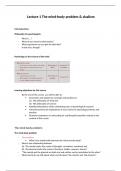
Lecture 1 The mind-body problem & dualism
Introduction
Philosophy for psychologists
- What is …?
- What do you mean by that exactly?
- What arguments can you give for that idea?
- Is that true, though?
Psychology as the science of the mind
Learning objectives for this course
- By the end of this course, you will be able to:
Summarize and explain key concepts and positions in
(a) The philosophy of mind and
(b) The philosophy of science;
Identify philosophical claims underlying cases of psychological research;
Critically examine the implications of such claims for psychological theory and
practice;
Illustrate competence in advocating for a philosophical position related to the
content of this course
The mind-body problem
The mind-body problem
- The problem:
What is the relationship between the mind and the body?
- What is the relationship between
(a) The mental realm (the realm of thoughts, sensations, emotions) and
(b) The physical realm (the realm of furniture, bodies, neurons, atoms)?
- “The mental and the physical are both real and neither can be assimilated to the other”
- What exactly do we talk about when we talk about ‘the mental’ and ‘the physical’?
, - Options:
Substance dualism things
Property dualism properties
Predicate dualism terms in our language
Substance dualism
Substance dualism: mind and body are different things
Substance dualism: Descartes
- René Descartes (1596-1650)
- Meditations (1641)
- Mind: res cogitans, a thinking thing
- Body: rex extensa, an extended thing
- Radical doubt
- “I doubt, therefore I am – or what is the same – I think, therefore I am”
- This specific form of substance dualism is also called “Cartesian Dualism”
- What arguments could Descartes give for that idea?
X = Y, only when X and Y share all properties
Premise 1: I can doubt the existence of my body
Premise 2: I cannot doubt the existence of my thinking
Conclusion: therefore, my body and my thinking cannot be the same thing
Princess Elisabeth’s objection
- Princess Elisabeth of Bohemia (1616-1680)
- The interaction problem:
How can an immaterial substance act on a material substance?
- If the mind is immaterial, it cannot come into direct physical contact with the body
- How, then, can there be any direct (causal) relations between the two?
- How can my mind bring it about that my finger moves?
Analogy: the morning star and the evening star
- The “Morning Star” and “Evening Star” refer
to the same object: the planet Venus, seen at
different times a day
- Any difference between them results from
human perception, not from them being two
separate objects
A counterargument against substance dualism
,Let’s apply this to the mind-body problem:
- Descartes: the mind (immaterial) and the body (material) are distinct substances
- Elizabeth of Bohemia (not convinced):
If Descartes was right, then how could mind and body interact?
It is unimaginable that an immaterial substance (mind) could influence physical
material (body)
- Just as the “Morning Star” and “Evening Star” are one and the same object, the mind and
body might not be fundamentally distinct, as Descartes suggests, but two interconnected
aspects of the same system
Ontology vs. epistemology
- Descartes’ error can be traced to a conflation of two distinct types of questions:
Ontological questions: What really exists?
Is there a mind? Is there a body?
Is the mind distinct from the body and vice versa? (Whether we doubt it or
not)
Epistemological questions: What can we know and how can we know it?
Can we doubt the existence of our body?
Can we doubt the existence of our mind?
- Descartes’ argument for substance dualism ultimately fails because it’s invalid to draw an
ontological conclusion (mind and body are distinct) from an epistemological distinction (I can
doubt that I have a body but not that I’m thinking)
Summary: substance dualism
A. The mind and the body are two different things (substance dualism)
What does this mean exactly?
B. Mind is a thinking substance; body is an extended substance (Cartesian dualism)
What arguments support this idea?
C. We can doubt the existence of our bodies (premise 1), but not of our doubting (premise 2),
so our doubting/thinking and our bodies cannot be the same (conclusion)
Is this true though? No, the conclusion does not follow from the premises (by
analogy)
Property dualism & consciousness
Two kinds of dualism
- What do ‘the mental realm’ and ‘the physical realm’ refer to?
- Substance dualism:
They are different types of things (“soul-body dualism”)
- Property dualism:
They are different properties of physical things (“brain-body dualism”)
Property dualism
, - There is just one kind of thing, but there are two kinds of properties
- Mental properties: e.g., sadness, being curious
- Physical properties: e.g., being tall or heavy
- They are distinct: some mental properties cannot be reduced to physical properties (unlike
water, which can be reduced to H2O)
- For example? What about consciousness?
Access consciousness: what content is S aware of?
- An access-conscious state is a state directly available to you to drive your actions, speech, and
thoughts
- An actual brain-state may play this role
- Accessible from 3rd-person point-of-view
- It’s non-trivial: you cannot report how to ride a bike even if you have access to this
knowledge (you can perform the action)
Phenomenal consciousness (qualia): what is it like?
- The subjective feel, or “what it is like” to be in a particular state
- Is associated with a specific qualitative-experience character
- Is well-identifiable, temporally bound
- Only accessible from the 1st-person point-of-view
Can we study what it is like for a bat to experience the world?
- Bats perceive the external world primarily by echolocation
- “… there is no reason to suppose that [this] is subjectively like anything we can experience or
imagine… It will not help to try to imagine that one has webbing on one’s arm, which enables
one to fly around at dusk and dawn catching insects in one’s mouth … and that one spends
the day hanging upside down by one’s feet in an attic”
- [This] “tells me only what it would be like for me to behave as a bat behaves. But that is not
the question. I want to know what it is like for a bat to be a bat. Yet if I try to imagine this, I
am restricted to the resources of my own mind, and those resources are inadequate to the
task”
Property dualism & consciousness
- Property dualists: consciousness cannot be fully explained by physical laws
What does this mean exactly?
- They think that objective physical processes (including brain-facts) cannot explain subjective
experience (the “what it is like” or “qualia”)
Why think so? Arguments?
The knowledge argument: Mary
Introduction
Philosophy for psychologists
- What is …?
- What do you mean by that exactly?
- What arguments can you give for that idea?
- Is that true, though?
Psychology as the science of the mind
Learning objectives for this course
- By the end of this course, you will be able to:
Summarize and explain key concepts and positions in
(a) The philosophy of mind and
(b) The philosophy of science;
Identify philosophical claims underlying cases of psychological research;
Critically examine the implications of such claims for psychological theory and
practice;
Illustrate competence in advocating for a philosophical position related to the
content of this course
The mind-body problem
The mind-body problem
- The problem:
What is the relationship between the mind and the body?
- What is the relationship between
(a) The mental realm (the realm of thoughts, sensations, emotions) and
(b) The physical realm (the realm of furniture, bodies, neurons, atoms)?
- “The mental and the physical are both real and neither can be assimilated to the other”
- What exactly do we talk about when we talk about ‘the mental’ and ‘the physical’?
, - Options:
Substance dualism things
Property dualism properties
Predicate dualism terms in our language
Substance dualism
Substance dualism: mind and body are different things
Substance dualism: Descartes
- René Descartes (1596-1650)
- Meditations (1641)
- Mind: res cogitans, a thinking thing
- Body: rex extensa, an extended thing
- Radical doubt
- “I doubt, therefore I am – or what is the same – I think, therefore I am”
- This specific form of substance dualism is also called “Cartesian Dualism”
- What arguments could Descartes give for that idea?
X = Y, only when X and Y share all properties
Premise 1: I can doubt the existence of my body
Premise 2: I cannot doubt the existence of my thinking
Conclusion: therefore, my body and my thinking cannot be the same thing
Princess Elisabeth’s objection
- Princess Elisabeth of Bohemia (1616-1680)
- The interaction problem:
How can an immaterial substance act on a material substance?
- If the mind is immaterial, it cannot come into direct physical contact with the body
- How, then, can there be any direct (causal) relations between the two?
- How can my mind bring it about that my finger moves?
Analogy: the morning star and the evening star
- The “Morning Star” and “Evening Star” refer
to the same object: the planet Venus, seen at
different times a day
- Any difference between them results from
human perception, not from them being two
separate objects
A counterargument against substance dualism
,Let’s apply this to the mind-body problem:
- Descartes: the mind (immaterial) and the body (material) are distinct substances
- Elizabeth of Bohemia (not convinced):
If Descartes was right, then how could mind and body interact?
It is unimaginable that an immaterial substance (mind) could influence physical
material (body)
- Just as the “Morning Star” and “Evening Star” are one and the same object, the mind and
body might not be fundamentally distinct, as Descartes suggests, but two interconnected
aspects of the same system
Ontology vs. epistemology
- Descartes’ error can be traced to a conflation of two distinct types of questions:
Ontological questions: What really exists?
Is there a mind? Is there a body?
Is the mind distinct from the body and vice versa? (Whether we doubt it or
not)
Epistemological questions: What can we know and how can we know it?
Can we doubt the existence of our body?
Can we doubt the existence of our mind?
- Descartes’ argument for substance dualism ultimately fails because it’s invalid to draw an
ontological conclusion (mind and body are distinct) from an epistemological distinction (I can
doubt that I have a body but not that I’m thinking)
Summary: substance dualism
A. The mind and the body are two different things (substance dualism)
What does this mean exactly?
B. Mind is a thinking substance; body is an extended substance (Cartesian dualism)
What arguments support this idea?
C. We can doubt the existence of our bodies (premise 1), but not of our doubting (premise 2),
so our doubting/thinking and our bodies cannot be the same (conclusion)
Is this true though? No, the conclusion does not follow from the premises (by
analogy)
Property dualism & consciousness
Two kinds of dualism
- What do ‘the mental realm’ and ‘the physical realm’ refer to?
- Substance dualism:
They are different types of things (“soul-body dualism”)
- Property dualism:
They are different properties of physical things (“brain-body dualism”)
Property dualism
, - There is just one kind of thing, but there are two kinds of properties
- Mental properties: e.g., sadness, being curious
- Physical properties: e.g., being tall or heavy
- They are distinct: some mental properties cannot be reduced to physical properties (unlike
water, which can be reduced to H2O)
- For example? What about consciousness?
Access consciousness: what content is S aware of?
- An access-conscious state is a state directly available to you to drive your actions, speech, and
thoughts
- An actual brain-state may play this role
- Accessible from 3rd-person point-of-view
- It’s non-trivial: you cannot report how to ride a bike even if you have access to this
knowledge (you can perform the action)
Phenomenal consciousness (qualia): what is it like?
- The subjective feel, or “what it is like” to be in a particular state
- Is associated with a specific qualitative-experience character
- Is well-identifiable, temporally bound
- Only accessible from the 1st-person point-of-view
Can we study what it is like for a bat to experience the world?
- Bats perceive the external world primarily by echolocation
- “… there is no reason to suppose that [this] is subjectively like anything we can experience or
imagine… It will not help to try to imagine that one has webbing on one’s arm, which enables
one to fly around at dusk and dawn catching insects in one’s mouth … and that one spends
the day hanging upside down by one’s feet in an attic”
- [This] “tells me only what it would be like for me to behave as a bat behaves. But that is not
the question. I want to know what it is like for a bat to be a bat. Yet if I try to imagine this, I
am restricted to the resources of my own mind, and those resources are inadequate to the
task”
Property dualism & consciousness
- Property dualists: consciousness cannot be fully explained by physical laws
What does this mean exactly?
- They think that objective physical processes (including brain-facts) cannot explain subjective
experience (the “what it is like” or “qualia”)
Why think so? Arguments?
The knowledge argument: Mary