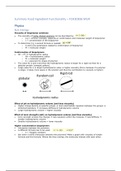
Summary Food Ingredient Functionality – FCH30306 WUR
Physics
Bulk rheology
Viscosity of biopolymer solutions
• The viscosity of highly diluted solutions can be described by:
o [η] = intrinsic viscosity, depends on conformation and molecular weight of biopolymer
o c = concentration of the biopolymer
• To determine [η], a second formula is needed:
o K and a are parameters related to conformation of biopolymer
o M = molecular weight
Conformation of biopolymers
• Rh ~ Mb → hydrodynamic radius
o Rh = hydrodynamic radius
o M = molecular weight
o b = exponent for shape of polymer
• The value for a and b and thus the hydrodynamic radius is larger for a rigid rod than for a
globular protein (compact sphere).
• Large value for a → larger hydrodynamic value → higher viscosity (this is because if a polymer
is larger, it takes more space in the solution and thus the contribution to viscosity is higher)
Effect of pH on hydrodynamic volume (and thus viscosity)
• Higher charge density on specific groups → more electrostatic repulsion between the groups →
stretched backbone → increases stiffness & hydrodynamic volume
• Large hydrodynamic volume = higher viscosity
Effect of ionic strength (salt) on hydrodynamic volume (and thus viscosity)
• Ionic strength screens the charges → less repulsion within the molecule → less stiffness →
smaller hydrodynamic volume
• Smaller hydrodynamic volume = lower viscosity
Higher concentration biopolymers
• Interaction between the polymers
• A different formula has to be used:
o k = Huggins constant
• But when is there interaction between the polymers? Make a graph with viscosity of simple
formula and this formula. Where the lines overlap, the molecules interact with each other.
, Interactions in food
Steric stabilization
When does it occur?
• In solutions with attractive interactions between particles
and polymers.
What happens?
• Polymers adsorb on the surface of the particles. This
results in a thick layer around the particles that cover
the complete surface. Different particles cannot approach
each other anymore because of this layer.
Bridging interaction/flocculation
When does it occur?
• In solutions with attractive interactions between particles
and a low concentration of biopolymers
What happens?
• Not enough polymers are present to cover the whole
surface of the particles
• The polymer chains links 2 or more particles together, so
it forms a bridge between them
• Size of the clusters depends on the ratio between the
particles and the polymers and the degree of attractive
interactions
• Clusters can sediment or cream
Depletion interaction
When does it occur?
• In solutions with no attractive interactions between particles and biopolymers at high
concentration of one or both.
What happens?
• Low concentration: polymers (red) fit between the particles → even distribution
• High concentration: more particles so closer together, polymers don’t fit in between particles so
they move to the outside. Now, on the outside the osmotic pressure is higher because of more
polysaccharides. The water between the particles will move to the outside to balance. The
particles will come even more close together and they aggregate/flocculate.
• Depletion can also take place between for instance oil droplets and polysaccharides, oil droplets
and protein aggregates, different polysaccharides,
• If the polysaccharides are larger, at lower concentration the depletion already occurs. As the
size of molecules also depends on repulsion, pH and salt have an effect on depletion.
Physics
Bulk rheology
Viscosity of biopolymer solutions
• The viscosity of highly diluted solutions can be described by:
o [η] = intrinsic viscosity, depends on conformation and molecular weight of biopolymer
o c = concentration of the biopolymer
• To determine [η], a second formula is needed:
o K and a are parameters related to conformation of biopolymer
o M = molecular weight
Conformation of biopolymers
• Rh ~ Mb → hydrodynamic radius
o Rh = hydrodynamic radius
o M = molecular weight
o b = exponent for shape of polymer
• The value for a and b and thus the hydrodynamic radius is larger for a rigid rod than for a
globular protein (compact sphere).
• Large value for a → larger hydrodynamic value → higher viscosity (this is because if a polymer
is larger, it takes more space in the solution and thus the contribution to viscosity is higher)
Effect of pH on hydrodynamic volume (and thus viscosity)
• Higher charge density on specific groups → more electrostatic repulsion between the groups →
stretched backbone → increases stiffness & hydrodynamic volume
• Large hydrodynamic volume = higher viscosity
Effect of ionic strength (salt) on hydrodynamic volume (and thus viscosity)
• Ionic strength screens the charges → less repulsion within the molecule → less stiffness →
smaller hydrodynamic volume
• Smaller hydrodynamic volume = lower viscosity
Higher concentration biopolymers
• Interaction between the polymers
• A different formula has to be used:
o k = Huggins constant
• But when is there interaction between the polymers? Make a graph with viscosity of simple
formula and this formula. Where the lines overlap, the molecules interact with each other.
, Interactions in food
Steric stabilization
When does it occur?
• In solutions with attractive interactions between particles
and polymers.
What happens?
• Polymers adsorb on the surface of the particles. This
results in a thick layer around the particles that cover
the complete surface. Different particles cannot approach
each other anymore because of this layer.
Bridging interaction/flocculation
When does it occur?
• In solutions with attractive interactions between particles
and a low concentration of biopolymers
What happens?
• Not enough polymers are present to cover the whole
surface of the particles
• The polymer chains links 2 or more particles together, so
it forms a bridge between them
• Size of the clusters depends on the ratio between the
particles and the polymers and the degree of attractive
interactions
• Clusters can sediment or cream
Depletion interaction
When does it occur?
• In solutions with no attractive interactions between particles and biopolymers at high
concentration of one or both.
What happens?
• Low concentration: polymers (red) fit between the particles → even distribution
• High concentration: more particles so closer together, polymers don’t fit in between particles so
they move to the outside. Now, on the outside the osmotic pressure is higher because of more
polysaccharides. The water between the particles will move to the outside to balance. The
particles will come even more close together and they aggregate/flocculate.
• Depletion can also take place between for instance oil droplets and polysaccharides, oil droplets
and protein aggregates, different polysaccharides,
• If the polysaccharides are larger, at lower concentration the depletion already occurs. As the
size of molecules also depends on repulsion, pH and salt have an effect on depletion.