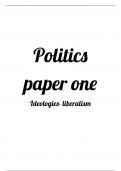
Politics
paper one
Ideologies- liberalism
, To what extent are modern and classical liberals united on the role
of the state/ economy
All liberals agree on the structure of the state, the state is created by individuals for
them and a mechanism or what Locke described as mechanistic theory.This is the
idea that the state is created by rational individuals. The belief that a tyrannical
government would curb individual freedom is what drives most liberals to support
government by consent or what LOcke referred to as a social contract. To avoid the
suppression of individual freedom there ought to be checks and balances, the
separation of powers and the dispersal of power, that's why all liberals use the US
constitution as a model to others as it avoids tyranny through federalism and through
separation of the branches of government. In the UK all liberals have supported
constitutional reform particularly devolutions because it disperses power, so the
structure of the state is something that brings liberals together. The liberal view that
individuals are rational results in their support for a limited government that does not
possess draconian powers, this is because liberals believe that individuals are
rational enough to be trusted and left alone even John Rawls saw an enabling state
as something that would be consented too and one that shouldn't take away
freedom. Liberals acknowledge that some human beings could act selfishly and
break contracts, therefore a state is required to act as a neutral umpire between
individuals, in this sense all liberals believe that the state is a necessary evil.
However, while liberals support a similar structure accepting the state as a
necessary evil only ML supports an enabling state. Rawls' veils of ignorance is
where he imagined a world where non one knew their position in society and posed
questions to the inhabitants of that world regarding the things that they would want,
in case they found themselves at the bottom of the social structure. Rawls said that
because humans are rational, they would rationally choose a world where the risk for
the potential for their own individual suffering was minimised, especially if they had
no idea where they would end up, this is why Rawls argued for a welfare state. Mill
could potentially agree with this as he said ‘ to bring a child into existence with a fair
prospect is a moral crime’, meaning if a parent doesn't fulfil this obligation then the
state may as well, this means that the state has a role in educating people and giving
them a fair chance. An enabling or welfare state would, according to classical
liberals, curb freedom because it would demand higher taxes from others to pay for it
that reduces the freedom of those individuals and undermine the concept of a
nightwatchman limited state.. Nevertheless, only ML supports and enabling state
whereas CL does not.
All liberals support capitalism and therefore a limit on state intervention, they believe
in meritocracy but they do not seek to make society socially equal. Even Rawls
accepted that once helped by the state, individuals should free to rise or fall
depending on where their talent takes them, as long as we've given them the
paper one
Ideologies- liberalism
, To what extent are modern and classical liberals united on the role
of the state/ economy
All liberals agree on the structure of the state, the state is created by individuals for
them and a mechanism or what Locke described as mechanistic theory.This is the
idea that the state is created by rational individuals. The belief that a tyrannical
government would curb individual freedom is what drives most liberals to support
government by consent or what LOcke referred to as a social contract. To avoid the
suppression of individual freedom there ought to be checks and balances, the
separation of powers and the dispersal of power, that's why all liberals use the US
constitution as a model to others as it avoids tyranny through federalism and through
separation of the branches of government. In the UK all liberals have supported
constitutional reform particularly devolutions because it disperses power, so the
structure of the state is something that brings liberals together. The liberal view that
individuals are rational results in their support for a limited government that does not
possess draconian powers, this is because liberals believe that individuals are
rational enough to be trusted and left alone even John Rawls saw an enabling state
as something that would be consented too and one that shouldn't take away
freedom. Liberals acknowledge that some human beings could act selfishly and
break contracts, therefore a state is required to act as a neutral umpire between
individuals, in this sense all liberals believe that the state is a necessary evil.
However, while liberals support a similar structure accepting the state as a
necessary evil only ML supports an enabling state. Rawls' veils of ignorance is
where he imagined a world where non one knew their position in society and posed
questions to the inhabitants of that world regarding the things that they would want,
in case they found themselves at the bottom of the social structure. Rawls said that
because humans are rational, they would rationally choose a world where the risk for
the potential for their own individual suffering was minimised, especially if they had
no idea where they would end up, this is why Rawls argued for a welfare state. Mill
could potentially agree with this as he said ‘ to bring a child into existence with a fair
prospect is a moral crime’, meaning if a parent doesn't fulfil this obligation then the
state may as well, this means that the state has a role in educating people and giving
them a fair chance. An enabling or welfare state would, according to classical
liberals, curb freedom because it would demand higher taxes from others to pay for it
that reduces the freedom of those individuals and undermine the concept of a
nightwatchman limited state.. Nevertheless, only ML supports and enabling state
whereas CL does not.
All liberals support capitalism and therefore a limit on state intervention, they believe
in meritocracy but they do not seek to make society socially equal. Even Rawls
accepted that once helped by the state, individuals should free to rise or fall
depending on where their talent takes them, as long as we've given them the