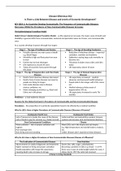
Disease Dilemmas SG2
Is There a Link Between Disease and Levels of Economic Development?
KEY IDEA 2: As Countries Develop Economically, The Frequency of Communicable Diseases
Decreases While the Prevalence of Non-Communicable Diseases Increases
The Epidemiological Transition Model
Abdel Omran’s Epidemiological Transition Model – as life expectancy increases, the major cause of death and
disability in general shifts from communicable, maternal and perinatal causes to chronic, non-communicable
ones
As a country develops it passes through four stages:
Stage 1 – The Age of Pestilence and Famine Stage 2 – The Age of Receding Pandemics
Parasitic diseases are main cause of death Reduction of infectious disease – improved
e.g. Black Plague sanitation, nutrition and medicine
Mortality is high and fluctuates from year Epidemics causing large scale mortality to
to year become rare
Famine due to food shortages This phase includes many LIDCs and EDCs
Life expectancy around 30 years today
Today all countries have passed through Life expectancy above 50 years
this phase
Stage 3 – The Age of Degenerative and Man-Made Stage 4 – The Age of Delayed Degenerative
Diseases Diseases
Deaths from infectious diseases decreased Life expectancy increased – medical
Deaths from chronic diseases increased as advances and improved health behaviour
people are living for longer People able to live longer with CVD, cancer,
Man-made diseases due to lifestyle etc.
choices, pollution, etc. Medical advances delay onset of
Many emerging economies e.g. Brazil and degenerative CVD etc.
China are in this phase Life expectancy increased to early 70s –
mid 80s
Pestilence – a fatal epidemic disease
Reasons for the Global Contrasts in Prevalence of Communicable and Non-Communicable Diseases
Prevalence – the proportion of a particular population found to be affected by a medical condition
Why Do LIDCs Have a Higher Prevalence of Communicable Diseases (Diseases of Poverty)?
Inadequate Health Care Inadequate Food Intake
Lack of resources to tackle the cause of the disease Undernutrition and malnutrition weaken immune
Lack of funds to pay for vaccines e.g. cholera in Haiti systems and increase viral and bacterial infections
Poor Environmental Conditions Climate
Water pollution – lack of proper sanitation and Most LIDCs are in the tropics and sub tropics
hygiene E.g. High temperature and rainfall leads to malaria,
Poor drainage sites etc.
Slum living and overcrowding Colder climates don’t experience these diseases
Why Do ACs Have a Higher Prevalence of Non-Communicable Diseases (Disease of Affluence)?
The Eradication of Communicable Diseases Over Nutrition
Advancements in medical diagnoses and treatments Excess fats, salts, sugar, carbohydrates
Higher standard of living and proper sanitation Becoming a problem in EDCs e.g. Brazil – in 1974
Health population with longer life expectancy there was 2 cases of underweight adults for every 1
meaning death rates increase in old age obese, but in 1997 the ratio had reversed
A Raise in Living Standards
Is There a Link Between Disease and Levels of Economic Development?
KEY IDEA 2: As Countries Develop Economically, The Frequency of Communicable Diseases
Decreases While the Prevalence of Non-Communicable Diseases Increases
The Epidemiological Transition Model
Abdel Omran’s Epidemiological Transition Model – as life expectancy increases, the major cause of death and
disability in general shifts from communicable, maternal and perinatal causes to chronic, non-communicable
ones
As a country develops it passes through four stages:
Stage 1 – The Age of Pestilence and Famine Stage 2 – The Age of Receding Pandemics
Parasitic diseases are main cause of death Reduction of infectious disease – improved
e.g. Black Plague sanitation, nutrition and medicine
Mortality is high and fluctuates from year Epidemics causing large scale mortality to
to year become rare
Famine due to food shortages This phase includes many LIDCs and EDCs
Life expectancy around 30 years today
Today all countries have passed through Life expectancy above 50 years
this phase
Stage 3 – The Age of Degenerative and Man-Made Stage 4 – The Age of Delayed Degenerative
Diseases Diseases
Deaths from infectious diseases decreased Life expectancy increased – medical
Deaths from chronic diseases increased as advances and improved health behaviour
people are living for longer People able to live longer with CVD, cancer,
Man-made diseases due to lifestyle etc.
choices, pollution, etc. Medical advances delay onset of
Many emerging economies e.g. Brazil and degenerative CVD etc.
China are in this phase Life expectancy increased to early 70s –
mid 80s
Pestilence – a fatal epidemic disease
Reasons for the Global Contrasts in Prevalence of Communicable and Non-Communicable Diseases
Prevalence – the proportion of a particular population found to be affected by a medical condition
Why Do LIDCs Have a Higher Prevalence of Communicable Diseases (Diseases of Poverty)?
Inadequate Health Care Inadequate Food Intake
Lack of resources to tackle the cause of the disease Undernutrition and malnutrition weaken immune
Lack of funds to pay for vaccines e.g. cholera in Haiti systems and increase viral and bacterial infections
Poor Environmental Conditions Climate
Water pollution – lack of proper sanitation and Most LIDCs are in the tropics and sub tropics
hygiene E.g. High temperature and rainfall leads to malaria,
Poor drainage sites etc.
Slum living and overcrowding Colder climates don’t experience these diseases
Why Do ACs Have a Higher Prevalence of Non-Communicable Diseases (Disease of Affluence)?
The Eradication of Communicable Diseases Over Nutrition
Advancements in medical diagnoses and treatments Excess fats, salts, sugar, carbohydrates
Higher standard of living and proper sanitation Becoming a problem in EDCs e.g. Brazil – in 1974
Health population with longer life expectancy there was 2 cases of underweight adults for every 1
meaning death rates increase in old age obese, but in 1997 the ratio had reversed
A Raise in Living Standards