Title page
Faculty Economics and Business
Year 19/20
Course code EBB048A05
Course name Internal Control (BSc)
Period Block 1
Credits (ECTS) 5
Compulsory literature Romney & Steinbart: Accounting Information System (14 th edition);
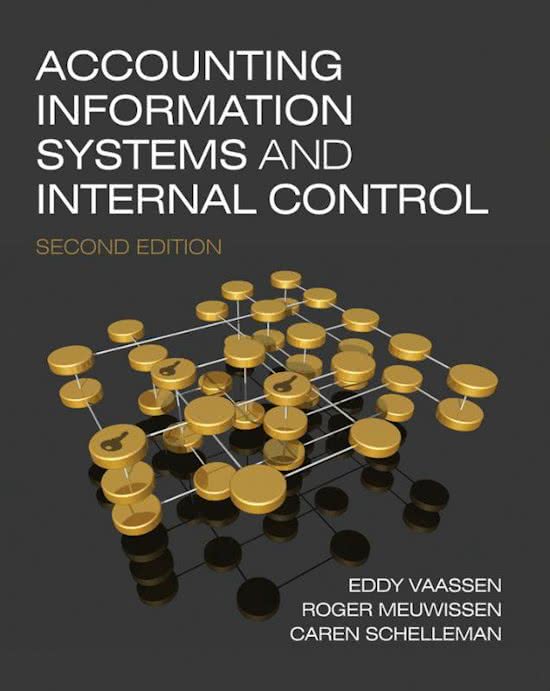
Vaassen, Meuwissen & Schelleman: Accounting Information Systems
and Internal Control (second edition);
Reader prof. dr. J.A. Emanuels: ‘’Basic of Accounting Information
Systems’´.
Learning goals of this course
Upon completion of the course, the student is able to:
Explain the concepts of relevance and reliability of information for organizations;
Understand the relationship between business cycles, typologies, information requirements
and information flows;
Determine which risks are relevant in business cycles and describe appropriate controls;
Explain the meaning of internal control;
Explain the importance of IT for the efficiency and effectiveness for the management of
organizations;
Explain the influence of corporate ethics and the three elements of the fraud triangle.
Questions on the exam can be:
What type or organization do we have: what is the typology of this organization?
Name risks and controls.
Which business cycles are running through this company?
How is this company implementing control measures?
Focus in this course
During the course, F. Bos says the syllabus introduces the subjects of both books. Both books goes
deeper into these topics. About the book of Romney & Steinbart, the business cycles are important.
In the book of Vaassen you need to study typologies well.
,Preface
Why is this course important?
It is all over the news when bad things happen: for example, when companies report false figures or
governmental organizations lose control over large projects. But can we do better? That is what we
teach within the course Internal Control!
Every organization depends on information to manage and control processes. Information is supplied
to external stakeholders, for example by means the annual report.
Organizations use information systems to come from a state of being out-of-control into a state of
being in-control. To come into a state of being in-control, the organization’s information systems
must meet quality criteria. This course focuses on a type of information system, the accounting
information system (AIS).
Organizations have characteristics, that put constraints on the design of business cycles, and on the
AIS, in order to assure the reliability of information.
In addition to technology- and regulatory-driven changes, organizations are responding to the
increasingly competitive business environment by evaluating internal activities to create the most
value at least cost. As a result, accountants are being asked to do more than report the results of past
activities. Accountants must take a more proactive role in providing and interpreting financial and
nonfinancial information about the organization’s activities. Therefore, it is handy if accountants can
improve the design and functioning of the AIS. If accountants improve the design and functioning of
an AIS, accountants inform management how to effectively run their organization. An improved AIS
increases the value of the organization.
Next to that, there is a need for organizations that accountants are able to move beyond the
traditional role of scorekeeper and actively seek to add value to their organization. Accountants
should participate in decisions about adopting new technology and implementing new information
systems because they have the training to properly evaluate the relative costs and benefits, as well
as the economic risks, underlying such investments. Effectively participating in decisions concerning
technology requires accountants to stay informed about advances in IT.
Thus, accountants need to understand how an AIS works in order to:
effectively measure how cost-effectively the AIS performs;
assess the AIS’s reliability;
assess the reliability of the information the AIS produces.
Moreover, IT plays an (increasingly) important role in any AIS and can have a considerable impact on
the design of controls. IT is one of the main requirements for sustaining a reliable AIS.
,The figure below shows the topic of this course.
, Lecture 1: Introduction to IC BSc – Organizations &
Information
Literature: Romney & Steinbart CH. 1-3, Vaassen Ch. 1-3 and Reader prof. Emannuels
Organizations need information. If organizations don’t have information, there will not be much
activity. Organizations uses information to get things done. Information can come in many forms and
can be used in many different ways. Information always boils down to getting an organization from a
state of being out of control into a state of being in control. Because information is vital in
organizations, information and the systems that produce information must also be controlled.
The definition of an organization is: ‘an organization is a group of people intentionally cooperating to
achieve one or more common goals’.
What is data? And when can we speak of information?
Data are facts. When we put those facts within a context, we get information. So, data has to be
processed to be meaningful. For this reason, it is important to label data. Data with a label is
information. It may be clear that data is useless if you don’t have an objection. Therefore,
information is useful data.
Information is valuable when the benefits exceeds the costs :
A benefit could improve decision making. Decision making is the allocation of scares
resources.
Costs could be the time and resources used to get the information.
There are different types of information:
Quantitative versus qualitative information;
Organizational performance is mostly expressed by quantitative criteria (total revenue, increase in
profit, number of employees, customer retention, etc.). As a consequence key performance
indicators (KPI’s) used to control business cycles are also highly quantitative (call response time,
employee productivity, etc.).
There are two observations to stress the relevance of qualitative information in an organizational
context:
1. Quantitative information may conceal important details required to accurately interpret the
presented quantitative information.
2. “Not everything comes in numbers”.
Faculty Economics and Business
Year 19/20
Course code EBB048A05
Course name Internal Control (BSc)
Period Block 1
Credits (ECTS) 5
Compulsory literature Romney & Steinbart: Accounting Information System (14 th edition);
Vaassen, Meuwissen & Schelleman: Accounting Information Systems
and Internal Control (second edition);
Reader prof. dr. J.A. Emanuels: ‘’Basic of Accounting Information
Systems’´.
Learning goals of this course
Upon completion of the course, the student is able to:
Explain the concepts of relevance and reliability of information for organizations;
Understand the relationship between business cycles, typologies, information requirements
and information flows;
Determine which risks are relevant in business cycles and describe appropriate controls;
Explain the meaning of internal control;
Explain the importance of IT for the efficiency and effectiveness for the management of
organizations;
Explain the influence of corporate ethics and the three elements of the fraud triangle.
Questions on the exam can be:
What type or organization do we have: what is the typology of this organization?
Name risks and controls.
Which business cycles are running through this company?
How is this company implementing control measures?
Focus in this course
During the course, F. Bos says the syllabus introduces the subjects of both books. Both books goes
deeper into these topics. About the book of Romney & Steinbart, the business cycles are important.
In the book of Vaassen you need to study typologies well.
,Preface
Why is this course important?
It is all over the news when bad things happen: for example, when companies report false figures or
governmental organizations lose control over large projects. But can we do better? That is what we
teach within the course Internal Control!
Every organization depends on information to manage and control processes. Information is supplied
to external stakeholders, for example by means the annual report.
Organizations use information systems to come from a state of being out-of-control into a state of
being in-control. To come into a state of being in-control, the organization’s information systems
must meet quality criteria. This course focuses on a type of information system, the accounting
information system (AIS).
Organizations have characteristics, that put constraints on the design of business cycles, and on the
AIS, in order to assure the reliability of information.
In addition to technology- and regulatory-driven changes, organizations are responding to the
increasingly competitive business environment by evaluating internal activities to create the most
value at least cost. As a result, accountants are being asked to do more than report the results of past
activities. Accountants must take a more proactive role in providing and interpreting financial and
nonfinancial information about the organization’s activities. Therefore, it is handy if accountants can
improve the design and functioning of the AIS. If accountants improve the design and functioning of
an AIS, accountants inform management how to effectively run their organization. An improved AIS
increases the value of the organization.
Next to that, there is a need for organizations that accountants are able to move beyond the
traditional role of scorekeeper and actively seek to add value to their organization. Accountants
should participate in decisions about adopting new technology and implementing new information
systems because they have the training to properly evaluate the relative costs and benefits, as well
as the economic risks, underlying such investments. Effectively participating in decisions concerning
technology requires accountants to stay informed about advances in IT.
Thus, accountants need to understand how an AIS works in order to:
effectively measure how cost-effectively the AIS performs;
assess the AIS’s reliability;
assess the reliability of the information the AIS produces.
Moreover, IT plays an (increasingly) important role in any AIS and can have a considerable impact on
the design of controls. IT is one of the main requirements for sustaining a reliable AIS.
,The figure below shows the topic of this course.
, Lecture 1: Introduction to IC BSc – Organizations &
Information
Literature: Romney & Steinbart CH. 1-3, Vaassen Ch. 1-3 and Reader prof. Emannuels
Organizations need information. If organizations don’t have information, there will not be much
activity. Organizations uses information to get things done. Information can come in many forms and
can be used in many different ways. Information always boils down to getting an organization from a
state of being out of control into a state of being in control. Because information is vital in
organizations, information and the systems that produce information must also be controlled.
The definition of an organization is: ‘an organization is a group of people intentionally cooperating to
achieve one or more common goals’.
What is data? And when can we speak of information?
Data are facts. When we put those facts within a context, we get information. So, data has to be
processed to be meaningful. For this reason, it is important to label data. Data with a label is
information. It may be clear that data is useless if you don’t have an objection. Therefore,
information is useful data.
Information is valuable when the benefits exceeds the costs :
A benefit could improve decision making. Decision making is the allocation of scares
resources.
Costs could be the time and resources used to get the information.
There are different types of information:
Quantitative versus qualitative information;
Organizational performance is mostly expressed by quantitative criteria (total revenue, increase in
profit, number of employees, customer retention, etc.). As a consequence key performance
indicators (KPI’s) used to control business cycles are also highly quantitative (call response time,
employee productivity, etc.).
There are two observations to stress the relevance of qualitative information in an organizational
context:
1. Quantitative information may conceal important details required to accurately interpret the
presented quantitative information.
2. “Not everything comes in numbers”.