
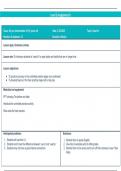
Level 3 Assignment B
Class: A2 pre-intermediate 10-12 years old Date: 2.25.2025 Topic: Used to
Number of students: 12 Duration: 60mins
Lesson type: Grammar (online)
Lesson aim: To introduce students to 'used to' for past states and habits that are no longer true.
Lesson objectives:
● To practice accuracy in the controlled practice stage via a worksheet.
● To develop fluency in the freer practice stage with a role play.
Materials and equipment:
PPT showing Tim before and after.
Handouts for controlled practice activity.
Role cards for freer practice.
Anticipated problems: Solutions:
1. Students will use their L1. 1. Remind them to speak English.
2. Students won’t hear the difference between ‘use to’ and ‘used to.’ 2. Give lots of examples and do drilling tasks.
3. Students may not have a good Internet connection. 3. Remind them not to worry and to turn off their cameras to see if that
helps.
, Stage Stage Aim Timing Interaction Teacher Activity Student Activity
Warmer To introduce 15 minutes Whole class The teacher tells students to write on the Students come up to the board and write an
students to board something that they liked to do when activity that they used to do.
the target they were younger.
grammar in
the lesson Teacher-class After two minutes, the teacher asks students Students sit down and listen in silence.
to sit down and then continues to talk about
his/her own life.
Improvements:
• Prompt students and engage them by encouraging personal reflection on whether they themselves did these activities in the past.
• Elicit feedback from students and establish a connection by asking them to write down three things they did in the past but don’t do now. Give them a few
minutes to think about it and share their responses through the chat function.
• To ensure that tasks are suitable for an online setting, and in this case, instead of students coming up to the board, they could share their responses through
a digital platform or the chat function.
• Encourage all students to actively participate by sharing their responses in the chat, ensuring engagement from the entire class.
• Keep the warmer as a short and dynamic activity. In terms of timing consider reducing the duration to 10 minutes to maintain engagement while utilizing time
effectively.
• With these adjustments, the warmer can better serve as an engaging introduction to the lesson, ensuring active participation from all students.
, Stage Stage Aim Timing Interaction Teacher Activity Student Activity
Presentation Introduce 15 minutes Teacher-class Show the class some images of a boy, Students listen and make notes.
topic and around 9 years old. His name is Tim. Show
grammar him doing well at football, the piano, and
dance. Tell the class that the boy is very
interested in sports and music.
Next, show some images of Tim a little older,
around 13. He doesn’t like sports anymore,
and he doesn’t play the piano. Instead, he
likes gaming and reading.
Give the students an example sentence with
used to directly and write it on the board.
Write the form of used to on the board
without asking the students first.
If they seem to understand, do not ask
concept-checking questions. Students repeat sentences with the target
language.
Drill some sentences about Tim.
Improvements:
• Students are primarily focused on listening, jotting down notes, and repeating sentences, which mainly involve basic cognitive skills. This approach
may not guarantee their understanding or active involvement with the target language.
Enhance student engagement from the start: rather than having students passively listen and take notes, actively involve them by posing questions
about the images or inviting them to speculate on how Tim’s interests may evolve as he ages, this approach can significantly increase
comprehension and participation.
• The idea of “Used to” depends significantly on highlighting a clear difference between the past and the present. In the absence of a timeline, visual
comparisons like charts or…., students might find it difficult to grasp the change tin time.
Visual and contextual aids: Incorporate additional visual tools, such as timelines or diagrams, to help students clearly understand the differences
between past and present habits, thereby reinforcing the concept of “used to”.
Class: A2 pre-intermediate 10-12 years old Date: 2.25.2025 Topic: Used to
Number of students: 12 Duration: 60mins
Lesson type: Grammar (online)
Lesson aim: To introduce students to 'used to' for past states and habits that are no longer true.
Lesson objectives:
● To practice accuracy in the controlled practice stage via a worksheet.
● To develop fluency in the freer practice stage with a role play.
Materials and equipment:
PPT showing Tim before and after.
Handouts for controlled practice activity.
Role cards for freer practice.
Anticipated problems: Solutions:
1. Students will use their L1. 1. Remind them to speak English.
2. Students won’t hear the difference between ‘use to’ and ‘used to.’ 2. Give lots of examples and do drilling tasks.
3. Students may not have a good Internet connection. 3. Remind them not to worry and to turn off their cameras to see if that
helps.
, Stage Stage Aim Timing Interaction Teacher Activity Student Activity
Warmer To introduce 15 minutes Whole class The teacher tells students to write on the Students come up to the board and write an
students to board something that they liked to do when activity that they used to do.
the target they were younger.
grammar in
the lesson Teacher-class After two minutes, the teacher asks students Students sit down and listen in silence.
to sit down and then continues to talk about
his/her own life.
Improvements:
• Prompt students and engage them by encouraging personal reflection on whether they themselves did these activities in the past.
• Elicit feedback from students and establish a connection by asking them to write down three things they did in the past but don’t do now. Give them a few
minutes to think about it and share their responses through the chat function.
• To ensure that tasks are suitable for an online setting, and in this case, instead of students coming up to the board, they could share their responses through
a digital platform or the chat function.
• Encourage all students to actively participate by sharing their responses in the chat, ensuring engagement from the entire class.
• Keep the warmer as a short and dynamic activity. In terms of timing consider reducing the duration to 10 minutes to maintain engagement while utilizing time
effectively.
• With these adjustments, the warmer can better serve as an engaging introduction to the lesson, ensuring active participation from all students.
, Stage Stage Aim Timing Interaction Teacher Activity Student Activity
Presentation Introduce 15 minutes Teacher-class Show the class some images of a boy, Students listen and make notes.
topic and around 9 years old. His name is Tim. Show
grammar him doing well at football, the piano, and
dance. Tell the class that the boy is very
interested in sports and music.
Next, show some images of Tim a little older,
around 13. He doesn’t like sports anymore,
and he doesn’t play the piano. Instead, he
likes gaming and reading.
Give the students an example sentence with
used to directly and write it on the board.
Write the form of used to on the board
without asking the students first.
If they seem to understand, do not ask
concept-checking questions. Students repeat sentences with the target
language.
Drill some sentences about Tim.
Improvements:
• Students are primarily focused on listening, jotting down notes, and repeating sentences, which mainly involve basic cognitive skills. This approach
may not guarantee their understanding or active involvement with the target language.
Enhance student engagement from the start: rather than having students passively listen and take notes, actively involve them by posing questions
about the images or inviting them to speculate on how Tim’s interests may evolve as he ages, this approach can significantly increase
comprehension and participation.
• The idea of “Used to” depends significantly on highlighting a clear difference between the past and the present. In the absence of a timeline, visual
comparisons like charts or…., students might find it difficult to grasp the change tin time.
Visual and contextual aids: Incorporate additional visual tools, such as timelines or diagrams, to help students clearly understand the differences
between past and present habits, thereby reinforcing the concept of “used to”.



