

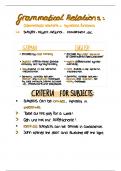
Garrammmmatical Relations ÷
Grammatical relations = syntactic functions
↳ subject, object, adjunct, complement. etc.
GERMAN: ENGLISH:
◦ encoded by case marking ◦ encoded by linear sequence
of constituents (fixed word order)
◦ objects differentiated paradig- ◦ objects differentiated syntag-
matically and syntagmatically. matically.
◦ less diverse in the semantic ◦ more diverse in the semantic
interpretation. interpretation.
◦ semantic contrast between ◦ semantic contrast between
location and direction expressed location and direction not
by case marking (dative, accusati overtly expressed.
ve), prepositions and postpositions
CRITERIA FOR SUBJECTS:
◦ subjects can be omitted, typically in
imperatives:
> Take out the dog for a walk!
> Geh und hol mir Apfelschorle!
◦ identical subjects can be omitted in coordination.
> John opened the door and switched off the light.
Grammatical relations = syntactic functions
↳ subject, object, adjunct, complement. etc.
GERMAN: ENGLISH:
◦ encoded by case marking ◦ encoded by linear sequence
of constituents (fixed word order)
◦ objects differentiated paradig- ◦ objects differentiated syntag-
matically and syntagmatically. matically.
◦ less diverse in the semantic ◦ more diverse in the semantic
interpretation. interpretation.
◦ semantic contrast between ◦ semantic contrast between
location and direction expressed location and direction not
by case marking (dative, accusati overtly expressed.
ve), prepositions and postpositions
CRITERIA FOR SUBJECTS:
◦ subjects can be omitted, typically in
imperatives:
> Take out the dog for a walk!
> Geh und hol mir Apfelschorle!
◦ identical subjects can be omitted in coordination.
> John opened the door and switched off the light.


