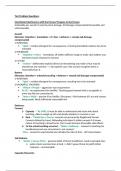
Tort Problem Questions:
Intentional Interference with the Person/Trespass to the Person:
Actionable per sae don’t need to prove damage. All damage compensated foreseeable and
unforeseeable.
Assault
Elements: Intention + immediate + cl’s fear + defences + remedy (all damage
compensated)
1-INTENTION
*Iqbal – reckless disregard for consequences, cl fearing immediate violence has to be
intended
2-IMMEDIATE
*Stephens v Myers – immediate, df within sufficient range to make clear battery was
imminent (court reluctant to narrow)
3-CL FEAR
*Ireland – deliberately exploit (silence) in threatening way make cl fear may be
attacked at any moment -> v fact specific case. Not narrow recognise when cl
reasonably fears X.
Battery
Elements: Intention + unlawful touching + defences + remedy (all damage compensated)
1-INTENTION
*Iqbal – reckless disregard for consequences, touching has to be intended
2-UNLAWFUL TOUCHING
*Wilson v Pringle – aggression was requirement
Re (F) – no requirement for hostility. Touching goes beyond what’s acceptable in
every day life/not consented to
*Innes v Wylie – passive df no liability. Directness = link between df’s act and contact
being made. Need sufficiently reasonable link
Defences:
Consent
1- Capacity – *Re (MB): cl must be able to understand and retain info about
touching. Able to weigh up info and decide whether to consent or not.
2- Real – *Chatterton v Gerson: consent not procured by illegitimate threats.
Consent vitiated by fraud. Misleading info doesn’t vitiate consent if cl knows
nature of touching in broad terms. Don’t need to know all possible side effects.
3- To the actual touching occurred – *Blake v Galloway – consent to touching for
tonsillectomy but was circumcised = not consent.
*Dica – consent to unprotected sex includes the risks of that – HIV transmission.
Self-Defence
*Ashley v Sussex Police – genuine belief of threat insufficient, need reasonable fear.
o police shoot unarmed man in bed => didn’t posse threat to justify lethal
response = unreasonable
Capacity/Necessity:
, Not possible to get Cl’s consent to touching – med treatment but
unconscious/mentally incapacitate
Mental Capacity Act 2005 – only for care/treatment. Take account of factors in act.
Does df reasonably believe cl lacks capacity + imagine what cl may want/touching
in cl’s best interests
*F v West Berkshire Health Authority – how court interpret act. Act only applies to
certain mental incapacity.
1- Cl lacks capacity
2- In cl’s best interest to receive contact
3- Not reasonable belief but factually in cl’s best interest
*Re MB^^
Defamation:
ELEMENTS:
1- Standing to sue => groups, parties, gov, company
2- Can df be sued => publishers: Byrne + or - ; single publication rule unless materially
diff
3- Slander or libel? => presume damage or not
4- Defam Meaning => Berkoff, Byrne, Lewis, Charleston, Cassidy
5- Is s.1 serious harm satisfied? Lachaux, sobrinho, economu, Cooke v MGN, Banks v
Cadwallar
6- Defences => Distributors (limited involvement in pub); General defences [df can use
combo] truth, honest opinion, Public interest, AP/QP
7- Remedies => Damages OR Injunction
Standing to Sue:
Anybody who is referred to by defam words as ordinary/reasonable reader would
understand
Companies:
*Jameel v Wall St Journal – company can sue
o Hoffman + Hale – show serious £ loss (introduced in DA 2013)
o Hope + Scott – no £ loss needed
Groups:
*Knupffer- group members can sue if statement can be understood as referring to
individuals, if not can’t sue
o V small/tightly defined group member can sue if ppl can understand it refers
to all members
Leader of 24-member party couldn’t sue for Nazi-collab allegations bc
statement couldn’t be understood as individually referring to cl
o Lord Porter – larger groups individuals could sue E.g. “no one can live in X if
don’t commit murder” goes out of its way to defame each person living in X
Political Parties:
*Derbyshire County Council v Times Newspaper – blanket exclusion on public boy
entitlement to sue, need freedom to discuss their shortcomings/performance
, *Goldsmith v Bhoyrol – same for political parties, same reasons
NB exclusion doesn’t apply to individuals of party, can still sue.
o S.4 DA defence (Publication on matter of public interest)
Slander or Libel?
*Thorely v Lord Kerry: treated differently.
Can be both (spoken words quoted in article)
Slander: speech not permanent
o *Thorely v Lord Kerry: damage not presumed, cl needs to show suffered
damage
o s.2 DA: Don’t need to show damage for: Professional incompetence or
committing indictable crim offence -> actionable per se
used to have more actionable per se slander but s.14 DA abolished
them.
o Deal w/ slander (acc suffered) + s1 DA (likely to suffer) requirements: cant
assume if one satisfied so is the other.
Libel: permanent form (writing) actionable per se
o *Thorely v Lord Kerry: Damage presumed, cl doesn’t need to show damage
o Speech reclassified as libel w/ widespread audience:
1- Words in theatre (Theatres Act 1968)
2- Words spoken in broadcast (Broadcasting Act 1990)
Publication: make known/communicate defam to someone other than cl
writing/spoken, df intention important to classifying as libel/slander
old law: fresh tort committed per publication
s.8 DA: 2nd repetition by same df, no new tort only 1 at 1st publication. limitation
period (14 yrs) starts w/ 1st.
o statement made to public.
o matters for online publications/archives
s.8(4) new tort if manner of later publication is materially diff to 1 st
o (a) level of prominence of statement
o (b) extent of later publication
s.8(6) court discretion to exclude limitation period unaffected
*Byrne v Dean – not always + act, can be failure to act/remove defam statement
o e.g. little trouble to remove considered publication
Are statements Defam?
*Berkoff v Burchill: published in relation to cl, lower estimation of right thinking ppl
generally => expose cl to hatred, ridicule or contempt.
o NB decide diff post-DA 2013, honest opinion defence
o ‘ugly’ actor
*Byrne v Dean: right thinking person = good & worthy subject (e.g. approve of
reporting crim activity (gambling) to police)
o Dissenting opinion: potential opinion of general society is not cl’s social group
(golf club members view reporting as disloyal)
*Lewis v Daily Telegraph: interpret how ordinary, reasonable reader of that
particular document would
, o E.g. newspaper reader not as intensely analytical as lawyer reading legal doc
o “investigated by Fraud Squad” no one assumes someone is guilty but being
investigated. Don’t come w/ idea of ‘no smoke w/out no fire”
*Charleston v News Group Newspapers Ltd: applies Lewis. Actors in falsely edited
pornographic photo
o Take article, photo and headline when interpreting.
o Don’t give effect to inattentive reader.
o Single standard of reasonable reader.
o Reasonable reader reads publication as a whole
o Give text 1 meaning in law based on that, wont reflect all possible meanings
o Cl argued: tabloid readers flick w/out acc reading – rejected bc article about
sympathy to Photoshop victims
*Cassidy v Daily Mirror Newspapers Ltd: take account of facts the ordinary
reasonable reader would know that skews their interpretation
o Cl can sue where defam meaning accessible to certain ppl w/ knowledge so
long as cl sets out what the knowledge is/who has it
o Even if df doesn’t know words are defam – no fault requirement
o E.g. paper printed cl’s husband engaged to another. Neighbours knew cl was
acc his wife. Df didn’t know/no reason to doubt what husband told them but
defam anyway.
S.1 Serious Harm:
Apply s.1 evidentiary threshold to statements
s.1(1) – cl needs to show serious harm to rep/likely to happen
*Lachaux: no longer presume damage.
o to whom publication was made/how many received
o nature of statement relevant
o harm = > substantial, not defined narrowly
o likely to cause = tendency to cause ≠ balance of prob
*Sobrinho: number of receivers = indicator => targeted pub counts e.g. to employer
o multiple pub at once => causation, 1 or all; don’t assume 1st does all damage,
repetition can too
o sympathetic to cl gathering evidence/forcing cl to remind ppl
o court entitled to infer => cl doesn’t always have to show its suffered
*Economu: not just nature of allegation but context of publication + to whom
o serious (rape) allegation to small number of sympathetic ppl (know cl +
protest his innocence) ≠ srs harm
*Cooke v MGN: important => df’s quick apology/retraction lessen srs harm.
o others see defam statement + retraction together
*Banks v Cadwalladr: disliked cl still has rep in community.
o careful what ‘rep’ is.
o alleging committing crime = srs harm
Possible Debate: s1(1) or s1(2)? If cl is body trading for profit need to show serious £
loss. E.g. regulatory body not for profit but take subscription – profit or funding
activities. If the latter, not s1(2) but if cl spends more after allegation then look at
serious harm.
Intentional Interference with the Person/Trespass to the Person:
Actionable per sae don’t need to prove damage. All damage compensated foreseeable and
unforeseeable.
Assault
Elements: Intention + immediate + cl’s fear + defences + remedy (all damage
compensated)
1-INTENTION
*Iqbal – reckless disregard for consequences, cl fearing immediate violence has to be
intended
2-IMMEDIATE
*Stephens v Myers – immediate, df within sufficient range to make clear battery was
imminent (court reluctant to narrow)
3-CL FEAR
*Ireland – deliberately exploit (silence) in threatening way make cl fear may be
attacked at any moment -> v fact specific case. Not narrow recognise when cl
reasonably fears X.
Battery
Elements: Intention + unlawful touching + defences + remedy (all damage compensated)
1-INTENTION
*Iqbal – reckless disregard for consequences, touching has to be intended
2-UNLAWFUL TOUCHING
*Wilson v Pringle – aggression was requirement
Re (F) – no requirement for hostility. Touching goes beyond what’s acceptable in
every day life/not consented to
*Innes v Wylie – passive df no liability. Directness = link between df’s act and contact
being made. Need sufficiently reasonable link
Defences:
Consent
1- Capacity – *Re (MB): cl must be able to understand and retain info about
touching. Able to weigh up info and decide whether to consent or not.
2- Real – *Chatterton v Gerson: consent not procured by illegitimate threats.
Consent vitiated by fraud. Misleading info doesn’t vitiate consent if cl knows
nature of touching in broad terms. Don’t need to know all possible side effects.
3- To the actual touching occurred – *Blake v Galloway – consent to touching for
tonsillectomy but was circumcised = not consent.
*Dica – consent to unprotected sex includes the risks of that – HIV transmission.
Self-Defence
*Ashley v Sussex Police – genuine belief of threat insufficient, need reasonable fear.
o police shoot unarmed man in bed => didn’t posse threat to justify lethal
response = unreasonable
Capacity/Necessity:
, Not possible to get Cl’s consent to touching – med treatment but
unconscious/mentally incapacitate
Mental Capacity Act 2005 – only for care/treatment. Take account of factors in act.
Does df reasonably believe cl lacks capacity + imagine what cl may want/touching
in cl’s best interests
*F v West Berkshire Health Authority – how court interpret act. Act only applies to
certain mental incapacity.
1- Cl lacks capacity
2- In cl’s best interest to receive contact
3- Not reasonable belief but factually in cl’s best interest
*Re MB^^
Defamation:
ELEMENTS:
1- Standing to sue => groups, parties, gov, company
2- Can df be sued => publishers: Byrne + or - ; single publication rule unless materially
diff
3- Slander or libel? => presume damage or not
4- Defam Meaning => Berkoff, Byrne, Lewis, Charleston, Cassidy
5- Is s.1 serious harm satisfied? Lachaux, sobrinho, economu, Cooke v MGN, Banks v
Cadwallar
6- Defences => Distributors (limited involvement in pub); General defences [df can use
combo] truth, honest opinion, Public interest, AP/QP
7- Remedies => Damages OR Injunction
Standing to Sue:
Anybody who is referred to by defam words as ordinary/reasonable reader would
understand
Companies:
*Jameel v Wall St Journal – company can sue
o Hoffman + Hale – show serious £ loss (introduced in DA 2013)
o Hope + Scott – no £ loss needed
Groups:
*Knupffer- group members can sue if statement can be understood as referring to
individuals, if not can’t sue
o V small/tightly defined group member can sue if ppl can understand it refers
to all members
Leader of 24-member party couldn’t sue for Nazi-collab allegations bc
statement couldn’t be understood as individually referring to cl
o Lord Porter – larger groups individuals could sue E.g. “no one can live in X if
don’t commit murder” goes out of its way to defame each person living in X
Political Parties:
*Derbyshire County Council v Times Newspaper – blanket exclusion on public boy
entitlement to sue, need freedom to discuss their shortcomings/performance
, *Goldsmith v Bhoyrol – same for political parties, same reasons
NB exclusion doesn’t apply to individuals of party, can still sue.
o S.4 DA defence (Publication on matter of public interest)
Slander or Libel?
*Thorely v Lord Kerry: treated differently.
Can be both (spoken words quoted in article)
Slander: speech not permanent
o *Thorely v Lord Kerry: damage not presumed, cl needs to show suffered
damage
o s.2 DA: Don’t need to show damage for: Professional incompetence or
committing indictable crim offence -> actionable per se
used to have more actionable per se slander but s.14 DA abolished
them.
o Deal w/ slander (acc suffered) + s1 DA (likely to suffer) requirements: cant
assume if one satisfied so is the other.
Libel: permanent form (writing) actionable per se
o *Thorely v Lord Kerry: Damage presumed, cl doesn’t need to show damage
o Speech reclassified as libel w/ widespread audience:
1- Words in theatre (Theatres Act 1968)
2- Words spoken in broadcast (Broadcasting Act 1990)
Publication: make known/communicate defam to someone other than cl
writing/spoken, df intention important to classifying as libel/slander
old law: fresh tort committed per publication
s.8 DA: 2nd repetition by same df, no new tort only 1 at 1st publication. limitation
period (14 yrs) starts w/ 1st.
o statement made to public.
o matters for online publications/archives
s.8(4) new tort if manner of later publication is materially diff to 1 st
o (a) level of prominence of statement
o (b) extent of later publication
s.8(6) court discretion to exclude limitation period unaffected
*Byrne v Dean – not always + act, can be failure to act/remove defam statement
o e.g. little trouble to remove considered publication
Are statements Defam?
*Berkoff v Burchill: published in relation to cl, lower estimation of right thinking ppl
generally => expose cl to hatred, ridicule or contempt.
o NB decide diff post-DA 2013, honest opinion defence
o ‘ugly’ actor
*Byrne v Dean: right thinking person = good & worthy subject (e.g. approve of
reporting crim activity (gambling) to police)
o Dissenting opinion: potential opinion of general society is not cl’s social group
(golf club members view reporting as disloyal)
*Lewis v Daily Telegraph: interpret how ordinary, reasonable reader of that
particular document would
, o E.g. newspaper reader not as intensely analytical as lawyer reading legal doc
o “investigated by Fraud Squad” no one assumes someone is guilty but being
investigated. Don’t come w/ idea of ‘no smoke w/out no fire”
*Charleston v News Group Newspapers Ltd: applies Lewis. Actors in falsely edited
pornographic photo
o Take article, photo and headline when interpreting.
o Don’t give effect to inattentive reader.
o Single standard of reasonable reader.
o Reasonable reader reads publication as a whole
o Give text 1 meaning in law based on that, wont reflect all possible meanings
o Cl argued: tabloid readers flick w/out acc reading – rejected bc article about
sympathy to Photoshop victims
*Cassidy v Daily Mirror Newspapers Ltd: take account of facts the ordinary
reasonable reader would know that skews their interpretation
o Cl can sue where defam meaning accessible to certain ppl w/ knowledge so
long as cl sets out what the knowledge is/who has it
o Even if df doesn’t know words are defam – no fault requirement
o E.g. paper printed cl’s husband engaged to another. Neighbours knew cl was
acc his wife. Df didn’t know/no reason to doubt what husband told them but
defam anyway.
S.1 Serious Harm:
Apply s.1 evidentiary threshold to statements
s.1(1) – cl needs to show serious harm to rep/likely to happen
*Lachaux: no longer presume damage.
o to whom publication was made/how many received
o nature of statement relevant
o harm = > substantial, not defined narrowly
o likely to cause = tendency to cause ≠ balance of prob
*Sobrinho: number of receivers = indicator => targeted pub counts e.g. to employer
o multiple pub at once => causation, 1 or all; don’t assume 1st does all damage,
repetition can too
o sympathetic to cl gathering evidence/forcing cl to remind ppl
o court entitled to infer => cl doesn’t always have to show its suffered
*Economu: not just nature of allegation but context of publication + to whom
o serious (rape) allegation to small number of sympathetic ppl (know cl +
protest his innocence) ≠ srs harm
*Cooke v MGN: important => df’s quick apology/retraction lessen srs harm.
o others see defam statement + retraction together
*Banks v Cadwalladr: disliked cl still has rep in community.
o careful what ‘rep’ is.
o alleging committing crime = srs harm
Possible Debate: s1(1) or s1(2)? If cl is body trading for profit need to show serious £
loss. E.g. regulatory body not for profit but take subscription – profit or funding
activities. If the latter, not s1(2) but if cl spends more after allegation then look at
serious harm.