100% Zufriedenheitsgarantie Sofort verfügbar nach Zahlung Sowohl online als auch als PDF Du bist an nichts gebunden 4.2 TrustPilot
logo-home
Prüfung

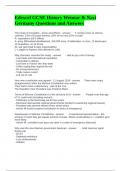
Edexcel GCSE History Weimar & Nazi Germany Questions and Answers

Bewertung
-
Verkauft
-
seiten
14
Klasse
A+
Hochgeladen auf
02-05-2025
geschrieben in
2024/2025

Edexcel GCSE History Weimar & Nazi Germany Questions and Answers The treaty of Versailles - terms and effects T- territory (lost 11 African colonies, 13% of Europe territory, 50% of iron and 15% of coal) R- reparations (£6.6 billion) A- army (Rhineland demilitarised, 100,000 army, 6 battleships, 6 crisis, 12 destroyers, 12 torpedoes, no air force) W- war guilt (had to take responsibility) L- League to Nations (Not allowed in LoN) Why Germans resented the treaty - Had to pay a lot of money - Lost trade and international reputation - Vulnerable to attacks - Lost land to France who they beat - Unfair saying they started the war - No money/resources - Trade routes ruined - Left out of LoN How new constitution was agreed - 11 August 1919 There were many disagreements when the Weimar Constitution was written They had to have a democracy - part of the ToV The Republic's first President was Friedrich Ebert Terms of Weimar Constitution (i.e the structure of it) - People over that age of 21 could vote (including women) - Politicians in the Reichstag sat for four years - Reichsrat represented regional governments (limited to examining regional issues) - President was elected elected every seven years - Article 48 (could suspend constitution in times of emergency) Weaknesses of Weimar Constitution - Proportional representation - the amount of votes they get equals amount of seats. Allows small parties in = coalition govt more likely - Article 48 - president can pass any laws in a state of emergency (decrees) Why was the new Weimar government bankrupt - Gold reserves spent during war - £6.6 b - Depleted workforce - Less professionals - Inflation What happened during the French Occupation of the Ruhr 1923 - French wanted Germany to pay reparations but they couldn't because they were so expensive. - French and Belgian troops invaded the Ruhr and took over the factories and coal mines - Germany's army was limited and so they could not retaliate - German workers refused to work (passive resistance) and this lifted morale for the general public. - By not working it ruined economy because they were getting no produce but still paying the workers. What the effects of Hyperinflation - By October 1923 currency was worthless - People were paid daily - Restaurants didn't print prices on menus as they changed so quickly - Cheaper to burn banknotes than buy coal. Who Inflation and hyperinflation affected Old people - Saved money was worth nothing Lower Class - Not affected / closer to middle class Middle Class - Savings worth noting / change in class Upper Class - Richest still had land and that were expensive / saving worth nothing What were the political groups in Weimar Republic The Social Democratic Party had a lot of support because it was a mix between the left and right KDP - Communist party DAP - Germany workers' party (early Nazi party) Talk about the events of the Spartacists Revolution - 6th January 1919 - Tried to bring in communism and overthrow the government - Rosa Luxemburg / Karl Liebknecht / 100,000 communists - Charged Berlin and took key buildings - 4000 Freikorp were sent to sort out communists (which made Weimar govt look weak) - Rebels murdered / leaders killed / government back to 'normal' Talk about the events of The Kapp Putsch (right wing) - Take over government / Abolish ToV / Take land back from ToV - Dr. Wolfgang Kapp / Freikorps (armed and trained fighters) - 5000 marched on Berlin / government fled - Government told workers to stop, Berlin went bust, new government fell through and Kapp fled to Sweden Stresemann's reforms to currency crisis Currency abolished and Rentenmark was brought in and it was run by the Reichsbank (independent international bank). The Rentenmark was soon renamed the Reichsmark. Reducing reparations - What was the Dawes Plan 1924 - Cycle of prosperity / everyone can recover - Everyone was reliant on the USA(Germany - France,GB and the USA!) The reparations were temporarily reduced to £50 million. -US banks agreed to loan $25 billion between to the German Industry -The Passive Resistance was called off and the French left the Ruhr. Reducing reparations - What was the Young Plan -1929 - Reparations were dropped to £2 billion (£50 mil and year - 59 extra years to pay (Hitler 'passing on the penalty to the unborn') - Germany could lower taxes What were the terms of the Locarno Pact -1925 - French troops left Rhineland - France promised peace - LoN talks began - Some Germans thought that the Germans were accepting the borders laid out in the ToV What were the terms of the Kellogg-Briand pact -1928 - Meant that war would not be used to achieve foreign policy aims - Germany became a respectable member of the international community - Some Germans regained confidence in the Weimar Constitution - Troubled years over - When Stresemann died all of his expertise and moderation was a severe blow to the Weimar Republic What were the effects or terms of the League of Nations -1926 - Germany were allowed onto the 'League of Nations Council' (League was made from ToV - accepting the ToV?) - International relations got better What happened during the cultural development in Weimar Germany There was an explosion in arts and literature: (- New Objectivism - The idea that the Arts should not show a romantic view of the world, but should show life as it really is, including poverty and squalor. - Modernism - The idea that the Arts should not always link to the past but instead embrace the future. - Expressionism - The idea that the Arts should reflect the thoughts of the artist rather than being limited to showing things exactly as they look.) Expressionism was popular earlier and towards the start of the Weimar Republic but by 1920, the society had taken a sharp turn towards new objectivism. This tended to reflect the harsh disaster of war. (ART) The most influential visual art movements in Weimar was at the Bauhaus School founded by Walter Gropius in 1919, their ideas challenged traditional styles that had been popular before the war. (ARCHITECTURE) Films had become popular all over the world in the 1920s. An expressionist style became popular in films especially as there were more relaxed rules in Weimar. They often had unrealistic sets and exaggerated acting techniques. Expressionist film-makers favoured darker storylines and themes, including horror and crime. The first horror film was ' The cabinet of Dr. Caligari'. (FILM) The causes of the Great Depression in Germany - The Wall Street Crash was the main reason for the Great Depression- Share prices were on a constant up and people worries that they would soon fall - This meant that people worried and rushed to sell their shares - People kept in selling their shares because their value dropped -American banks reclaimed their loans they had lent to German banks and they recalled their loans to German businesses and this mean that factories closed and people lost their jobs The effects of the Great Depression in Germany - Banks suffered huge losses in the Wall Street Crash - German businesses and factories were forced to close - Many German workers lost their jobs - Unemployment benefits dropped - Higher taxes - People fell through the class system - 17 million people were claiming unemployment benefits Hitler's youth in Austria His father beat him Incestuous relationship His father dies from a heart attack Was rejected from art school His mother died What happened during Hitler's move to Germany and service in the First World War - He was influenced by people in the streets / They blamed the Jews for everything - Was homeless for a period / Grew up around a lot of cultures and religions - At the age of 21 he got his inheritance and joined the Bavarian Army - He won the Iron Cross First Class and the prestigious Iron Cross Second Class during World War 1 - He were injured in a Mustard Gas attack and we in hospital for the end of the war - When he heard the news that Germany had surrendered he was extremely angry because he, like other German soldiers, did not feel defeated What was Hitler's first political activity - After the war he worked as a spy for the German Government - His job was to investigate political parties - When spying on the DAP he liked their policies and joined What was the German Workers' Party (DAP) when Hitler joined It was lead by Anton Drexler and when Hitler went to two meetings there were only 23 people there first and 40 there the second time.When he joined he was only the 17th member. The early Nazi Party, its aim and early features, including the SA - Demanded that large industries share profits with workers or nationalise industries - Immigration for non - Germans was to be stopped immediately - No Jew can be a citizen of Germany - All German speakers should be united to from a Greater Germany - Improvement to Old Age Pensions - Only German citizens have the right to vote - Demanded land for the growing population by expanding Germany across new territories known as LEBENSRAUM - As political armies were allowed Hitler created the SA / They were just a group of thugs and only cared about getting revenge on the Weimar Republic - Treaty of Versailles will be scrapped and a strong Germany will be formed - Government control of newspapers - Strong central Government for the Reich to put the new programme in effect What were the Nazi policies called? The 25 point programme. Munich Putsch - Causes - The Nazi party had 50,000 member and was stronger than ever - Weimar Republic was in a crisis and about to collapse - Every nationalist was against the government after they called off a general strike - Hitler had a huge army of Stormtroopers and had to give them something or he would lose control - 'Stab in the back' myth, Germany lost the war and the soldiers and public felt betrayed by the signers who they believed to be Jews and socialists - Hyperinflation, there was increased support for extreme parties as the economy was failing - Hitler thought that he had more support than he actually did - Mussolini's March Rome, Mussolini's right wing party (the Fascists) marched on Rome in 1922 and forced the democratic government to accept him as their leader - Resentment of the Weimar Government - Loss of German colonies and reparations Munich Putsch - Events - 8 November 1923 Hitler and 600 Stormtroopers charged into a Beer Hall and forced , Seisser and Lossow to join the Rebellion or demanded that they support him (brandished a gun) - Rohm took over local police and army headquarters - Ludendorff released the leaders when Hitler left - The next day they hit the streets of Munich, they thought it would be a triumphant day where they march to power - Hitler continued with the revolt and had the support of 1,000 SA and 2,000 paid (with stolen money) supporters - Hitler wrongly thought that he would gain support from locals but many remained indifferent and the army remained loyal to the government - Hitler and Ludendorff met the police at the main square - Somebody opened fire and Graf, Hitler' bodyguard protected Hitler and died from half dozen bullets - 4 police men died and 14-16 Nazis died - Most rebels ran away and took refuge in a girls school - Ludendorff, Rohm and Streicher were arrested, Goering was hidden by supporters and went into hiding abroad - Hitler fled in a car and hid in a friend's house but was arrested two days later Munich Putsch - Results (failure and success) Failure - The Nazi Party was banned and Hitler was prevented from speaking in public until 1927 - Hitler was sent to prison for 5 years - He made himself look disloyal - Rohm,Ludendorff and Streicher were arrested - Showed lack of organisation and support for the party Success - Gave Hitler a chance to reorder the Nazi Party - He realised that they could not come to power through force - Hitler used his trial as a propaganda exercise - Press coverage of trial raised profile of the Nazi party to a national level - Hitler was released after 9 months and the ban on his party was lifted in Feb 1925 - Hitler was given a lenient sentence which showed that he support from some people in authority The beliefs/ideas or aims of the Nazi Party after 1924 - Economic - Values - Sufficient on itself or depend on other countries - German people - Races - Leader - Nationalism, socialism and totalitarianism - Traditional German values, struggle and 'racial purity' - German self sufficient / not dependent on imports (AUTARKY) - Purifying German race - Expanding Germany's borders - Control big businesses - Strong family values - Run economy in national interest - All all German people to live together - Believed that other races from places like Eastern Europe (like Slavs), Asia and from Africa were inferior races - Führerprinzip- total loyalty to the leader / every aspect of society to benefit the German people - Clear male and female values What was the Bamberg 1926 Conference and what did it mean for the Nazi Party? - Bamberg Conference 1926 - Hitler organised this conference to address the split between the socialist ad nationalist wings of the Nazi Movement. Nazis in the NORTH (led by Gregor Strasser) were eager to implement the SOCIALIST values but the SOUTHERN sector were more interested in the NATIONALIST values. Hitler reaffirmed that the 25 point programme along with the socialist ideas is the party's platform. Any ideas that could be seen as communist would not be pursued. How Hitler improved organisation and finance of the NSDAP -Philipp Bouhler - Secretary -Franz Schwartz - Treasurer -Divided party into regions / run party across the country -Befriended Germany's most wealthy businessmen / promised to abolish trade unions -Received donations from giants of German industry - Thyssen/Krapp/Bosch The growth of the SA and the start of the SS- what were the effects and - Income helped expand the SA / by 1930 it had 400,000 members - Hitler did not trust the SA / developed a dangerous loyalty to Ernst Röhm - commander / thugs - hard to control - 1925 - New party security group - Schutzstufe (protections squad) / SS- Chauffeur/Bodyguard (Julius Schreck) then Heinrich Himmler (loyal supporter) - The SS became famous and feared (black uniforms 1932) Joseph Goebbels and Nazi propaganda - what was used - Scapegoat // Jews, communists and ToV signers (Armistice)- Speeches in 120 daily/weekly newspapers // 100,000s readers - Aeroplanes - Public eye - Radio, films and gramophone records (New tech) - Clear image for the party Why were there weak Nazi results in national elections 1924-29 - Germany was doing very well under Stresemann and nearly all of Hitler's ideas suited an extreme situation -'However it gave time to reforms and the Nazi came back stronger than ever How much the support for the Nazis grew, 1929-32 July 1932 - the Nazis had 230 seats and were the biggest in the Reichstag November 1932 - Nazis196 seats / Social Democrats 121 / Communists 100 Why support for the Nazis grew, 1929-32 Wall Street Crash - People lost money, jobs and houses / would provide them with jobs - Extreme situation - Weimar Government failed - unable to tackle unemployment Why support for the Nazis grew, 1929-32 Hitler's appeal - Strong leader - Unite country - Restore social unrest - Scrap ToV - Treat Germany fairly - Controls SA well Why support for the Nazis grew, 1929-32 The Role of the SA - Seems strong, organised, disciplined and reliable - Control urest - Stand up to foreign powers- Feelings of hope - Disrupt opposition parties - Intimidate voters - Disrupt opposition rallies Why the middle class supported Hitler - recover companies, saving and pensions - protection against the communists Why the farmers supported Hitler - self sufficient Germany - protection against the communists - Jewish land confiscated - gain sales Why big businesses supported Hitler - keep business private - funded Nazi party / trusted each other Why young people supported Hitler - passionate speeches - ambitions for the future- atmosphere at speeches Why women supported Hitler - voting was good for families and the country - want their children to have a good future Why the working classes supported Hitler - traditional German values - strong Germany- 'work and bread' posters - 'German Workers Party' Hitler standing for election as president - results during the months April and March March- Hindenburg 18m / Thalmann 5m / Hitler 11m April - Hindenburg 19.36m / Thalmann 3.7m / Hitler 13.4m A series of chancellors falling from power 1932 - who were they, why did they resign and what happened - 1932 -Bruning was Chancellor but resigned due to a lack of support - May 1932- Von Papen was made Chancellor in May and was the leader of the right wing coalition - November 1932- Further election. Von Schleicher warns Hindenburg that if Von Papen stays there will be a civil war. Von Papen is forced to resign. - December 1932 Von Schleicher becomes Chancellor and tries to split the Nazis up by asking Gregor Strasser to be his Vice-Chancellor, Hitler forced to him decline -Von Papen went to Hindenburg saying Von Papen and Hitler were conspiring against him and that he wanted to lead a military dictatorship / Hindenburg said no and he resigned - January 1933- Von Papen tells Hindenburg that he should appoint Hitler as Chancellor and him as Vice-Chancellor. This will allow them to control what Hitler does. - January 1933- Hitler is legally appointed Chancellor How did Hitler become chancellor in January 1933 - Von Papen said that Hindenburg should make Hitler chancellor so he could get rid of the communists - Hitler would be 'in his pocket' if Von Papen was made the Vice Chancellor - Hindenburg agreed and said ''it is my unpleasant duty to appoint this fellow Hitler as Chancellor'' - Got to power legally and democratically The Reichstag fire and the election of March 1933 - what happened and what did this result in -27/02/33 it was set alight -Hitler consolidated power - imprison communist leaders (during the campaign) / allowed Nazis to say Germany was under threat from communism-Courts did not convict communist leaders (only van de Lube) so replaced them with 'Nazi People's Courts' The enabling act, the banning of political parties and trade unions- March 1933 More effects and what happened - Allowed Hitler to make laws without the involvement of the Reichstag - SA pressured people to vote Nazi / detain people without trial / seize property / ban trade unions / kill communists / force immigrants to leave - Opened concentration camps

Mehr anzeigen Weniger lesen
Hochschule
EDEXCEL
Kurs
EDEXCEL


Ups! Dein Dokument kann gerade nicht geladen werden. Versuch es erneut oder kontaktiere den Support.

Schule, Studium & Fach

Hochschule
EDEXCEL
Kurs
EDEXCEL

Dokument Information

Hochgeladen auf
2. mai 2025
Anzahl der Seiten
14
geschrieben in
2024/2025
Typ
Prüfung
Enthält
Fragen & Antworten

Themen

Inhaltsvorschau

Edexcel GCSE History Weimar & Nazi
Germany Questions and Answers
The treaty of Versailles - terms and effects - answer T- territory (lost 11 African
colonies, 13% of Europe territory, 50% of iron and 15% of coal)
R- reparations (£6.6 billion)
A- army (Rhineland demilitarised, 100,000 army, 6 battleships, 6 crisis, 12 destroyers,
12 torpedoes, no air force)
W- war guilt (had to take responsibility)
L- League to Nations (Not allowed in LoN)

Why Germans resented the treaty - answer - Had to pay a lot of money
- Lost trade and international reputation
- Vulnerable to attacks
- Lost land to France who they beat
- Unfair saying they started the war
- No money/resources
- Trade routes ruined
- Left out of LoN

How new constitution was agreed - 11 August 1919 - answer There were many
disagreements when the Weimar Constitution was written
They had to have a democracy - part of the ToV
The Republic's first President was Friedrich Ebert

Terms of Weimar Constitution (i.e the structure of it) - answer - People over that age
of 21 could vote (including women)
- Politicians in the Reichstag sat for four years
- Reichsrat represented regional governments (limited to examining regional issues)
- President was elected elected every seven years
- Article 48 (could suspend constitution in times of emergency)

Weaknesses of Weimar Constitution - answer - Proportional representation - the
amount of votes they get equals amount of seats. Allows small parties in = coalition govt
more likely
- Article 48 - president can pass any laws in a state of emergency (decrees)

Why was the new Weimar government bankrupt - answer - Gold reserves spent
during war
- £6.6 b
- Depleted workforce
- Less professionals
- Inflation

, What happened during the French Occupation of the Ruhr 1923 - answer - French
wanted Germany to pay reparations but they couldn't because they were so expensive.
- French and Belgian troops invaded the Ruhr and took over the factories and coal
mines
- Germany's army was limited and so they could not retaliate
- German workers refused to work (passive resistance) and this lifted morale for the
general public.
- By not working it ruined economy because they were getting no produce but still
paying the workers.

What the effects of Hyperinflation - answer - By October 1923 currency was
worthless
- People were paid daily
- Restaurants didn't print prices on menus as they changed so quickly
- Cheaper to burn banknotes than buy coal.

Who Inflation and hyperinflation affected - answer Old people - Saved money was
worth nothing
Lower Class - Not affected / closer to middle class
Middle Class - Savings worth noting / change in class
Upper Class - Richest still had land and that were expensive / saving worth nothing

What were the political groups in Weimar Republic - answer The Social Democratic
Party had a lot of support because it was a mix between the left and right
KDP - Communist party
DAP - Germany workers' party (early Nazi party)

Talk about the events of the Spartacists Revolution - answer - 6th January 1919
- Tried to bring in communism and overthrow the government
- Rosa Luxemburg / Karl Liebknecht / 100,000 communists
- Charged Berlin and took key buildings
- 4000 Freikorp were sent to sort out communists (which made Weimar govt look weak)
- Rebels murdered / leaders killed / government back to 'normal'

Talk about the events of The Kapp Putsch (right wing) - answer - Take over
government / Abolish ToV / Take land back from ToV
- Dr. Wolfgang Kapp / Freikorps (armed and trained fighters)
- 5000 marched on Berlin / government fled
- Government told workers to stop, Berlin went bust, new government fell through and
Kapp fled to Sweden

Stresemann's reforms to currency crisis - answer Currency abolished and
Rentenmark was brought in and it was run by the Reichsbank (independent
international bank). The Rentenmark was soon renamed the Reichsmark.

14,14 €
Vollständigen Zugriff auf das Dokument erhalten:

100% Zufriedenheitsgarantie
Sofort verfügbar nach Zahlung
Sowohl online als auch als PDF
Du bist an nichts gebunden


Ebenfalls erhältlich im paket-deal

Lerne den Verkäufer kennen

Seller avatar
Bewertungen des Ansehens basieren auf der Anzahl der Dokumente, die ein Verkäufer gegen eine Gebühr verkauft hat, und den Bewertungen, die er für diese Dokumente erhalten hat. Es gibt drei Stufen: Bronze, Silber und Gold. Je besser das Ansehen eines Verkäufers ist, desto mehr kannst du dich auf die Qualität der Arbeiten verlassen.
Pogba119 Harvard University
Folgen Sie müssen sich einloggen, um Studenten oder Kursen zu folgen.
Verkauft
48
Mitglied seit
1 Jahren
Anzahl der Follower
2
Dokumente
4845
Zuletzt verkauft
3 Jahren vor
NURSING TEST

BEST EDUCATIONAL RESOURCES FOR STUDENTS

3,9

9 rezensionen

5
4
4
2
3
2
2
0
1
1

Kürzlich von dir angesehen.

Warum sich Studierende für Stuvia entscheiden

on Mitstudent*innen erstellt, durch Bewertungen verifiziert

Geschrieben von Student*innen, die bestanden haben und bewertet von anderen, die diese Studiendokumente verwendet haben.

Nicht zufrieden? Wähle ein anderes Dokument

Kein Problem! Du kannst direkt ein anderes Dokument wählen, das besser zu dem passt, was du suchst.

Bezahle wie du möchtest, fange sofort an zu lernen

Kein Abonnement, keine Verpflichtungen. Bezahle wie gewohnt per Kreditkarte oder Sofort und lade dein PDF-Dokument sofort herunter.

Student with book image

“Gekauft, heruntergeladen und bestanden. So einfach kann es sein.”

Alisha Student

Häufig gestellte Fragen