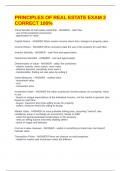
PRINCIPLES OF REAL ESTATE EXAM 2
CORRECT 100%
Three benefits of real estate ownership - ANSWER - cash flow
- use (of the property)/ possession
- appreciation in value
Capital Return - ANSWER When owners receive return from changes in property value
Income Return - ANSWER When investors trade the use of the property for cash flow
Investor Benefits - ANSWER - cash flow and appreciation
Owner/User Benefits - ANSWER - Use and appreciation
Determinants of Value - ANSWER - utility: the usefulness
- relative scarcity: more scarce, more value
- effective demand: somebody must want it
- transferability: finding out real value by selling it
Value Measures - ANSWER - market value
- investment value
- cost
- transaction price
Investment Value - ANSWER the value a particular investor places on a property; value
in use
- based on unique expectations of the individual investor, not the market in general; also
based on cash flow
- buyers: maximum they'd be willing to pay for property
- sellers: minimum they'd be willing to accept
Market Value - ANSWER Its most probable selling price, assuming "normal" sale
conditions; value in exchange (in economics); based on EBIT
- value the typical participant would place on the property
- rests on willing buyers and freely bidding sellers
- result of supply and demand
Cost as a value measure - ANSWER - useful is something is brand new, but doesn't
indicate value
Transaction Prices - ANSWER Prices we observe on sold properties
- related to market and investment value but different
,- observed only when the investment value of the buyer exceeds the investment value
of the seller; used to estimate the market value
Principles of Change and Anticipation - ANSWER - those who anticipate/forecast
changes better get more value
- things will change, try to look ahead
Principle of Contribution - ANSWER - parts contribute to the whole; appraisers dissect
property into characteristics
- examples: best investment per dollar invested=paint, soap, and water=adds value;
renovating kitchens or bathrooms=adds higher value
Principle of Substitution - ANSWER - properties substitute for one another
- similar to competition
- paying more/less for a similar property
Principle of Scale/Balance - ANSWER - Example: don't buy a $100k lot for a mobile
home but rather a $300k home instead
- applies to commercial as well
Principle of Conformity - ANSWER - too much is bad (ex: all houses looking the same in
a neighborhood)
- zoning laws is a good example of this being a good thing
Principle of Supply and Demand - ANSWER - recognize huge price drops
- value can change rapidly
The Appraisal Process - ANSWER - all states and federal regulatory agencies are
required to follow Uniform Standards of Professional Appraisal Practice (USPAP)
- steps: 1) identify the appraisal problem; 2) determine the required scope of work; 3)
collect data and describe property; 4) data analysis; 5) determine value of land; 6) apply
three approaches to valuation; 7) reconcile indicated values from three approaches; 8)
report final value estimate
Step 1: Identifying the problem - ANSWER Appraiser must discuss the:
- intended use of the appraisal
- the purpose of the assignment (type of value to be estimated)
- effective date of valuation
- relevant characteristics of the property
- any important assumptions, conditions, or limitations of the appraisal assignment;
assignments focus on estimating the current market value of a property under the
assumptions the owner will hold full title to the property (i.e. fee simple)
Step 8: Report Final Value Estimate - ANSWER - report writing is one of the most
important functions appraisers perform
, - two types: appraisal report and the restricted appraisal report; third option is form
report
- appraisal reports: long, detailed, narrative like, and used mainly in income-producing
properties; most common report is Uniform Residential Appraisal Report Form 1004
- form reports: short, efficient, convenient, generally required by mortgage lenders when
households are purchasing or refinancing single-family homes
- restricted appraisal report: minimal discussion, lots of references to internal file docs
Traditional Sales Comparison Approach (aka: Market Data Approach) - ANSWER -
general method used for all types of properties and involves comparing the subject
property with comps that have recently sold
- based on the principle of substitution (substituting for similar comp properties)
- if the information (which comes from the market) is available, this is the best approach
- subject property value is estimated by appraisers making explicit adjustments to sales
prices of comp properties (because no two properties are identical); sales prices of
comps are reconciled to a single indicated value that becomes the value of the subject
property
- works best with frequently traded properties, such as houses, condos, and land
- steps: identify elements of comparison value adjustment, select comp sales (typically
5), adjust comp sales to approximate subject, reconcile adjusted prices to obtain
indicated value of subject
- identifying truly comparable properties is subjective and an art more than a science
- important characteristic of sales comps are the "arm's length transactions"; ensures
fairly negotiation has occurred under typical market conditions (i.e. not buying property
from family)
- large number of comps is desirable (typically 5)
- sources of info on subject and comp properties include public records, (info on deeds,
sales prices, property taxes, etc.), multiple listing services, and private companies
- transaction adjustments: property rights conveyed, financing terms, conditions of sale,
expenditures made immediately after purchase, market conditions; applied in this order
- property adjustments: location, physical and economic characteristics, use, and non-
realty items (personal property); applied after transaction adjustments but in no
particular order
- adjustments can either be in dollars or percentages; (pg. 175) gives the sequence
Cost Approach - ANSWER - the weakest approach (used when other two approaches
don't work)
- When the total cost to construct a property is less than its expected market value upon
completion, developers have an incentive to build additional competing properties,
which tends to reduce market values.
- When the cost to produce a property exceeds its expected market value, developers
have the incentive to stop or slow construction, which tends to increase the market
value of competing properties.
- based on economic principle of substitution and assumes market value of a new
building is similar to the cost of constructing it today
CORRECT 100%
Three benefits of real estate ownership - ANSWER - cash flow
- use (of the property)/ possession
- appreciation in value
Capital Return - ANSWER When owners receive return from changes in property value
Income Return - ANSWER When investors trade the use of the property for cash flow
Investor Benefits - ANSWER - cash flow and appreciation
Owner/User Benefits - ANSWER - Use and appreciation
Determinants of Value - ANSWER - utility: the usefulness
- relative scarcity: more scarce, more value
- effective demand: somebody must want it
- transferability: finding out real value by selling it
Value Measures - ANSWER - market value
- investment value
- cost
- transaction price
Investment Value - ANSWER the value a particular investor places on a property; value
in use
- based on unique expectations of the individual investor, not the market in general; also
based on cash flow
- buyers: maximum they'd be willing to pay for property
- sellers: minimum they'd be willing to accept
Market Value - ANSWER Its most probable selling price, assuming "normal" sale
conditions; value in exchange (in economics); based on EBIT
- value the typical participant would place on the property
- rests on willing buyers and freely bidding sellers
- result of supply and demand
Cost as a value measure - ANSWER - useful is something is brand new, but doesn't
indicate value
Transaction Prices - ANSWER Prices we observe on sold properties
- related to market and investment value but different
,- observed only when the investment value of the buyer exceeds the investment value
of the seller; used to estimate the market value
Principles of Change and Anticipation - ANSWER - those who anticipate/forecast
changes better get more value
- things will change, try to look ahead
Principle of Contribution - ANSWER - parts contribute to the whole; appraisers dissect
property into characteristics
- examples: best investment per dollar invested=paint, soap, and water=adds value;
renovating kitchens or bathrooms=adds higher value
Principle of Substitution - ANSWER - properties substitute for one another
- similar to competition
- paying more/less for a similar property
Principle of Scale/Balance - ANSWER - Example: don't buy a $100k lot for a mobile
home but rather a $300k home instead
- applies to commercial as well
Principle of Conformity - ANSWER - too much is bad (ex: all houses looking the same in
a neighborhood)
- zoning laws is a good example of this being a good thing
Principle of Supply and Demand - ANSWER - recognize huge price drops
- value can change rapidly
The Appraisal Process - ANSWER - all states and federal regulatory agencies are
required to follow Uniform Standards of Professional Appraisal Practice (USPAP)
- steps: 1) identify the appraisal problem; 2) determine the required scope of work; 3)
collect data and describe property; 4) data analysis; 5) determine value of land; 6) apply
three approaches to valuation; 7) reconcile indicated values from three approaches; 8)
report final value estimate
Step 1: Identifying the problem - ANSWER Appraiser must discuss the:
- intended use of the appraisal
- the purpose of the assignment (type of value to be estimated)
- effective date of valuation
- relevant characteristics of the property
- any important assumptions, conditions, or limitations of the appraisal assignment;
assignments focus on estimating the current market value of a property under the
assumptions the owner will hold full title to the property (i.e. fee simple)
Step 8: Report Final Value Estimate - ANSWER - report writing is one of the most
important functions appraisers perform
, - two types: appraisal report and the restricted appraisal report; third option is form
report
- appraisal reports: long, detailed, narrative like, and used mainly in income-producing
properties; most common report is Uniform Residential Appraisal Report Form 1004
- form reports: short, efficient, convenient, generally required by mortgage lenders when
households are purchasing or refinancing single-family homes
- restricted appraisal report: minimal discussion, lots of references to internal file docs
Traditional Sales Comparison Approach (aka: Market Data Approach) - ANSWER -
general method used for all types of properties and involves comparing the subject
property with comps that have recently sold
- based on the principle of substitution (substituting for similar comp properties)
- if the information (which comes from the market) is available, this is the best approach
- subject property value is estimated by appraisers making explicit adjustments to sales
prices of comp properties (because no two properties are identical); sales prices of
comps are reconciled to a single indicated value that becomes the value of the subject
property
- works best with frequently traded properties, such as houses, condos, and land
- steps: identify elements of comparison value adjustment, select comp sales (typically
5), adjust comp sales to approximate subject, reconcile adjusted prices to obtain
indicated value of subject
- identifying truly comparable properties is subjective and an art more than a science
- important characteristic of sales comps are the "arm's length transactions"; ensures
fairly negotiation has occurred under typical market conditions (i.e. not buying property
from family)
- large number of comps is desirable (typically 5)
- sources of info on subject and comp properties include public records, (info on deeds,
sales prices, property taxes, etc.), multiple listing services, and private companies
- transaction adjustments: property rights conveyed, financing terms, conditions of sale,
expenditures made immediately after purchase, market conditions; applied in this order
- property adjustments: location, physical and economic characteristics, use, and non-
realty items (personal property); applied after transaction adjustments but in no
particular order
- adjustments can either be in dollars or percentages; (pg. 175) gives the sequence
Cost Approach - ANSWER - the weakest approach (used when other two approaches
don't work)
- When the total cost to construct a property is less than its expected market value upon
completion, developers have an incentive to build additional competing properties,
which tends to reduce market values.
- When the cost to produce a property exceeds its expected market value, developers
have the incentive to stop or slow construction, which tends to increase the market
value of competing properties.
- based on economic principle of substitution and assumes market value of a new
building is similar to the cost of constructing it today