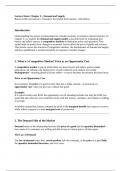
Lecture Notes: Chapter 3 – Demand and Supply
Based on Microeconomics: Canada in the Global Environment, 11th Edition
Introduction
Understanding how prices are determined in a market economy is central to microeconomics. In
Chapter 3, we explore the demand and supply model, a powerful tool for explaining how
buyers and sellers interact in competitive markets to determine prices and quantities. This
model helps us predict how changes in economic factors affect the price of goods and services.
This lecture covers the structure of competitive markets, the determinants of demand and supply,
and how equilibrium is reached and shifts in response to market changes.
1. What is a Competitive Market? Price as an Opportunity Cost
A competitive market is one in which there are many buyers and sellers, and no single
participant can influence the market price. Goods traded in such markets are usually
homogeneous—meaning identical across sellers—so price becomes the primary decision factor.
Price as an Opportunity Cost
In economics, the price of a good is more than just a dollar amount—it represents an
opportunity cost: what you give up to obtain that good.
Example:
If a concert ticket costs $100, the opportunity cost of attending includes not only the $100 you
spend but also what else you could have done with that money—perhaps a nice dinner or adding
to savings.
In market transactions, buyers compare the price to the marginal benefit they expect to receive,
while sellers compare it to their marginal cost of production.
2. The Demand Side of the Market
Demand refers to the relationship between the price of a good and the quantity demanded—
how much of it consumers are willing and able to buy at various prices, all else equal.
The Law of Demand
The law of demand states that, ceteris paribus (all else constant), as the price of a good falls,
the quantity demanded increases, and vice versa.
, Graph Description:
X-axis: Quantity demanded
Y-axis: Price of the good
The demand curve slopes downward, reflecting the inverse relationship between price
and quantity demanded.
Example:
If the price of coffee drops from $4 to $3, more people may decide to buy a cup, increasing the
quantity demanded.
Why the Demand Curve Slopes Downward
Substitution Effect: When the price of a good falls, it becomes relatively cheaper
compared to substitutes, so consumers switch to it.
Income Effect: A lower price increases consumers' real purchasing power, allowing
them to buy more.
Influences on Demand (Determinants of Demand)
A change in these non-price factors shifts the entire demand curve left or right:
1. Prices of related goods
o Substitutes: If the price of tea rises, demand for coffee may increase.
o Complements: If the price of cream falls, coffee demand may rise.
2. Income
o Normal goods: Demand increases with income (e.g., organic food).
o Inferior goods: Demand decreases with income (e.g., instant noodles).
3. Expectations
o If consumers expect prices to rise in the future, they may buy more now.
4. Population
o A growing population increases market demand.
5. Preferences
o Changes in tastes due to trends, advertising, or health awareness shift demand.
Example:
A sudden health report linking red meat to heart disease might reduce the demand for beef,
shifting the demand curve leftward.
3. The Supply Side of the Market
Based on Microeconomics: Canada in the Global Environment, 11th Edition
Introduction
Understanding how prices are determined in a market economy is central to microeconomics. In
Chapter 3, we explore the demand and supply model, a powerful tool for explaining how
buyers and sellers interact in competitive markets to determine prices and quantities. This
model helps us predict how changes in economic factors affect the price of goods and services.
This lecture covers the structure of competitive markets, the determinants of demand and supply,
and how equilibrium is reached and shifts in response to market changes.
1. What is a Competitive Market? Price as an Opportunity Cost
A competitive market is one in which there are many buyers and sellers, and no single
participant can influence the market price. Goods traded in such markets are usually
homogeneous—meaning identical across sellers—so price becomes the primary decision factor.
Price as an Opportunity Cost
In economics, the price of a good is more than just a dollar amount—it represents an
opportunity cost: what you give up to obtain that good.
Example:
If a concert ticket costs $100, the opportunity cost of attending includes not only the $100 you
spend but also what else you could have done with that money—perhaps a nice dinner or adding
to savings.
In market transactions, buyers compare the price to the marginal benefit they expect to receive,
while sellers compare it to their marginal cost of production.
2. The Demand Side of the Market
Demand refers to the relationship between the price of a good and the quantity demanded—
how much of it consumers are willing and able to buy at various prices, all else equal.
The Law of Demand
The law of demand states that, ceteris paribus (all else constant), as the price of a good falls,
the quantity demanded increases, and vice versa.
, Graph Description:
X-axis: Quantity demanded
Y-axis: Price of the good
The demand curve slopes downward, reflecting the inverse relationship between price
and quantity demanded.
Example:
If the price of coffee drops from $4 to $3, more people may decide to buy a cup, increasing the
quantity demanded.
Why the Demand Curve Slopes Downward
Substitution Effect: When the price of a good falls, it becomes relatively cheaper
compared to substitutes, so consumers switch to it.
Income Effect: A lower price increases consumers' real purchasing power, allowing
them to buy more.
Influences on Demand (Determinants of Demand)
A change in these non-price factors shifts the entire demand curve left or right:
1. Prices of related goods
o Substitutes: If the price of tea rises, demand for coffee may increase.
o Complements: If the price of cream falls, coffee demand may rise.
2. Income
o Normal goods: Demand increases with income (e.g., organic food).
o Inferior goods: Demand decreases with income (e.g., instant noodles).
3. Expectations
o If consumers expect prices to rise in the future, they may buy more now.
4. Population
o A growing population increases market demand.
5. Preferences
o Changes in tastes due to trends, advertising, or health awareness shift demand.
Example:
A sudden health report linking red meat to heart disease might reduce the demand for beef,
shifting the demand curve leftward.
3. The Supply Side of the Market