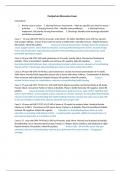
Physics Grade 10 Term 2
By Sherbhai
1. Matter and Material
● Matter- Anything that has mass & takes up space
○ It can be classified as a mixture of pure substances
○ Made up of small particles of atoms of the periodic table. These determine the
properties & reactivity of the substance
Mixtures
Combination of 2 or more substances that maintain their physical form
● Homogenous- Have uniform composition & one can’t visually distinguish components of
the mixture. All components are in the same state. Eg alloys
● Heterogeneous- Don’t have uniform composition & components can be visually
distinguished. Components are not in the same state. Eg Cereal
○ Separation of Mixtures- Magnetism, Boiling Point & Solubility
● Properties of a mixture
○ Not in a fixed ratio
○ Components keep their properties
Components can be separated by physical means
Pure Substances
Substances with 1 type of constituent particle
● Consists of only 1 type of substance and can’t be separated physically.
● Elements and compounds are pure substances (eg. copper, gold, oxygen & iron)
Elements and Compounds
● Elements are pure substances that can’t be broken down into simpler substances. They
consist of atoms
● Compounds are made of 2 or more elements and can be broken down (by chemical means)
into the elements making up the compounds
Elements are made of
● Metals- 91
● Metalloids (semimetals)- 7
● Non Metals- around 17
, Electrical conductivity of elements
○ The conductivity of metals decreases as temperature increases
○ The conductivity of metalloids increases as temperature increases
● Insulators
○ Metals have electrons available to allow electrical conductivity but non-metals do
not have available electrons
Compounds
Compounds are named according to the elements making up the compound & we use formulae to
represent it. Eg
● HCl- Hydrochloric acid
● CO2- Carbon dioxide
● H2O2 -Hydrogen peroxide
● H2SO4- Sulphuric Acid
● CH4- Methane
2. State of Matter & Kinetic Molecular Theory
States & their properties
Solid Liquid Gases
Consists of small particles Consists of small particles Consists of small particles
Only vibrate Move randomly but restricted Move freely
Tiny spaces which explains why it can’t It has slightly larger spaces than solids so Huge spaces so it can be
be compressed it can be compressed slightly compressed
Strong attractive forces resulting in a Attractive forces are reasonably strong. Particles move freely because there
fixed shape Particles stay together but can slide over is a minimal attractive force
each other, allowing liquid to flow
Vibrate only within the crystal lattice Collisions occur causing pressure Collisions occur causing pressure
Diffusion takes place within 2 liquids Diffusion takes place within 2 gases
By Sherbhai
1. Matter and Material
● Matter- Anything that has mass & takes up space
○ It can be classified as a mixture of pure substances
○ Made up of small particles of atoms of the periodic table. These determine the
properties & reactivity of the substance
Mixtures
Combination of 2 or more substances that maintain their physical form
● Homogenous- Have uniform composition & one can’t visually distinguish components of
the mixture. All components are in the same state. Eg alloys
● Heterogeneous- Don’t have uniform composition & components can be visually
distinguished. Components are not in the same state. Eg Cereal
○ Separation of Mixtures- Magnetism, Boiling Point & Solubility
● Properties of a mixture
○ Not in a fixed ratio
○ Components keep their properties
Components can be separated by physical means
Pure Substances
Substances with 1 type of constituent particle
● Consists of only 1 type of substance and can’t be separated physically.
● Elements and compounds are pure substances (eg. copper, gold, oxygen & iron)
Elements and Compounds
● Elements are pure substances that can’t be broken down into simpler substances. They
consist of atoms
● Compounds are made of 2 or more elements and can be broken down (by chemical means)
into the elements making up the compounds
Elements are made of
● Metals- 91
● Metalloids (semimetals)- 7
● Non Metals- around 17
, Electrical conductivity of elements
○ The conductivity of metals decreases as temperature increases
○ The conductivity of metalloids increases as temperature increases
● Insulators
○ Metals have electrons available to allow electrical conductivity but non-metals do
not have available electrons
Compounds
Compounds are named according to the elements making up the compound & we use formulae to
represent it. Eg
● HCl- Hydrochloric acid
● CO2- Carbon dioxide
● H2O2 -Hydrogen peroxide
● H2SO4- Sulphuric Acid
● CH4- Methane
2. State of Matter & Kinetic Molecular Theory
States & their properties
Solid Liquid Gases
Consists of small particles Consists of small particles Consists of small particles
Only vibrate Move randomly but restricted Move freely
Tiny spaces which explains why it can’t It has slightly larger spaces than solids so Huge spaces so it can be
be compressed it can be compressed slightly compressed
Strong attractive forces resulting in a Attractive forces are reasonably strong. Particles move freely because there
fixed shape Particles stay together but can slide over is a minimal attractive force
each other, allowing liquid to flow
Vibrate only within the crystal lattice Collisions occur causing pressure Collisions occur causing pressure
Diffusion takes place within 2 liquids Diffusion takes place within 2 gases