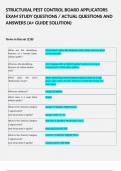
STRUCTURAL PEST CONTROL BOARD APPLICATORS
EXAM STUDY QUESTIONS / ACTUAL QUESTIONS AND
ANSWERS (A+ GUIDE SOLUTION)
Terms in this set (218)
What are the identifying Glossy black, globe-like abdomen with a deep red hour glass
features of a female black on her stomach.
widow spider?
What are the identifying It is irregular with no distinct pattern and very strong in
features of a black widow comparison to most other spiders.
web?
What does the term When spiderlings (newly hatched spiders) climb to a high
'Ballooning' mean? place, spin a piece of web, throw it out into the breeze and
float away.
What are chelicera? Fangs of a spider.
What color is a male black Brown
widow spider?
What is the Toxicity Category Danger. It signifies 'Highly Toxic'.
1 signal word?
And what does it signify? Danger LD50 = 0 -50
What is the Toxicity Category Warning. It signifies 'Moderately Toxic'.
2 signal word?
And what does it signify? Warning LD50=50-500
What is the Toxicity Category Caution. It signifies 'Slightly Toxic'.
3 signal word?
And what does it signify? Caution LD50= 500-5000
,What is the Toxicity No signal word is required. It signifies 'Relatively Nontoxic'.
Category 4 signal word?
And what does it signify?
What are the 11 key parts of 1. Classification of pesticide use
a pesticide label? 2. Product name
3. Type of formulation
4. Ingredient statement
5. Net contents of container
6. Signal word
7. Name of manufacturing company
8. EPA registration and establishment numbers
9. Directions for use
10. Hazard Statement
11. Storage and disposal information.
What species of recluse The Desert Recluse
spider is found in the
Southwest?
What are the identifying Brown with a violin shape behind its head. Usually found in
features of a recluse spider? dark places; wood piles, under rocks, closets and stored
boxes.
What is the largest native The Tarantula
spider in the U.S.?
What does Tarantula mean? Big, hairy spider
How does a tarantula live? They live in burrows or gaps under rocks. They will often
utilize an abandoned rodent hole which they will at least
partially line with silk.
The Argentine Ant.
What is the most
persistent and
troublesome ant that
invades houses?
,What are some identifying Argentine ants live in shallow galleries in the ground, often only
features of an argentine ant a few inches deep.
colony?
One colony will have multiple queens.
They feed off of aphid honeydew, and will often defend the
aphids.
What are some identifying Usually found to live in large mounds in fields, woodlands and
features of the imported fire other open spaces.
ant and of the black fire ant?
Will eat pretty much anything organic; other insects, seeds,
fruits, meats, vegetables, flowers, honeydew, etc.
One prominent queen.
Have a stinger and can bite.
Very hostile to other ants.
Large, hairy spider.
Had three rows of eyes when most other spiders have two rows.
What are the identifying Three tiny claws on the end of each leg
features of a Wolf Spider?
Will prey on their victims instead of weaving webs.
Will even prey on black widows.
Can inflict serious bites on humans.
, What are the identifying The spider is know to have beautiful spoke-patterned webs you
features of a Orb Weaver see hanging between trees or shrubs.
Spider?
They are medium to large-sized, with a body of about a half-
inch to an inch.
There are many kinds of web (or orb) weaver spiders, most
have a large abdomen and fairly long legs. They range in
body size up to about an inch, and many have color
markings. At least two varieties can inflict bites on humans,
notably the Common Orb Weaver and the Jeweled
Araneus.
What are the identifying It is know to builds its web in a funnel shape. The spider
features of a Funnel Spider? hides at the back of the funnel when disturbed. They
actually prey upon the Black Widow Spider along with
other insects on the ground.
Tiny, pale brownish ant.
Eats meats, cheeses, grease foods, and other dead insects.
Nest in galleries in dirt. Often very near another colony of
ants so they can raid and steal food from the other colony
What are some identifying
(hence the name).
features of the thief ant?
They will build colonies in houses; walls, cupboards, cracks and
crevices.
They can host diseases and tapeworms which can be an
additional problem for humans.
EXAM STUDY QUESTIONS / ACTUAL QUESTIONS AND
ANSWERS (A+ GUIDE SOLUTION)
Terms in this set (218)
What are the identifying Glossy black, globe-like abdomen with a deep red hour glass
features of a female black on her stomach.
widow spider?
What are the identifying It is irregular with no distinct pattern and very strong in
features of a black widow comparison to most other spiders.
web?
What does the term When spiderlings (newly hatched spiders) climb to a high
'Ballooning' mean? place, spin a piece of web, throw it out into the breeze and
float away.
What are chelicera? Fangs of a spider.
What color is a male black Brown
widow spider?
What is the Toxicity Category Danger. It signifies 'Highly Toxic'.
1 signal word?
And what does it signify? Danger LD50 = 0 -50
What is the Toxicity Category Warning. It signifies 'Moderately Toxic'.
2 signal word?
And what does it signify? Warning LD50=50-500
What is the Toxicity Category Caution. It signifies 'Slightly Toxic'.
3 signal word?
And what does it signify? Caution LD50= 500-5000
,What is the Toxicity No signal word is required. It signifies 'Relatively Nontoxic'.
Category 4 signal word?
And what does it signify?
What are the 11 key parts of 1. Classification of pesticide use
a pesticide label? 2. Product name
3. Type of formulation
4. Ingredient statement
5. Net contents of container
6. Signal word
7. Name of manufacturing company
8. EPA registration and establishment numbers
9. Directions for use
10. Hazard Statement
11. Storage and disposal information.
What species of recluse The Desert Recluse
spider is found in the
Southwest?
What are the identifying Brown with a violin shape behind its head. Usually found in
features of a recluse spider? dark places; wood piles, under rocks, closets and stored
boxes.
What is the largest native The Tarantula
spider in the U.S.?
What does Tarantula mean? Big, hairy spider
How does a tarantula live? They live in burrows or gaps under rocks. They will often
utilize an abandoned rodent hole which they will at least
partially line with silk.
The Argentine Ant.
What is the most
persistent and
troublesome ant that
invades houses?
,What are some identifying Argentine ants live in shallow galleries in the ground, often only
features of an argentine ant a few inches deep.
colony?
One colony will have multiple queens.
They feed off of aphid honeydew, and will often defend the
aphids.
What are some identifying Usually found to live in large mounds in fields, woodlands and
features of the imported fire other open spaces.
ant and of the black fire ant?
Will eat pretty much anything organic; other insects, seeds,
fruits, meats, vegetables, flowers, honeydew, etc.
One prominent queen.
Have a stinger and can bite.
Very hostile to other ants.
Large, hairy spider.
Had three rows of eyes when most other spiders have two rows.
What are the identifying Three tiny claws on the end of each leg
features of a Wolf Spider?
Will prey on their victims instead of weaving webs.
Will even prey on black widows.
Can inflict serious bites on humans.
, What are the identifying The spider is know to have beautiful spoke-patterned webs you
features of a Orb Weaver see hanging between trees or shrubs.
Spider?
They are medium to large-sized, with a body of about a half-
inch to an inch.
There are many kinds of web (or orb) weaver spiders, most
have a large abdomen and fairly long legs. They range in
body size up to about an inch, and many have color
markings. At least two varieties can inflict bites on humans,
notably the Common Orb Weaver and the Jeweled
Araneus.
What are the identifying It is know to builds its web in a funnel shape. The spider
features of a Funnel Spider? hides at the back of the funnel when disturbed. They
actually prey upon the Black Widow Spider along with
other insects on the ground.
Tiny, pale brownish ant.
Eats meats, cheeses, grease foods, and other dead insects.
Nest in galleries in dirt. Often very near another colony of
ants so they can raid and steal food from the other colony
What are some identifying
(hence the name).
features of the thief ant?
They will build colonies in houses; walls, cupboards, cracks and
crevices.
They can host diseases and tapeworms which can be an
additional problem for humans.