

Statistics summaries
Week 1:
Video lectures:
What is statistics ?
→Purpose of data analysis is to get information to answer the research question
-organise and analyse data to answer the research question adequately
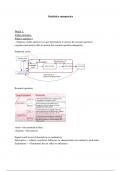
Empirical cycle:
Research question:
-static→one moment in time
-dynamic→time period
Signal words to see if descriptive or explanatory:
Descriptive→ related, correlated, difference or characteristics not related to each other
Explanatory → Determines has an effect or influences
,Statistical analysis to answer the different questions:
Measures for central tendency or dispersion, confidence intervals for point estimation,
correlations, different techniques to analyse data, trends, regression models and non
parametric models
→Some can be used for different types of questions and some are more appropriate for some
specific questions
Descriptive questions most of the time don’t relate to theory, theory is only apparent when it
is about correlation for example thru cross table analysis
Explanatory questions do relate to theory and most of the analysis can be used apart from
descriptive characteristics, like measure for central tendency and dispersion
→Trend analysis can be applied
Different examples of statistical topics
pearson's correlation, spearman's rank correlation and --> Correlation coefficient (2,3 or
more groups or repeated measures)
Logistic regression and historical regression →Regression analysis
Tests for differences between medians or distributions→non parametric
Variables can be distinguished in categorical and continuous
Categorical→ contain categories to distinguish different scores
Continuous→ include different scores but can't take any score on the scale there is always a
new subdivision possible
The distinguish in the measurement levels is important because there is requirements set
→ especially the data collection tool like a questionnaire
Starting point for statistical analysis→ data matrix
,Central tendency:
3 characteristics of data
→ central tendency: where is the middle point located
→ dispersion: how are the scores spread around the mid point
→ shape→ what does the distribution of scores look like
The applicability depends on the data
Most basic way is frequency table, can be used for all variables of all measurement levels
→however it may not be useful for example for a table with a lot of categories (income
measured in absolute euros)
Frequency is about counting the number of times a certain square appears in your data
→Covert frequencies in percentages (relative frequencies)
There are 3 common measures of central tendency
→mode, median and mean
, Dispersion:
Range→subtract the lowest score from the highest score (only says what the range is between
the lowest and the highest)
IQR→relates to the median and refers to the highest and lowest scores in which the middle
50% of the observation is located (the range that includes 25% above (QU) and 25% below
(QL) the median, adding up both parts gives you the middle 50% of the median)
Standard deviation→ relates to the mean and refers to the mean difference between the scores
and the mean ( is calculated from the variance,from each score you subtract the mean, you
square the difference than you divide this number by the total number of observation (-1
when you analyse sample data (usually the case ))
→tells you how close or widely the observation are spread around the mean, the higher the
standard deviation the more widely the results are spread
Week 1:
Video lectures:
What is statistics ?
→Purpose of data analysis is to get information to answer the research question
-organise and analyse data to answer the research question adequately
Empirical cycle:
Research question:
-static→one moment in time
-dynamic→time period
Signal words to see if descriptive or explanatory:
Descriptive→ related, correlated, difference or characteristics not related to each other
Explanatory → Determines has an effect or influences
,Statistical analysis to answer the different questions:
Measures for central tendency or dispersion, confidence intervals for point estimation,
correlations, different techniques to analyse data, trends, regression models and non
parametric models
→Some can be used for different types of questions and some are more appropriate for some
specific questions
Descriptive questions most of the time don’t relate to theory, theory is only apparent when it
is about correlation for example thru cross table analysis
Explanatory questions do relate to theory and most of the analysis can be used apart from
descriptive characteristics, like measure for central tendency and dispersion
→Trend analysis can be applied
Different examples of statistical topics
pearson's correlation, spearman's rank correlation and --> Correlation coefficient (2,3 or
more groups or repeated measures)
Logistic regression and historical regression →Regression analysis
Tests for differences between medians or distributions→non parametric
Variables can be distinguished in categorical and continuous
Categorical→ contain categories to distinguish different scores
Continuous→ include different scores but can't take any score on the scale there is always a
new subdivision possible
The distinguish in the measurement levels is important because there is requirements set
→ especially the data collection tool like a questionnaire
Starting point for statistical analysis→ data matrix
,Central tendency:
3 characteristics of data
→ central tendency: where is the middle point located
→ dispersion: how are the scores spread around the mid point
→ shape→ what does the distribution of scores look like
The applicability depends on the data
Most basic way is frequency table, can be used for all variables of all measurement levels
→however it may not be useful for example for a table with a lot of categories (income
measured in absolute euros)
Frequency is about counting the number of times a certain square appears in your data
→Covert frequencies in percentages (relative frequencies)
There are 3 common measures of central tendency
→mode, median and mean
, Dispersion:
Range→subtract the lowest score from the highest score (only says what the range is between
the lowest and the highest)
IQR→relates to the median and refers to the highest and lowest scores in which the middle
50% of the observation is located (the range that includes 25% above (QU) and 25% below
(QL) the median, adding up both parts gives you the middle 50% of the median)
Standard deviation→ relates to the mean and refers to the mean difference between the scores
and the mean ( is calculated from the variance,from each score you subtract the mean, you
square the difference than you divide this number by the total number of observation (-1
when you analyse sample data (usually the case ))
→tells you how close or widely the observation are spread around the mean, the higher the
standard deviation the more widely the results are spread


