Explore how Shakespeare presents uncertainty in Hamlet.
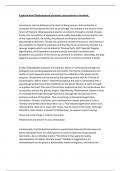
Uncertainty can be defined as the state of being unsure. Just as Hamlet is
uncertain of his purpose and role as an avenger, the audience are unsure of the
future of Elsinore. Shakespeare presents uncertainty through a myriad of ways.
Firstly, the uncertainty of appearance and reality especially concerning the role
of the supernatural. Secondly, the physical uncertainty derived from his
psychological dilemma. Thirdly, the audience and key characters' uncertainty of
the credibility of Hamlet's madness and fourthly moral uncertainty. Hamlet is a
revenge tragedy which can be linked to Thomas Kyd's 1587 Spanish Tragedy.
Significantly, the Elizabethan audience would have been uncertain over
Elizabeth's succession of the throne as she bore no children. Ultimately, the play
begs the question of whether the only element of certainty is Hamlet's death.
Firstly, Shakespeare presents the dramatic device of uncertainty through the
ambiguity surrounding appearance and reality. The theme of appearance and
reality is most apparent when concerning the credibility of the ghost and its
purpose. Uncertainty can be traced to the opening scene with its 14 lines of
stichomythia: 'Who's there?'. Hamlet throughout the play is confronted with a
psychological dilemma of the credibility of the ghost: 'Be thou a spirit of health,
or a goblin damned'. The use of the archaic subjunctive form 'be' emphasises this
uncertainty around the ghosts' origins. Significantly, Shakespeare creates a tone
of uncertainty through the stage directions, through the abruptness of the
entrance and exit of the ghost. This uncertainty is shared amongst other
characters. Horatio, a scholar, and a renaissance sceptic declares it to be a
'fantasy' whilst Marcellus describes it as a 'This dreaded sight twice seen of us',
reflecting the views of Le Loyer that 'souls cannot return to the body'. Although
Hamlet is, like Horatio, a student of Wittenberg, he appears more trusting:
'there are more things in heaven and earth,
Horatio than are dreamt in your philosophy'.
Contextually, the Elizabethan audience would have believed Ghosts were evil
spirits taking the form of a dead person in order to lead the living towards
damnation. As A.C Bradley claims "The Ghost is the supreme reality,
representative of hidden ultimate power". Bradley's suggestion is an
overstatement as the ghost is deliberately made ambiguous, and whilst the
Uncertainty can be defined as the state of being unsure. Just as Hamlet is
uncertain of his purpose and role as an avenger, the audience are unsure of the
future of Elsinore. Shakespeare presents uncertainty through a myriad of ways.
Firstly, the uncertainty of appearance and reality especially concerning the role
of the supernatural. Secondly, the physical uncertainty derived from his
psychological dilemma. Thirdly, the audience and key characters' uncertainty of
the credibility of Hamlet's madness and fourthly moral uncertainty. Hamlet is a
revenge tragedy which can be linked to Thomas Kyd's 1587 Spanish Tragedy.
Significantly, the Elizabethan audience would have been uncertain over
Elizabeth's succession of the throne as she bore no children. Ultimately, the play
begs the question of whether the only element of certainty is Hamlet's death.
Firstly, Shakespeare presents the dramatic device of uncertainty through the
ambiguity surrounding appearance and reality. The theme of appearance and
reality is most apparent when concerning the credibility of the ghost and its
purpose. Uncertainty can be traced to the opening scene with its 14 lines of
stichomythia: 'Who's there?'. Hamlet throughout the play is confronted with a
psychological dilemma of the credibility of the ghost: 'Be thou a spirit of health,
or a goblin damned'. The use of the archaic subjunctive form 'be' emphasises this
uncertainty around the ghosts' origins. Significantly, Shakespeare creates a tone
of uncertainty through the stage directions, through the abruptness of the
entrance and exit of the ghost. This uncertainty is shared amongst other
characters. Horatio, a scholar, and a renaissance sceptic declares it to be a
'fantasy' whilst Marcellus describes it as a 'This dreaded sight twice seen of us',
reflecting the views of Le Loyer that 'souls cannot return to the body'. Although
Hamlet is, like Horatio, a student of Wittenberg, he appears more trusting:
'there are more things in heaven and earth,
Horatio than are dreamt in your philosophy'.
Contextually, the Elizabethan audience would have believed Ghosts were evil
spirits taking the form of a dead person in order to lead the living towards
damnation. As A.C Bradley claims "The Ghost is the supreme reality,
representative of hidden ultimate power". Bradley's suggestion is an
overstatement as the ghost is deliberately made ambiguous, and whilst the