media systems in comparative perspective cm1008 | ibcom ba year I - term III (2019-2020) [by gycc]
MEDIA SYSTEMS IN COMPARATIVE PERSPECTIVE
(summary + reading notes)
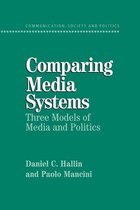
book; COMPARING MEDIA SYSTEMS: THREE
MODELS OF MEDIA AND POLITICS
by Hallin, D. C. & Mancini, P.
CHAPTER ONE: introduction
This book focuses on the questions posed by Siebert, Peterson and Schramm about the press
and the reason why news media is as it is. It aims to explain why news media apparently serve
different purposes and appear in widely different forms in different countries.
In this book, the authors, Hallin & Mancini (H&M) confine themselves to the developed
capitalist democracies of Western Europe and North America. They attempt to identify the major
variations that have developed in Western democracies in the structure and political role of the news
media. In addition, some ideas about how to account for these variations are explored and their
consequences for democratic politics are also described.
The primary focus of this book is the relation between media systems and political systems.
Therefore, the analysis of journalism and the news media will be emphasized.
To answer the question “Why is the press as it is?”, we will need comparative analysis. The
role of comparative analysis in social theory can be understood with two basic functions: (1) its role
in concept formation & (2) the clarification and its role in causal inference (hypothesis testing &
causality).
Firstly, comparative analysis is valuable in social investigation, because it sensitizes us to
both variation and to similarity, which is useful by concept formation and the explanation of media
systems. Most of the literature on the media is highly ethnocentric, meaning that the author refers
only to the experience of a single country, yet is written in general terms, as if the occurring model
can be applied to every other country. This, at least, is true in the countries with the most-developed
media scholarship, such as the US or Britain. Countries with less developed traditions of media
research, often follow another pattern: a tendency to borrow the literature of other countries and to
treat that borrowed literature as though it could be applied unproblematically anywhere.
Consequently, important aspects of media systems are assumed to be “natural” or became so familiar
that they are not perceived at all. Therefore, through comparison, we have to “denaturalize” a media
system that is so familiar to us, forcing us to conceptualize more clearly what aspects of that media
system actually require explanation.
The second reason comparison is important in social theory is that it allows us in many cases
to test hypotheses about the interrelationships among social phenomena (causal inference). In the field
of communication, those who do analysis at the system level often tend to be sceptical of
“positivism” → understanding the world based on science. The “positivists” in the field tend to be
concentrated among people working at the individual level. For many years, empirical research in
communication was focusing on the effects of particular messages on individual attitudes and beliefs
and not concerned with larger media structures.
However, H&M believe that it’s not necessary to adopt strong claims of the identity between
natural and social science to find comparative analysis useful in sorting out relationships between
media systems and their social and political settings. “Our purpose is to develop a framework for
comparing media systems and a set of hypotheses about how they are linked structurally and
historically to the development of the political system […].”
1
,media systems in comparative perspective cm1008 | ibcom ba year I - term III (2019-2020) [by gycc]
Scope of the study
This study covers the media systems of the US, Canada and most of Western Europe. By
limiting the study to North America and Western Europe, the dealing systems have relatively
comparable levels of economic development and much common culture and political history. An
advantage of this focus is the fact that the media models that appear in Western Europe and North
America tend to be the dominant models globally; understanding their logic and evolution will likely
to be of some use as an example for other regions of how to conduct comparative research but also
because these models have actually influence the development of other systems.
The legacy of “four theories of the press”
The Four Theories of the Press by Siebert, Peterson and Schramm (1956) remains remarkably
influential as an attempt to create a broad framework for comparative analysis of the news media.
“The thesis of this book is that the press always takes on the form and coloration of the social and
political structures within which it operates.” Especially, it reflects the system of social control
whereby the relations of individuals and institutions are adjusted. H&M follow the framework set out
by the three authors to show how different media models are rooted in broader differences of political
and economic structure. “One cannot understand the news media without understanding the nature of
the state, the system of political parties, the pattern of relation between economic and political
interests, and the development of civil society, among other elements of social structure.”
However, H&M opposed to a point that was made by the authors of Four Theories of the
Press. That is, the assumption that the media will always be dependent in relation to the “system of
social control”. Most of the cases, it may be reasonable to assume that the media system essentially
“reflects” other aspects of social structure. But there is evidence that media institutions have an
impact of their own and can be independent on other social institutions. For instance, scholars
witnessed an important trend in the direction of greater media influence, particularly in relation to the
political system.
Another point H&M separate themselves of the three authors is the focus on “philosophies of
the press”, also called the “ideologies” of the press. Siebert, Peterson and Schramm did not
empirically analyse or compare the relation between media systems and social systems. They looked
neither at the actual functioning of media systems nor at that of the social systems in which they
operated, but only at the “(four) theories” by which those systems legitimated themselves.
Media system models
One reason Four theories of the Press has proved to be influential over so many years is that
there is a great deal of appeal in the idea that the world’s media systems can be classified using a
small number of simple, discreet models. Is it possible to replace the four theories with a new set of
models, better-grounded empirically but sharing something of the originals? H&M in fact introduce
three media system models:
(1) Liberal model
o Prevails across the Britain, Ireland and North America
o Characterized by a relative dominance of market mechanisms and commercial
media
(2) Democratic Corporatist model
o Prevails across northern continental Europe
2
, media systems in comparative perspective cm1008 | ibcom ba year I - term III (2019-2020) [by gycc]
o Characterized by a historical coexistence of commercial media and media tied
to organized social and political groups, and by a relatively active but legally
limited role of the state
(3) Polarized Pluralist model
o Prevails in the Mediterranean countries of southern Europe
o Characterized by the integration of the media into part politics, weaker
historical development of commercial media, and a strong role of the state
H&M will try to show that the characteristics that define these models are interrelated, that
they result from a meaningful pattern of historical development and do not merely co-occur
coincidentally. The models will also organize the discussion of the media systems of individual
countries, trying to show how each country’s system does and does not fit the patterns of these
models. It should be noticed that the models are ideal types, and the media systems of individual
countries fit them only roughly. This means that there will be a considerable variation among
countries that will be grouped together in the discussion of the models. It should also be stressed that
their primary purpose is not the classification of individual systems, but the identification of
characteristic patterns of relationship between system characteristics.
It’s also important to note that media systems are not homogenous. They are often
characterized by a complex coexistence of media operating according to different principles. “In most
countries, the media do no constitute any single ‘system’, but are composed of many separate,
overlapping, often inconsistent elements, with appropriate differences of normative expectation and
actual regulation.” Finally, the models should not be seen as describing a set of fixed characteristics of
a number of static systems, but as identifying some of the underlying systematic relationships that
help us to understand the media systems that have been in a process of continual change.
H&M will also pay attention to history in this analysis. Media institutions evolve over time; at
each step of their evolution, past events and institutional patterns inherited from earlier periods
influence the direction they take. In addition, a question H&M cannot answer is whether the distinct
models identified here, which emerged in Western democracies in the mid-twentieth century, will
eventually disappear altogether.
Do we need normative theories of the media?
The field of communication, and most particularly the study of journalism, has always been
heavily normative in character → establishing, relating to a standard or norm, especially of
behaviour. This is partly due to its rooting in professional education, where it’s more important to
reflect on what journalism should be than to analyse in detail what and why it is.
H&M aren’t interested in measuring media systems against a normative ideal, but in
analysing their historical development as institutions within particular social settings; what roles did
they play in political, social and economic life or what patterns of relationship they have with other
social institutions. The three models of journalism are intended as empirical, not normative models.
Limitations of data
Limitations of comparative data impose severe restrictions on our ability to draw any firm
conclusions about the relations between media and social systems. In some ways, comparative
research in communication may be harder than in some fields. Due to the situation being far more
difficult with something such as the day-to-day flow of political discourse in the media, the
significance of which is often dependent on subtle cultural cues that may be harder to study
comparing to that of the subject matter of comparative politics and certainly harder to quantify.
Therefore, H&M cannot claim to test most of the hypotheses raised in this book. Neither will they
3
MEDIA SYSTEMS IN COMPARATIVE PERSPECTIVE
(summary + reading notes)
book; COMPARING MEDIA SYSTEMS: THREE
MODELS OF MEDIA AND POLITICS
by Hallin, D. C. & Mancini, P.
CHAPTER ONE: introduction
This book focuses on the questions posed by Siebert, Peterson and Schramm about the press
and the reason why news media is as it is. It aims to explain why news media apparently serve
different purposes and appear in widely different forms in different countries.
In this book, the authors, Hallin & Mancini (H&M) confine themselves to the developed
capitalist democracies of Western Europe and North America. They attempt to identify the major
variations that have developed in Western democracies in the structure and political role of the news
media. In addition, some ideas about how to account for these variations are explored and their
consequences for democratic politics are also described.
The primary focus of this book is the relation between media systems and political systems.
Therefore, the analysis of journalism and the news media will be emphasized.
To answer the question “Why is the press as it is?”, we will need comparative analysis. The
role of comparative analysis in social theory can be understood with two basic functions: (1) its role
in concept formation & (2) the clarification and its role in causal inference (hypothesis testing &
causality).
Firstly, comparative analysis is valuable in social investigation, because it sensitizes us to
both variation and to similarity, which is useful by concept formation and the explanation of media
systems. Most of the literature on the media is highly ethnocentric, meaning that the author refers
only to the experience of a single country, yet is written in general terms, as if the occurring model
can be applied to every other country. This, at least, is true in the countries with the most-developed
media scholarship, such as the US or Britain. Countries with less developed traditions of media
research, often follow another pattern: a tendency to borrow the literature of other countries and to
treat that borrowed literature as though it could be applied unproblematically anywhere.
Consequently, important aspects of media systems are assumed to be “natural” or became so familiar
that they are not perceived at all. Therefore, through comparison, we have to “denaturalize” a media
system that is so familiar to us, forcing us to conceptualize more clearly what aspects of that media
system actually require explanation.
The second reason comparison is important in social theory is that it allows us in many cases
to test hypotheses about the interrelationships among social phenomena (causal inference). In the field
of communication, those who do analysis at the system level often tend to be sceptical of
“positivism” → understanding the world based on science. The “positivists” in the field tend to be
concentrated among people working at the individual level. For many years, empirical research in
communication was focusing on the effects of particular messages on individual attitudes and beliefs
and not concerned with larger media structures.
However, H&M believe that it’s not necessary to adopt strong claims of the identity between
natural and social science to find comparative analysis useful in sorting out relationships between
media systems and their social and political settings. “Our purpose is to develop a framework for
comparing media systems and a set of hypotheses about how they are linked structurally and
historically to the development of the political system […].”
1
,media systems in comparative perspective cm1008 | ibcom ba year I - term III (2019-2020) [by gycc]
Scope of the study
This study covers the media systems of the US, Canada and most of Western Europe. By
limiting the study to North America and Western Europe, the dealing systems have relatively
comparable levels of economic development and much common culture and political history. An
advantage of this focus is the fact that the media models that appear in Western Europe and North
America tend to be the dominant models globally; understanding their logic and evolution will likely
to be of some use as an example for other regions of how to conduct comparative research but also
because these models have actually influence the development of other systems.
The legacy of “four theories of the press”
The Four Theories of the Press by Siebert, Peterson and Schramm (1956) remains remarkably
influential as an attempt to create a broad framework for comparative analysis of the news media.
“The thesis of this book is that the press always takes on the form and coloration of the social and
political structures within which it operates.” Especially, it reflects the system of social control
whereby the relations of individuals and institutions are adjusted. H&M follow the framework set out
by the three authors to show how different media models are rooted in broader differences of political
and economic structure. “One cannot understand the news media without understanding the nature of
the state, the system of political parties, the pattern of relation between economic and political
interests, and the development of civil society, among other elements of social structure.”
However, H&M opposed to a point that was made by the authors of Four Theories of the
Press. That is, the assumption that the media will always be dependent in relation to the “system of
social control”. Most of the cases, it may be reasonable to assume that the media system essentially
“reflects” other aspects of social structure. But there is evidence that media institutions have an
impact of their own and can be independent on other social institutions. For instance, scholars
witnessed an important trend in the direction of greater media influence, particularly in relation to the
political system.
Another point H&M separate themselves of the three authors is the focus on “philosophies of
the press”, also called the “ideologies” of the press. Siebert, Peterson and Schramm did not
empirically analyse or compare the relation between media systems and social systems. They looked
neither at the actual functioning of media systems nor at that of the social systems in which they
operated, but only at the “(four) theories” by which those systems legitimated themselves.
Media system models
One reason Four theories of the Press has proved to be influential over so many years is that
there is a great deal of appeal in the idea that the world’s media systems can be classified using a
small number of simple, discreet models. Is it possible to replace the four theories with a new set of
models, better-grounded empirically but sharing something of the originals? H&M in fact introduce
three media system models:
(1) Liberal model
o Prevails across the Britain, Ireland and North America
o Characterized by a relative dominance of market mechanisms and commercial
media
(2) Democratic Corporatist model
o Prevails across northern continental Europe
2
, media systems in comparative perspective cm1008 | ibcom ba year I - term III (2019-2020) [by gycc]
o Characterized by a historical coexistence of commercial media and media tied
to organized social and political groups, and by a relatively active but legally
limited role of the state
(3) Polarized Pluralist model
o Prevails in the Mediterranean countries of southern Europe
o Characterized by the integration of the media into part politics, weaker
historical development of commercial media, and a strong role of the state
H&M will try to show that the characteristics that define these models are interrelated, that
they result from a meaningful pattern of historical development and do not merely co-occur
coincidentally. The models will also organize the discussion of the media systems of individual
countries, trying to show how each country’s system does and does not fit the patterns of these
models. It should be noticed that the models are ideal types, and the media systems of individual
countries fit them only roughly. This means that there will be a considerable variation among
countries that will be grouped together in the discussion of the models. It should also be stressed that
their primary purpose is not the classification of individual systems, but the identification of
characteristic patterns of relationship between system characteristics.
It’s also important to note that media systems are not homogenous. They are often
characterized by a complex coexistence of media operating according to different principles. “In most
countries, the media do no constitute any single ‘system’, but are composed of many separate,
overlapping, often inconsistent elements, with appropriate differences of normative expectation and
actual regulation.” Finally, the models should not be seen as describing a set of fixed characteristics of
a number of static systems, but as identifying some of the underlying systematic relationships that
help us to understand the media systems that have been in a process of continual change.
H&M will also pay attention to history in this analysis. Media institutions evolve over time; at
each step of their evolution, past events and institutional patterns inherited from earlier periods
influence the direction they take. In addition, a question H&M cannot answer is whether the distinct
models identified here, which emerged in Western democracies in the mid-twentieth century, will
eventually disappear altogether.
Do we need normative theories of the media?
The field of communication, and most particularly the study of journalism, has always been
heavily normative in character → establishing, relating to a standard or norm, especially of
behaviour. This is partly due to its rooting in professional education, where it’s more important to
reflect on what journalism should be than to analyse in detail what and why it is.
H&M aren’t interested in measuring media systems against a normative ideal, but in
analysing their historical development as institutions within particular social settings; what roles did
they play in political, social and economic life or what patterns of relationship they have with other
social institutions. The three models of journalism are intended as empirical, not normative models.
Limitations of data
Limitations of comparative data impose severe restrictions on our ability to draw any firm
conclusions about the relations between media and social systems. In some ways, comparative
research in communication may be harder than in some fields. Due to the situation being far more
difficult with something such as the day-to-day flow of political discourse in the media, the
significance of which is often dependent on subtle cultural cues that may be harder to study
comparing to that of the subject matter of comparative politics and certainly harder to quantify.
Therefore, H&M cannot claim to test most of the hypotheses raised in this book. Neither will they
3