Accounting
1. Basic Concepts
Introduction to Financial Accounting
Accounting is the language of business. It systematically collects and records information on
every event that affects the economic wealth of a person or company.
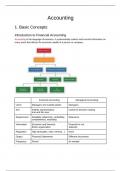
Financial Accounting Managerial Accounting
Users Managers and outside parties Managers
Aim Faithful representation, Useful for decision-making
true and fair view
Requirement Reliability (objectivity, verifiability, Relevance
completeness, neutrality)
Information Economic and financial; Financial or not;
Entire organization Subunits
Regulation High (principles, rules, formats…) None
Output Financial Statements Different documents
Frequency Period As needed
,Accounting Standards
1. US GAAP – issued by the FASB and endorsed by the US Securities and Exchange
Commission (SEC)
2. IAS/IFRS – regulated by the International Accounting Standards Board (IASB)
● Used in Spain and throughout Europe
Financial statements answer questions about the economic and financial situation of a firm.
Question Situation Financial Statements (Annual)
What does the Financial Balance Sheet (Statement of Financial Position)
company own or Situation ● Reports the measured elements of
owe? assets, net equity, and liabilities
How much profit or Economic Income Statement (Profit and Loss Account)
loss does the Situation ● Reports the net income for the reporting
company make? period that results from revenues and
expenses (except those recognized
directly in equity)
How much cash Cash Flow Cash Flow Statement
does the company ● Discloses the sources and uses of cash
have or use? and cash equivalents
How much is the Net Worth Statement of Changes in Equity
company worth? ● Discloses all changes made to net equity
Notes
● Provide additional information and clarify
and supplement the information provided
in the other four financial statements
The objective of accounting is to give a true and fair view of a business’s financial
performance and situation. Financial statements should be…
● Relevant – timely and useful information
● Reliable – verifiable, objective, aligned with common definitions
● Complete – a full picture of the economic situation
● Clear – understandable for the user
● Comparable – over time and to other companies (i.e. competitors)
Accounting Principles
1. Going concern – unless there is evidence to the contrary, it is presumed that the
company will continue in operation in the foreseeable future
2. Accrual – accounting entries are recognized when they occur, irrespective of
payment or collection
3. Consistency – if there are several options to record transactions, the chosen option
needs to be applied consistently to similar transactions over time
4. Prudence – in cases of uncertainty, prudent criteria should be applied in making
measurements
● Not overestimating the number of revenues recognized or underestimating
the number of expenses
, ● Being conservative in recording the number of assets, and not
underestimating liabilities
● Only recording a revenue transaction or an asset when it is certain, and
recording an expense transaction or liability when it is probable
5. No offsetting – unless specifically allowed, assets and liabilities or revenues and
expenses should be reported separately and not netted
6. Materiality – strict application of certain accounting principles and criteria may be
waived when the materiality of the item is of little significance and does not affect fair
presentation
Balance Sheet
The Balance Sheet is a snapshot of what the company owns and owes. It shows a
company's economic and financial position at a given moment in time.
Assets – goods, rights, and other resources controlled by the company as a result of past
events and from which future economic benefits are expected to flow to the company
● Non-current assets
○ Intangible assets – patents, computer software, R&D, administrative
concessions, rights over leased assets, goodwill…
○ Tangible assets
■ Property, Plant, and Equipment (PPE) – land and natural resources,
buildings and installations, machinery, office furniture, IT equipment,
vehicles…
■ Investment properties – real estate assets owned to obtain rental
earnings or gains from their sale
○ Noncurrent financial assets
■ Long-term investments in other companies (shares)
■ Long-term loans to third parties
■ Long-term guarantee deposits
● Current assets
○ Inventories – Assets held to be sold or used in the course of business: raw
materials, work in progress, finished products, other supplies
○ Receivables (Current Financial Assets) – Rights to receive money from
clients as a result of the normal trade
■ Money owed by other debtors, pre-paid expenses, and advanced
payments to suppliers also fall under this category
○ Cash and cash equivalents
, Liabilities – present obligations of the company arising from past events, the settlement of
which is expected to result in an outflow of resources from the company embodying future
economic benefits
● Non-current liabilities – Long-term loans (excluding the part payable within a year)
○ Mortgages
○ Long-term tax liabilities
● Current liabilities – Debts or payables due typically in 1 year
○ Payables to Vendors
○ Tax payables (VAT, Payroll, etc)
○ Short-term debt
○ Payables for long-term loans within the Fiscal Year
Net Equity – the residual interest in the assets of the company after deducting all its
liabilities
● Share Capital – Contributions made by equity holders or owners upon the
incorporation of the company or subsequently that are not considered liabilities
○ The amount of money the owners of a company have invested in the
business as represented by common and/or preferred shares
● Retained Earnings – Income from the previous period that is not distributed
● Net Income – Earnings from this period when subtracting expenses from revenues
○ Retained Earnings + Net Income = Profit of past and current accounting
period contributing to shareholder equity, instead of paying out dividends
Balance Sheet
1. Basic Concepts
Introduction to Financial Accounting
Accounting is the language of business. It systematically collects and records information on
every event that affects the economic wealth of a person or company.
Financial Accounting Managerial Accounting
Users Managers and outside parties Managers
Aim Faithful representation, Useful for decision-making
true and fair view
Requirement Reliability (objectivity, verifiability, Relevance
completeness, neutrality)
Information Economic and financial; Financial or not;
Entire organization Subunits
Regulation High (principles, rules, formats…) None
Output Financial Statements Different documents
Frequency Period As needed
,Accounting Standards
1. US GAAP – issued by the FASB and endorsed by the US Securities and Exchange
Commission (SEC)
2. IAS/IFRS – regulated by the International Accounting Standards Board (IASB)
● Used in Spain and throughout Europe
Financial statements answer questions about the economic and financial situation of a firm.
Question Situation Financial Statements (Annual)
What does the Financial Balance Sheet (Statement of Financial Position)
company own or Situation ● Reports the measured elements of
owe? assets, net equity, and liabilities
How much profit or Economic Income Statement (Profit and Loss Account)
loss does the Situation ● Reports the net income for the reporting
company make? period that results from revenues and
expenses (except those recognized
directly in equity)
How much cash Cash Flow Cash Flow Statement
does the company ● Discloses the sources and uses of cash
have or use? and cash equivalents
How much is the Net Worth Statement of Changes in Equity
company worth? ● Discloses all changes made to net equity
Notes
● Provide additional information and clarify
and supplement the information provided
in the other four financial statements
The objective of accounting is to give a true and fair view of a business’s financial
performance and situation. Financial statements should be…
● Relevant – timely and useful information
● Reliable – verifiable, objective, aligned with common definitions
● Complete – a full picture of the economic situation
● Clear – understandable for the user
● Comparable – over time and to other companies (i.e. competitors)
Accounting Principles
1. Going concern – unless there is evidence to the contrary, it is presumed that the
company will continue in operation in the foreseeable future
2. Accrual – accounting entries are recognized when they occur, irrespective of
payment or collection
3. Consistency – if there are several options to record transactions, the chosen option
needs to be applied consistently to similar transactions over time
4. Prudence – in cases of uncertainty, prudent criteria should be applied in making
measurements
● Not overestimating the number of revenues recognized or underestimating
the number of expenses
, ● Being conservative in recording the number of assets, and not
underestimating liabilities
● Only recording a revenue transaction or an asset when it is certain, and
recording an expense transaction or liability when it is probable
5. No offsetting – unless specifically allowed, assets and liabilities or revenues and
expenses should be reported separately and not netted
6. Materiality – strict application of certain accounting principles and criteria may be
waived when the materiality of the item is of little significance and does not affect fair
presentation
Balance Sheet
The Balance Sheet is a snapshot of what the company owns and owes. It shows a
company's economic and financial position at a given moment in time.
Assets – goods, rights, and other resources controlled by the company as a result of past
events and from which future economic benefits are expected to flow to the company
● Non-current assets
○ Intangible assets – patents, computer software, R&D, administrative
concessions, rights over leased assets, goodwill…
○ Tangible assets
■ Property, Plant, and Equipment (PPE) – land and natural resources,
buildings and installations, machinery, office furniture, IT equipment,
vehicles…
■ Investment properties – real estate assets owned to obtain rental
earnings or gains from their sale
○ Noncurrent financial assets
■ Long-term investments in other companies (shares)
■ Long-term loans to third parties
■ Long-term guarantee deposits
● Current assets
○ Inventories – Assets held to be sold or used in the course of business: raw
materials, work in progress, finished products, other supplies
○ Receivables (Current Financial Assets) – Rights to receive money from
clients as a result of the normal trade
■ Money owed by other debtors, pre-paid expenses, and advanced
payments to suppliers also fall under this category
○ Cash and cash equivalents
, Liabilities – present obligations of the company arising from past events, the settlement of
which is expected to result in an outflow of resources from the company embodying future
economic benefits
● Non-current liabilities – Long-term loans (excluding the part payable within a year)
○ Mortgages
○ Long-term tax liabilities
● Current liabilities – Debts or payables due typically in 1 year
○ Payables to Vendors
○ Tax payables (VAT, Payroll, etc)
○ Short-term debt
○ Payables for long-term loans within the Fiscal Year
Net Equity – the residual interest in the assets of the company after deducting all its
liabilities
● Share Capital – Contributions made by equity holders or owners upon the
incorporation of the company or subsequently that are not considered liabilities
○ The amount of money the owners of a company have invested in the
business as represented by common and/or preferred shares
● Retained Earnings – Income from the previous period that is not distributed
● Net Income – Earnings from this period when subtracting expenses from revenues
○ Retained Earnings + Net Income = Profit of past and current accounting
period contributing to shareholder equity, instead of paying out dividends
Balance Sheet