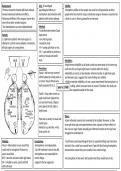
Background: Aim: To investigate Validity:
-Previous research showed split-brain animals psychological effects on -Population validity as the sample was small so cant generalise to other
showed numerous behavioural effects. hemispheric deconnection with people who have had the corpus colostomy surgery. However, everyone has
-Behavioural effects of the surgery may be less patients with severe epilepsy. a brain so can, in theory, generalise to everyone.
severe than other cerebral surgery.
-Two hemispheres can work independently. Method:
-Controlled observation/Quasi
Sample: experiment
11 split-brain patients who had surgery to -no control groups.
attempt to control severe epileptic convulsions. -Snapshot study
All had surgery at varying times. -IV = having split brain or not.
-DV = ppts ability to perform a
variety of visual and tactile
tests. Reliability:
+High internal reliability as all tasks carried out were done in the same way
Procedure: each time for each ppts (high level of control within the study).
Visual = Had one eye covered +Reliability in results as lateralisation of brain function in split-brain ppts
whilst looked at a fixed point on and between ppts, suggests that some findings are reliable.
a screen. Visual stimuli were + High in external reliability as it was a quasi experiment that took place in a
back projected for 0.1s. lab setting, which increases levels of control. Therefore, the study can
Sperry (1968)
be repeated outside of the study.
Tactile = Gap under screen so
ppts could reach objects but
not see their hands. Objects
were placed in left, right or
both hands.
Ethics:
Ppts took a variety of visual and +Gave informed consent and consented to be studied. However, as they
tactile tasks. were split brain ptts and experimenters were unaware of these effects of
Asked to say, describe, write, this, we can argue if ppts actually gave informed consent as thy may have
draw, point, etc. struggled to understand it.
Findings: Conclusions: -Could have caused psychological harm as repeated testing may have been
Visual = information in one visual field -Hemispheres are independent. stressful. Also, could have caused harm if ppts felt that having hemispheric
could only be recognised if shown to -Can still continue in day-to-day life. deconnection meant they were unable to do certain things.
same visual field. -Hemispheres are responsible for
RVF = describe and point with right hand. certain things. +No deception as they were told exactly what they would have to do.
LVF = Unable to name, point and find -Supports the bio approach.
with left hand.
-Previous research showed split-brain animals psychological effects on -Population validity as the sample was small so cant generalise to other
showed numerous behavioural effects. hemispheric deconnection with people who have had the corpus colostomy surgery. However, everyone has
-Behavioural effects of the surgery may be less patients with severe epilepsy. a brain so can, in theory, generalise to everyone.
severe than other cerebral surgery.
-Two hemispheres can work independently. Method:
-Controlled observation/Quasi
Sample: experiment
11 split-brain patients who had surgery to -no control groups.
attempt to control severe epileptic convulsions. -Snapshot study
All had surgery at varying times. -IV = having split brain or not.
-DV = ppts ability to perform a
variety of visual and tactile
tests. Reliability:
+High internal reliability as all tasks carried out were done in the same way
Procedure: each time for each ppts (high level of control within the study).
Visual = Had one eye covered +Reliability in results as lateralisation of brain function in split-brain ppts
whilst looked at a fixed point on and between ppts, suggests that some findings are reliable.
a screen. Visual stimuli were + High in external reliability as it was a quasi experiment that took place in a
back projected for 0.1s. lab setting, which increases levels of control. Therefore, the study can
Sperry (1968)
be repeated outside of the study.
Tactile = Gap under screen so
ppts could reach objects but
not see their hands. Objects
were placed in left, right or
both hands.
Ethics:
Ppts took a variety of visual and +Gave informed consent and consented to be studied. However, as they
tactile tasks. were split brain ptts and experimenters were unaware of these effects of
Asked to say, describe, write, this, we can argue if ppts actually gave informed consent as thy may have
draw, point, etc. struggled to understand it.
Findings: Conclusions: -Could have caused psychological harm as repeated testing may have been
Visual = information in one visual field -Hemispheres are independent. stressful. Also, could have caused harm if ppts felt that having hemispheric
could only be recognised if shown to -Can still continue in day-to-day life. deconnection meant they were unable to do certain things.
same visual field. -Hemispheres are responsible for
RVF = describe and point with right hand. certain things. +No deception as they were told exactly what they would have to do.
LVF = Unable to name, point and find -Supports the bio approach.
with left hand.