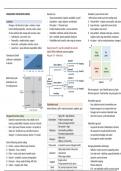
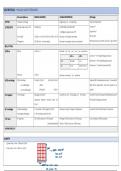
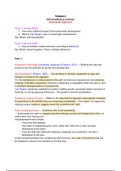
MANAGEMENT AND DECISION MAKING Decision trees Mendelow’s power interest matrix
- Visual representation of option’s probability + payoff = effort business needs to put into meeting needs
Leadership - Quantitative – Logical, objective, consideration 1) Minimal effort – irregular comms (public, odd custom
- Manager = tell what to do, leader = motivate + inspire - Pick option = ↑ financial return 2) Keep informed – regular brief comms (locals)
- Factors affecting leadership – structure, culture, nature - Familiar situations/routine = accurate estimates local suppliers, local council
of task, workforce skill, manager skill, recession, comp - Probability = likelihood, estimate off past data 3) Keep satisfied – anticipate needs (gov, customers,
> Authoritarian – give orders, crisis - Bias = unreliable, ignores qualitative (opinions) suppliers, banks, large shareholders, employees)
> Paternalistic – explain decision, support - Probabilities hard to predict, wider range of outcomes 4) Key player – vital to running (employees, managers)
> Democratic – participation, motivates, comms
> Laissez faire – weak, abdicates responsibility, skilled Expected value EV = pay off x probability of outcome
Add EV (EMV) of different outcomes together Keep Key
Tannenbaum Schmidt Net gain = EV – initial costs satisfied player
continuum = participation
in decision
Minimal Keep
effort informed
Blake Mouton grid =
leadership on care
for employee/prod
Win-win approach – pot of benefits grows so all gain
Win-lose approach – fixed benefits, one group gains more
Shareholder approach
Stakeholder needs - Aims, objectives domin by shareholders own
Internal (owners, staff) / external (customers, suppliers, gov) - Employ managers to run company their way
- Managers aim to maximise shareholder value
Management decision making High profit = high dividends - Short term rewards = profit and dividends
- Depends on speed of decision, info available, size of Shareholders Positive corporate image
business, predictability of situation, character of decider Vote out managers at AGM Stakeholder approach
- Risk = high reward, financial, uncertain = not predict all Job security + wage - Incorporate all needs of stakeholders in decision
- Oppo cost = benefit given up, use limited resources Employees Good working conditions - All cooperate for mutually beneficial results
- Strategic = LT, unknown outcome, tactical = ST, predict Promotional opportunities - Use specialist knowledge, feel valued
High status - Encouraged to consider externalities
Managers
High pay + job security
Factors influencing decision making
1) Mission – purpose, influence type of decision Trade unions Consulted to ensure strategies benefit Managing stakeholder relationships
2) Objectives – focus / yardstick High quality product at low prices - Attitudes + project success by supporting actions
3) Ethics – moral, social values to benefit society Customers Good service - Cyert and march - satisficing, sequential attention, sid
4) External – competitor, economy, demographics Wide range available payments, exercise of power
5) Resources – money, people (training, skill), time Regular orders - Stakeholder mapping
Suppliers
Prompt payments at fair prices
6) Culture – managers style, history - Mission statements
Banks Full, prompt repayment of loans
- CSR – see stakeholder conflicts so assess impacts
- Visual representation of option’s probability + payoff = effort business needs to put into meeting needs
Leadership - Quantitative – Logical, objective, consideration 1) Minimal effort – irregular comms (public, odd custom
- Manager = tell what to do, leader = motivate + inspire - Pick option = ↑ financial return 2) Keep informed – regular brief comms (locals)
- Factors affecting leadership – structure, culture, nature - Familiar situations/routine = accurate estimates local suppliers, local council
of task, workforce skill, manager skill, recession, comp - Probability = likelihood, estimate off past data 3) Keep satisfied – anticipate needs (gov, customers,
> Authoritarian – give orders, crisis - Bias = unreliable, ignores qualitative (opinions) suppliers, banks, large shareholders, employees)
> Paternalistic – explain decision, support - Probabilities hard to predict, wider range of outcomes 4) Key player – vital to running (employees, managers)
> Democratic – participation, motivates, comms
> Laissez faire – weak, abdicates responsibility, skilled Expected value EV = pay off x probability of outcome
Add EV (EMV) of different outcomes together Keep Key
Tannenbaum Schmidt Net gain = EV – initial costs satisfied player
continuum = participation
in decision
Minimal Keep
effort informed
Blake Mouton grid =
leadership on care
for employee/prod
Win-win approach – pot of benefits grows so all gain
Win-lose approach – fixed benefits, one group gains more
Shareholder approach
Stakeholder needs - Aims, objectives domin by shareholders own
Internal (owners, staff) / external (customers, suppliers, gov) - Employ managers to run company their way
- Managers aim to maximise shareholder value
Management decision making High profit = high dividends - Short term rewards = profit and dividends
- Depends on speed of decision, info available, size of Shareholders Positive corporate image
business, predictability of situation, character of decider Vote out managers at AGM Stakeholder approach
- Risk = high reward, financial, uncertain = not predict all Job security + wage - Incorporate all needs of stakeholders in decision
- Oppo cost = benefit given up, use limited resources Employees Good working conditions - All cooperate for mutually beneficial results
- Strategic = LT, unknown outcome, tactical = ST, predict Promotional opportunities - Use specialist knowledge, feel valued
High status - Encouraged to consider externalities
Managers
High pay + job security
Factors influencing decision making
1) Mission – purpose, influence type of decision Trade unions Consulted to ensure strategies benefit Managing stakeholder relationships
2) Objectives – focus / yardstick High quality product at low prices - Attitudes + project success by supporting actions
3) Ethics – moral, social values to benefit society Customers Good service - Cyert and march - satisficing, sequential attention, sid
4) External – competitor, economy, demographics Wide range available payments, exercise of power
5) Resources – money, people (training, skill), time Regular orders - Stakeholder mapping
Suppliers
Prompt payments at fair prices
6) Culture – managers style, history - Mission statements
Banks Full, prompt repayment of loans
- CSR – see stakeholder conflicts so assess impacts