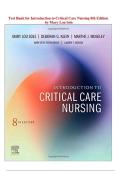
Test Bank for Introduction to Critical Care Nursing 8th Edition
by Mary Lou Sole
, Chapter 01: Overview of Critical Care Nursing
MULTIPLE CHOICE QUESTIONS
1. Which professional organization most effectively supports the field of critical care nursing?
a. American Association of Critical-Care Nurses
b. American Heart Association
c. American Nurses Association
d. Society of Critical Care Medicine
Correct Answer: A
Explanation: The American Association of Critical-Care Nurses specializes in advocating for and
representing critical care nurses. The American Heart Association focuses on cardiovascular health
initiatives, while the American Nurses Association represents all nurses. The Society of Critical Care
Medicine supports a multidisciplinary critical care team led by an intensivist.
Cognitive Level: Knowledge | Reference: p. 4
Objective: Explain the roles and functions of professional organizations in critical care.
NCLEX Category: Safe and Effective Care Environment
2. A nurse with two years of experience in a surgical intensive care unit wants to obtain certification.
Which credential is most suitable?
a. ACNPC
b. CCNS
c. CCRN
d. PCCN
Correct Answer: C
Explanation: The CCRN certification is ideal for bedside nurses providing care to critically ill patients.
The ACNPC certification is designated for acute care nurse practitioners, while the CCNS is meant for
critical care clinical nurse specialists. The PCCN certification applies to nurses working in progressive or
step-down care units.
Cognitive Level: Application | Reference: p. 5
Objective: Outline certification options for critical care nurses.
NCLEX Category: Safe and Effective Care Environment
,3. What is the primary purpose of certification?
a. Guarantee that no mistakes will be made in patient care.
b. Serve as preparation for graduate school.
c. Contribute to magnet status recognition for healthcare facilities.
d. Confirm expertise in critical care nursing.
Correct Answer: D
Explanation: Certification verifies expertise in critical care nursing, promotes professional excellence,
and ensures ongoing competency. While it reassures patients of a nurse’s competence, it does not
eliminate errors. Certification does not serve as a prerequisite for graduate education, though it does
demonstrate professionalism. Facilities with magnet status benefit from a high number of certified nurses,
but that is not the primary goal of certification.
Cognitive Level: Analysis | Reference: pp. 4-5
Objective: Describe certification opportunities in critical care nursing.
NCLEX Category: Safe and Effective Care Environment
4. What is the main focus of the synergy model of nursing practice?
a. Allowing 24-hour unrestricted visitation for patients.
b. Utilizing holistic and alternative therapies.
c. Addressing patient and family needs, which define nursing competency.
d. Meeting patients’ energy and support requirements.
Correct Answer: C
Explanation: The synergy model asserts that nursing competencies should align with patient and family
needs. Although visiting policies and alternative therapies may be incorporated, they are not the primary
focus of the model.
Cognitive Level: Application | Reference: p. 5 | Fig. 1-3
Objective: Explain the professional standards in critical care nursing.
NCLEX Category: Safe and Effective Care Environment
5. A critically ill patient’s family mentions they have not spoken with the physician in over 24 hours
and need clarification on some concerns. During morning rounds, the nurse informs the intensivist
and arranges a meeting for the family at 4:00 PM. Which critical care nursing competency does
this best represent?
, a. Advocacy and ethical problem-solving
b. Clinical reasoning and judgment
c. Team collaboration with patients, families, and healthcare providers
d. Educating patients, families, and healthcare team members
Correct Answer: C
Explanation: While multiple competencies could be involved, coordinating communication between the
family and physician primarily represents collaboration.
Cognitive Level: Analysis | Reference: p. 9
Objective: Explain professional practice standards for critical care nurses.
NCLEX Category: Safe and Effective Care Environment
6. The AACN Standards for Acute and Critical Care Nursing Practice are based on which
framework?
a. Evidence-based practice
b. Healthy work environment
c. National Patient Safety Goals
d. Nursing process
Correct Answer: D
Explanation: The AACN Standards use the nursing process framework, including assessment, diagnosis,
planning, implementation, and evaluation. Though AACN promotes a healthy work environment and
follows patient safety initiatives, these are not part of its core standards.
Cognitive Level: Analysis | Reference: p. 5 | Box 1-2
Objective: Discuss professional standards in critical care.
NCLEX Category: Safe and Effective Care Environment
7. A charge nurse assigns an experienced, certified nurse to a critically ill sepsis patient requiring
continuous renal replacement therapy and ventilation, while a less experienced nurse is assigned to
more stable patients. This assignment reflects the implementation of:
a. Crew resource management model
b. National Patient Safety Goals
c. Quality and Safety Education for Nurses (QSEN) model
d. Synergy model of practice
by Mary Lou Sole
, Chapter 01: Overview of Critical Care Nursing
MULTIPLE CHOICE QUESTIONS
1. Which professional organization most effectively supports the field of critical care nursing?
a. American Association of Critical-Care Nurses
b. American Heart Association
c. American Nurses Association
d. Society of Critical Care Medicine
Correct Answer: A
Explanation: The American Association of Critical-Care Nurses specializes in advocating for and
representing critical care nurses. The American Heart Association focuses on cardiovascular health
initiatives, while the American Nurses Association represents all nurses. The Society of Critical Care
Medicine supports a multidisciplinary critical care team led by an intensivist.
Cognitive Level: Knowledge | Reference: p. 4
Objective: Explain the roles and functions of professional organizations in critical care.
NCLEX Category: Safe and Effective Care Environment
2. A nurse with two years of experience in a surgical intensive care unit wants to obtain certification.
Which credential is most suitable?
a. ACNPC
b. CCNS
c. CCRN
d. PCCN
Correct Answer: C
Explanation: The CCRN certification is ideal for bedside nurses providing care to critically ill patients.
The ACNPC certification is designated for acute care nurse practitioners, while the CCNS is meant for
critical care clinical nurse specialists. The PCCN certification applies to nurses working in progressive or
step-down care units.
Cognitive Level: Application | Reference: p. 5
Objective: Outline certification options for critical care nurses.
NCLEX Category: Safe and Effective Care Environment
,3. What is the primary purpose of certification?
a. Guarantee that no mistakes will be made in patient care.
b. Serve as preparation for graduate school.
c. Contribute to magnet status recognition for healthcare facilities.
d. Confirm expertise in critical care nursing.
Correct Answer: D
Explanation: Certification verifies expertise in critical care nursing, promotes professional excellence,
and ensures ongoing competency. While it reassures patients of a nurse’s competence, it does not
eliminate errors. Certification does not serve as a prerequisite for graduate education, though it does
demonstrate professionalism. Facilities with magnet status benefit from a high number of certified nurses,
but that is not the primary goal of certification.
Cognitive Level: Analysis | Reference: pp. 4-5
Objective: Describe certification opportunities in critical care nursing.
NCLEX Category: Safe and Effective Care Environment
4. What is the main focus of the synergy model of nursing practice?
a. Allowing 24-hour unrestricted visitation for patients.
b. Utilizing holistic and alternative therapies.
c. Addressing patient and family needs, which define nursing competency.
d. Meeting patients’ energy and support requirements.
Correct Answer: C
Explanation: The synergy model asserts that nursing competencies should align with patient and family
needs. Although visiting policies and alternative therapies may be incorporated, they are not the primary
focus of the model.
Cognitive Level: Application | Reference: p. 5 | Fig. 1-3
Objective: Explain the professional standards in critical care nursing.
NCLEX Category: Safe and Effective Care Environment
5. A critically ill patient’s family mentions they have not spoken with the physician in over 24 hours
and need clarification on some concerns. During morning rounds, the nurse informs the intensivist
and arranges a meeting for the family at 4:00 PM. Which critical care nursing competency does
this best represent?
, a. Advocacy and ethical problem-solving
b. Clinical reasoning and judgment
c. Team collaboration with patients, families, and healthcare providers
d. Educating patients, families, and healthcare team members
Correct Answer: C
Explanation: While multiple competencies could be involved, coordinating communication between the
family and physician primarily represents collaboration.
Cognitive Level: Analysis | Reference: p. 9
Objective: Explain professional practice standards for critical care nurses.
NCLEX Category: Safe and Effective Care Environment
6. The AACN Standards for Acute and Critical Care Nursing Practice are based on which
framework?
a. Evidence-based practice
b. Healthy work environment
c. National Patient Safety Goals
d. Nursing process
Correct Answer: D
Explanation: The AACN Standards use the nursing process framework, including assessment, diagnosis,
planning, implementation, and evaluation. Though AACN promotes a healthy work environment and
follows patient safety initiatives, these are not part of its core standards.
Cognitive Level: Analysis | Reference: p. 5 | Box 1-2
Objective: Discuss professional standards in critical care.
NCLEX Category: Safe and Effective Care Environment
7. A charge nurse assigns an experienced, certified nurse to a critically ill sepsis patient requiring
continuous renal replacement therapy and ventilation, while a less experienced nurse is assigned to
more stable patients. This assignment reflects the implementation of:
a. Crew resource management model
b. National Patient Safety Goals
c. Quality and Safety Education for Nurses (QSEN) model
d. Synergy model of practice