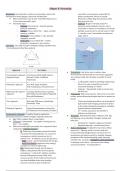
Chapter 9: Personality
Hippocrates: Developed his own theory of personality rooted in the accessible to consciousness, responsible for
four humours: blood, phlegm, yellow bile and black bile defence mechanisms, directs us towards
● Believed that these were the four vital bodily fluids (excess behaviours yielding long-term pleasures rather
of one causes personality type) then short-term ones
● Personality types: ○ Superego: Begins to develop around 4-5,
○ Sanguine: Excess blood = cheerful, optimist, represents moral standards of society, tries to
extrovert, enthusiastic ensure that we always act according to our morals,
○ Choleric: Excess yellow bile = angry, excitable, partially conscious (we’re actively aware of what
assertive, confident is “morally correct” and whether our behaviour
○ Phlegmatic: Excess phlegm = calm, peaceful, aligns with it)
thoughtful, reserved
○ Melancholic: Excess black bile = somber,
pessimistic, introspective, sad, sensitive
Personality: The study of people’s thoughts, feelings and behaviours,
+ the mechanisms behind those patterns
Approach Key Topics
● Preconscious: Just below water’s surface, where
Psychoanalytic Approach Unconscious Mind, Hidden desires, facts/memories/emotions that are not actively engaged by
(Sigmund Freud) Internal Conflict, Childhood our conscious mind, but still easily accessible for recall
Experiences reside
○ Ie. Being told to think of something embarrassing
Humanistic Approach Free Will, Innate Goodness, allows it to come to mind but you weren’t
Self-Actualization, Personal Growth consciously thinking of it before
○ Superego + Ego partially reside in preconscious
Behavioural & Cognitive Learning, Reinforcement, Cognition, (Id does not)
Approach How Behaviour Develops/Is Shaped By ● Unconscious: Below preconscious, where most of our mind
Rewards/Punishments resides, anxious/distressing thoughts kept here to protect our
psyche
Trait Approach Individual Differences, Quantifying ○ Various psychological problems can be brought to
Personality Traits light and solved by bringing unconscious desires
to the surface (through psychoanalysis, including
Biological Approach Genes/Neurotransmitters Giving Rise hypnotism/dream interpretation)
To Differences In Personality, Evolution ○ Id = entirely unconscious but still able to
influence our behaviours
Psychoanalytic Approach: Created by Freud to explain how
● Personality: Determined by relative influence of Id, Ego,
unconscious processes could be brought to light/alter behaviour
and Superego on an individual’s thoughts, feelings and
● Pro: Offers complete theory of personality
behaviour
● Criticisms: Unmeasurable + not capable of benign proven
○ Dominant Id = impulsive/aggressive/criminal
false + very complex
○ Dominant Superego = perfectionistic/pious
● Believed an individual’s personality was comprised of three
● Defence Mechanisms: Employed by Ego when conflicts
components (“tripartite structure”)
between Id + Superego result in anxiety, make sure
○ Id: Primal part of personality, present from birth,
anxiety-producing thoughts/desires are kept at level of
concerned with seeking pleasure, no concern for
unconscious, ego reduces anxiety by mentally changing
consequences, entirely unconscious (we’re
perception of the situation/distorting reality into more
unaware of it + its influence on us), driving forces
tolerable form, can lead to maladaptive coping mechanisms
= libido (sexual + preserving/bettering life energy)
(ie denying severe illness = prevention from seeking
+ death drive/thanatos (aggressive/risky energy),
necessary treatment = worsening illness)
no patience or sense of right/wrong
○ Ego: Rational part of mind, first develops in
toddlers, seeks pleasure like Id but recognizes
consequences + restricts Id’s impulses, mediator
between Id/Superego/external reality, both
conscious (aware of real world) and unconscious
(can keep forbidden desires from reaching
conscious awareness), part of mind most
, Chapter 9: Personality
● Childhood Experiences: Believed childhood experience had
Defense Definition Example
a lasting impact on one’s personality (3 components making
Mechanism
up personality are all present by age 5)
○ Believed children were inherently sexual beings,
Denial Anxiety-producing A patient refuses to
and as children developed, they went through a
(problematic) events are not believe that they have
series of psychosexual stages, each marked by
accepted as reality an incurable disease,
specific challenges/realisations
(even after they have despite multiple
○ If a conflict occurred during one of these stages, a
entered conscious doctors’ diagnosis.
person’s unconscious mind would become fixated
awareness)
on that stage, leaving lasting impacts on
personality
Repression Anxiety-producing Someone who suffered
■ Minority develop no fixations at any
(problematic) thoughts and abuse in childhood
psychosexual stage
unacceptable cannot remember the
impulses are kept in traumatic events. ■ Ie. If conflict occurs at oral stage
the subconscious. (centred around feeding) = personality
traits associated with the mouth
Reaction Anxiety-producing Although a man wants a (overtalkative, smoker)
Formation thoughts and girlfriend, he is unable ○ Core tenet of this theory = children develop sexual
impulses are to get one. To reduce desire towards opposite-sex parent + view
replaced with their this anxiety, he same-sex parent as rival
opposite. expresses misogynistic ○ Freudian Slip: Mistakes in speaking that aren’t
beliefs. random/meaningless but reflect the desires/
worries preoccupying our unconscious mind
Projection The attribution of an A partner who is ■ Ie. Calling your teacher mom because
(problematic) undesirable considering cheating you see her as a nurturing, maternal
trait/impusle in strongly suspects their figure
oneself to another. partner is cheating on ○ Dreams: Highly revealing of our unconscious
them. minds, have manifest content (what they’re
literally about) + latent content (hidden meanings
Rationalization Anxiety-producing Someone who is that speak to some desire/concern we’re unaware
(problematic) feelings/actions and rejected for a date says of)
id impulses are that they weren’t ■ Ie. Dream about taking a long journey
justified with attracted to that person with a king and queen, king and queen =
seemingly logical anyway. your parents, journey = death, dream =
explanations. unconscious anxiety about your parents’
death
Intellectualization Anxiety-producing Someone whose family Classic Behaviourism: Watson and Skinner focused on personality as
and threatening member has passed will only overt expressions of behaviour that could be measured (complete
situations are be detached, opposite of freud), instrumental conditioning (rewards/punishment)
translated into emotionless, and focused
intellectual terms technical when they ● Believed you could not accurately measure someone’s
devoid of emotion. describe the events. mental processes (especially unconscious ones)
(e.g. “the presence of ● Aimed to answer the question of how personality changes
edema indicated to us over time (People = born with no particular personality/
that their time was blank-slate, can be conditioned/trained into anything)
near”) ● Criticisms: Too narrow + ignores biological basis for
personality characteristics + simplistic (people are more
Displacement Forbidden impulses Someone who has had a than just their actions)
are redirected to a difficult day at work ○ Little Albert: Conditioned nine-month-old infant
safer target. may go home and fight to fear certain stimuli by presenting it with loud
with their partner. noises, albert began to generalize fear response (ie
originally white rat generalized to other fluffy,
Sublimation Anxiety-producing Someone may channel white objects), conclusion = fear critically impacts
(mature, thoughts and their anger and personality development + behaviour/personality
well-functioning impulses are compose a piece of rock is changed through classical and especially
mind) converted into music. instrumental conditioning (shapes behaviour
socially acceptable through rewards/punishments)
outputs (to satisfy Social Cognitive Theory: Cognitive approach to personality created by
both id and Albert Bandura, emphasizes the role of observational learning,
superego) modelling and cognitive processes in shaping behaviour
● States that people are not simply reacting to their
environment but are actively participating in it
Hippocrates: Developed his own theory of personality rooted in the accessible to consciousness, responsible for
four humours: blood, phlegm, yellow bile and black bile defence mechanisms, directs us towards
● Believed that these were the four vital bodily fluids (excess behaviours yielding long-term pleasures rather
of one causes personality type) then short-term ones
● Personality types: ○ Superego: Begins to develop around 4-5,
○ Sanguine: Excess blood = cheerful, optimist, represents moral standards of society, tries to
extrovert, enthusiastic ensure that we always act according to our morals,
○ Choleric: Excess yellow bile = angry, excitable, partially conscious (we’re actively aware of what
assertive, confident is “morally correct” and whether our behaviour
○ Phlegmatic: Excess phlegm = calm, peaceful, aligns with it)
thoughtful, reserved
○ Melancholic: Excess black bile = somber,
pessimistic, introspective, sad, sensitive
Personality: The study of people’s thoughts, feelings and behaviours,
+ the mechanisms behind those patterns
Approach Key Topics
● Preconscious: Just below water’s surface, where
Psychoanalytic Approach Unconscious Mind, Hidden desires, facts/memories/emotions that are not actively engaged by
(Sigmund Freud) Internal Conflict, Childhood our conscious mind, but still easily accessible for recall
Experiences reside
○ Ie. Being told to think of something embarrassing
Humanistic Approach Free Will, Innate Goodness, allows it to come to mind but you weren’t
Self-Actualization, Personal Growth consciously thinking of it before
○ Superego + Ego partially reside in preconscious
Behavioural & Cognitive Learning, Reinforcement, Cognition, (Id does not)
Approach How Behaviour Develops/Is Shaped By ● Unconscious: Below preconscious, where most of our mind
Rewards/Punishments resides, anxious/distressing thoughts kept here to protect our
psyche
Trait Approach Individual Differences, Quantifying ○ Various psychological problems can be brought to
Personality Traits light and solved by bringing unconscious desires
to the surface (through psychoanalysis, including
Biological Approach Genes/Neurotransmitters Giving Rise hypnotism/dream interpretation)
To Differences In Personality, Evolution ○ Id = entirely unconscious but still able to
influence our behaviours
Psychoanalytic Approach: Created by Freud to explain how
● Personality: Determined by relative influence of Id, Ego,
unconscious processes could be brought to light/alter behaviour
and Superego on an individual’s thoughts, feelings and
● Pro: Offers complete theory of personality
behaviour
● Criticisms: Unmeasurable + not capable of benign proven
○ Dominant Id = impulsive/aggressive/criminal
false + very complex
○ Dominant Superego = perfectionistic/pious
● Believed an individual’s personality was comprised of three
● Defence Mechanisms: Employed by Ego when conflicts
components (“tripartite structure”)
between Id + Superego result in anxiety, make sure
○ Id: Primal part of personality, present from birth,
anxiety-producing thoughts/desires are kept at level of
concerned with seeking pleasure, no concern for
unconscious, ego reduces anxiety by mentally changing
consequences, entirely unconscious (we’re
perception of the situation/distorting reality into more
unaware of it + its influence on us), driving forces
tolerable form, can lead to maladaptive coping mechanisms
= libido (sexual + preserving/bettering life energy)
(ie denying severe illness = prevention from seeking
+ death drive/thanatos (aggressive/risky energy),
necessary treatment = worsening illness)
no patience or sense of right/wrong
○ Ego: Rational part of mind, first develops in
toddlers, seeks pleasure like Id but recognizes
consequences + restricts Id’s impulses, mediator
between Id/Superego/external reality, both
conscious (aware of real world) and unconscious
(can keep forbidden desires from reaching
conscious awareness), part of mind most
, Chapter 9: Personality
● Childhood Experiences: Believed childhood experience had
Defense Definition Example
a lasting impact on one’s personality (3 components making
Mechanism
up personality are all present by age 5)
○ Believed children were inherently sexual beings,
Denial Anxiety-producing A patient refuses to
and as children developed, they went through a
(problematic) events are not believe that they have
series of psychosexual stages, each marked by
accepted as reality an incurable disease,
specific challenges/realisations
(even after they have despite multiple
○ If a conflict occurred during one of these stages, a
entered conscious doctors’ diagnosis.
person’s unconscious mind would become fixated
awareness)
on that stage, leaving lasting impacts on
personality
Repression Anxiety-producing Someone who suffered
■ Minority develop no fixations at any
(problematic) thoughts and abuse in childhood
psychosexual stage
unacceptable cannot remember the
impulses are kept in traumatic events. ■ Ie. If conflict occurs at oral stage
the subconscious. (centred around feeding) = personality
traits associated with the mouth
Reaction Anxiety-producing Although a man wants a (overtalkative, smoker)
Formation thoughts and girlfriend, he is unable ○ Core tenet of this theory = children develop sexual
impulses are to get one. To reduce desire towards opposite-sex parent + view
replaced with their this anxiety, he same-sex parent as rival
opposite. expresses misogynistic ○ Freudian Slip: Mistakes in speaking that aren’t
beliefs. random/meaningless but reflect the desires/
worries preoccupying our unconscious mind
Projection The attribution of an A partner who is ■ Ie. Calling your teacher mom because
(problematic) undesirable considering cheating you see her as a nurturing, maternal
trait/impusle in strongly suspects their figure
oneself to another. partner is cheating on ○ Dreams: Highly revealing of our unconscious
them. minds, have manifest content (what they’re
literally about) + latent content (hidden meanings
Rationalization Anxiety-producing Someone who is that speak to some desire/concern we’re unaware
(problematic) feelings/actions and rejected for a date says of)
id impulses are that they weren’t ■ Ie. Dream about taking a long journey
justified with attracted to that person with a king and queen, king and queen =
seemingly logical anyway. your parents, journey = death, dream =
explanations. unconscious anxiety about your parents’
death
Intellectualization Anxiety-producing Someone whose family Classic Behaviourism: Watson and Skinner focused on personality as
and threatening member has passed will only overt expressions of behaviour that could be measured (complete
situations are be detached, opposite of freud), instrumental conditioning (rewards/punishment)
translated into emotionless, and focused
intellectual terms technical when they ● Believed you could not accurately measure someone’s
devoid of emotion. describe the events. mental processes (especially unconscious ones)
(e.g. “the presence of ● Aimed to answer the question of how personality changes
edema indicated to us over time (People = born with no particular personality/
that their time was blank-slate, can be conditioned/trained into anything)
near”) ● Criticisms: Too narrow + ignores biological basis for
personality characteristics + simplistic (people are more
Displacement Forbidden impulses Someone who has had a than just their actions)
are redirected to a difficult day at work ○ Little Albert: Conditioned nine-month-old infant
safer target. may go home and fight to fear certain stimuli by presenting it with loud
with their partner. noises, albert began to generalize fear response (ie
originally white rat generalized to other fluffy,
Sublimation Anxiety-producing Someone may channel white objects), conclusion = fear critically impacts
(mature, thoughts and their anger and personality development + behaviour/personality
well-functioning impulses are compose a piece of rock is changed through classical and especially
mind) converted into music. instrumental conditioning (shapes behaviour
socially acceptable through rewards/punishments)
outputs (to satisfy Social Cognitive Theory: Cognitive approach to personality created by
both id and Albert Bandura, emphasizes the role of observational learning,
superego) modelling and cognitive processes in shaping behaviour
● States that people are not simply reacting to their
environment but are actively participating in it