CSET Multiple Subject Subtest III Human Development Exam Q&A
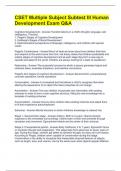
Cognitive Development - Answer-Transformations in a child's thought, language, and intelligence. Theories: 1. Piaget's Stages of Cognitive Development 2. Kohlberg's Stages of Moral Development 3. Multi-theoretical perspectives of language, intelligence, and children with special needs Piaget's Contributions - Answer-Much of what we know about how children think feel and respond to the world come from him. His theory states that children predictable and orderly stages of cognitive development and at each stage they form a new way to operate and adapt to the world. Children are always looking for a state of equilibrium. Reasoning - Answer-The purposeful process by which a person generates logical and coherent ideas, evaluates situations, and reaches conclusions. Piaget's four stages of cognitive development - Answer-Sensorimotor, preoperational, concrete operations, formal operations Conservation - Answer-A conceptual tool that allows a child to recognize that when altering the appearance of an object the basic properties do not change Assimilation - Answer-The way children incorporate new information with existing schemes in order to form a new cognitive structure, fitting the new knowledge into a template of existing schemes Accomodation - Answer-Occurs when children take existing schemes and adjust them to fit their experience piano/keyboard Schemas - Answer-Mental structure in which childrens knowledge is ordered into Stage 1- Sensorimotor stage - Answer-Infancy, Birth to 2 years, infants physical response to the immediate surroundings, Infants learn of their environments through sensation and movement. Egocentrism-infants are the center of their universe. Stage 2- Preoperational period - Answer-Early childhood, 2 to 7 years, Egocentric focus on symbolic thought and imagination, This stage lasts from about two to seven years of age. During this stage, children get better at symbolic thought, but they can't yet reason. According to Piaget, children aren't capable of conservation during this stage. Conservation is the ability to recognize that measurable physical features of objects, such as length, area, and volume, can be the same even when objects appear different.
Schule, Studium & Fach
- Hochschule
- CSET
- Kurs
- CSET
Dokument Information
- Hochgeladen auf
- 19. februar 2024
- Anzahl der Seiten
- 22
- geschrieben in
- 2023/2024
- Typ
- Prüfung
- Enthält
- Fragen & Antworten
Themen
-
cset multiple subject subtest iii human developmen
-
cognitive development answer transformations in

Ebenfalls erhältlich im paket-deal