Week 1
- Lecture: The big picture: determinants of long-run change
Week 2
- Lecture: The Malthusian world
Week 3
- Lecture: The first industrial revolution
Week 4
- Lecture: The spread of industry
- Tutorial: Serfdom and industrialization in Russia
o The economic effects of the abolition of serfdom: Evidence from the Russian Empire
(Markevich & Zhuravskaya, 2018)
Week 5
- Lecture: Infrastructure and growth
- Tutorial: Railways in England and Wales
o Railways, divergence, and structural change in 19 th century England and Wales
(Bogart et al., 2022)
Week 6
- Lecture: cancelled
- Tutorial: Geography and industrial location
o The location of the UK cotton textiles industry in 1838: a quantitative analysis (Crafts
& Wolf, 2014)
Week 7
- Lecture: Culture and development
- Tutorial: The role of Protestantism
o Weber revisited: the protestant ethic and the spirit of nationalism (Kersting et al.,
2020)
o Was Weber wrong? A human capital theory of Protestant economic history (Becker &
Woessmann, 2009)
Week 8
- Lecture: Nation building
- Tutorial: Nation building in France
o French (Blanc & Kubo, 2023)
Week 9
- Lecture: State capacity and democracy
- Tutorial: Revolution, war and democracy
o Democratization under the threat of revolution: evidence from the Great Reform Act
in 1831 (Aidt & Frank, 2015)
o Background: Window of opportunity: war and the origins of parliament (Dincecco et
al., 2023)
,Week 10
- Lecture: The economics of colonialism
- Tutorial: Colonialism
o The colonial origins of comparative development: an empirical investigation
(Acemoglu et al., 2001)
o Comment on: the colonial origins of comparative development (Albouy, 2012)
o Background: The ‘reversal of fortune’ thesis and the compression of history:
Perspectives from African and comparative economic history (Austin, 2008)
Week 11
- Lecture: A first globalization
- Tutorial: Globalization and the rise of steam
o The wind of change: maritime technology, trade, and economic development
(Pascali, 2017)
Week 12
- Lecture: Capital markets and the gold standard
- Tutorial: Real effects of money
o The real effects of monetary expansions: evidence from a large-scale historical
experiment (Palma, 2022)
Week 13
- Lecture: Labor markets: migrations
- Tutorial: Mass migration in the US
o A nation of immigrants: Assimilation and economic outcomes in the age of mass
migration (Abramitzky et al., 2014)
Week 14
- Lecture: Labor markets: growth and fragmentation
- Tutorial: Female labor market participation
o Understanding the gender gap: an economic history of American women (Goldin,
1990)
Week 15
- Lecture: Economics and the origins of world war I
- Tutorial: Trade and war
o Make trade not war? (Martin et al., 2008)
P.S.: Tutorial of Week 2 and 3 were cancelled do not need to know these papers.
P.S.: Lecture of Week 6 on urbanization and agglomeration was cancelled do not need to know this!
,Week 1: The Big Picture: Determinants of Long-run Change
“Path dependence”: past decisions/ events affect current and future options.
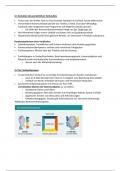
World economic history in one picture
- Up to 1800 no sustained growth of per capita income (“Malthusian World”)
o There were large variations across time and space, but without a trend.
o Long run stable or very slowly growing population
- Around 1800 per capita income started to grow (“industrial Revolution”/ “First
Globalization”)
o In a global perspective we observe a “great divergence” in per capita income
We have population data due to many efforts to tax and archaeology. We have first “GDP-estimates”
in 1920s, fostered by Great Depression.
Distinguish proximate and fundamental causes (Acemoglu)
- Proximate causes: physical capital, human capital, labor, land, technology
- Fundamental causes: luck, geography (first and second nature), institutions (“Rules of the
game”), culture (can be subsumed under informal institutions)
, Week 2: The Malthusian World
Women can have a lot of children, why didn’t the population grow before 1800?
“Malthusian growth” is the idea that population tends to grow at a geometric rate (exponential
growth), while output (resources such as food) can only increase at an arithmetic rate (linear growth).
Malthusian thinking: Thomas Robert Malthus: ‘An essay on the principle of population’.
Effect of higher wages on population growth and standard of living:
- Positive effect on population growth: higher wages leads to an increase in the standard of
living, which increases BR.
- Negative effect on standards of living: due to increase BR and growing population, it would
eventually outstrip the available supply. In turn, this would lead to decline in standard of
living.
This is called the “Malthusian trap”
- Growth rate of population: GR = BR – DR
- Positive checks: disease, Famine, and War. Natural ways to control population. DR will
increase if positive checks increase.
- Preventive checks: moral restraint (limiting size family) and delayed marriage. Implemented
by individuals and societies. BR will decrease when preventive checks increase.
According to Malthus only a reduced BR (preventive checks) will increase the standard of
living for the poor.
CBR and CDR (number of births or deaths in a given year per 1000 population) and their response to
the standard of living changed in England since 1650. The change was from “chaos and inefficiency to
order and efficiency”: strategic space of population growth.
- First we see a decline in CDR
o Caused by better food and improved sanitary infrastructure, standards and medicine.
- Followed by a decline in CBR
o Caused by various factors (i.e., increase in wages for women; this raised opportunity
costs children, late marriage, unmarried)
A period of massive population growth
“Malthusian trap” is broken (due to technology, agricultural improvements and
industrialization)
- Lecture: The big picture: determinants of long-run change
Week 2
- Lecture: The Malthusian world
Week 3
- Lecture: The first industrial revolution
Week 4
- Lecture: The spread of industry
- Tutorial: Serfdom and industrialization in Russia
o The economic effects of the abolition of serfdom: Evidence from the Russian Empire
(Markevich & Zhuravskaya, 2018)
Week 5
- Lecture: Infrastructure and growth
- Tutorial: Railways in England and Wales
o Railways, divergence, and structural change in 19 th century England and Wales
(Bogart et al., 2022)
Week 6
- Lecture: cancelled
- Tutorial: Geography and industrial location
o The location of the UK cotton textiles industry in 1838: a quantitative analysis (Crafts
& Wolf, 2014)
Week 7
- Lecture: Culture and development
- Tutorial: The role of Protestantism
o Weber revisited: the protestant ethic and the spirit of nationalism (Kersting et al.,
2020)
o Was Weber wrong? A human capital theory of Protestant economic history (Becker &
Woessmann, 2009)
Week 8
- Lecture: Nation building
- Tutorial: Nation building in France
o French (Blanc & Kubo, 2023)
Week 9
- Lecture: State capacity and democracy
- Tutorial: Revolution, war and democracy
o Democratization under the threat of revolution: evidence from the Great Reform Act
in 1831 (Aidt & Frank, 2015)
o Background: Window of opportunity: war and the origins of parliament (Dincecco et
al., 2023)
,Week 10
- Lecture: The economics of colonialism
- Tutorial: Colonialism
o The colonial origins of comparative development: an empirical investigation
(Acemoglu et al., 2001)
o Comment on: the colonial origins of comparative development (Albouy, 2012)
o Background: The ‘reversal of fortune’ thesis and the compression of history:
Perspectives from African and comparative economic history (Austin, 2008)
Week 11
- Lecture: A first globalization
- Tutorial: Globalization and the rise of steam
o The wind of change: maritime technology, trade, and economic development
(Pascali, 2017)
Week 12
- Lecture: Capital markets and the gold standard
- Tutorial: Real effects of money
o The real effects of monetary expansions: evidence from a large-scale historical
experiment (Palma, 2022)
Week 13
- Lecture: Labor markets: migrations
- Tutorial: Mass migration in the US
o A nation of immigrants: Assimilation and economic outcomes in the age of mass
migration (Abramitzky et al., 2014)
Week 14
- Lecture: Labor markets: growth and fragmentation
- Tutorial: Female labor market participation
o Understanding the gender gap: an economic history of American women (Goldin,
1990)
Week 15
- Lecture: Economics and the origins of world war I
- Tutorial: Trade and war
o Make trade not war? (Martin et al., 2008)
P.S.: Tutorial of Week 2 and 3 were cancelled do not need to know these papers.
P.S.: Lecture of Week 6 on urbanization and agglomeration was cancelled do not need to know this!
,Week 1: The Big Picture: Determinants of Long-run Change
“Path dependence”: past decisions/ events affect current and future options.
World economic history in one picture
- Up to 1800 no sustained growth of per capita income (“Malthusian World”)
o There were large variations across time and space, but without a trend.
o Long run stable or very slowly growing population
- Around 1800 per capita income started to grow (“industrial Revolution”/ “First
Globalization”)
o In a global perspective we observe a “great divergence” in per capita income
We have population data due to many efforts to tax and archaeology. We have first “GDP-estimates”
in 1920s, fostered by Great Depression.
Distinguish proximate and fundamental causes (Acemoglu)
- Proximate causes: physical capital, human capital, labor, land, technology
- Fundamental causes: luck, geography (first and second nature), institutions (“Rules of the
game”), culture (can be subsumed under informal institutions)
, Week 2: The Malthusian World
Women can have a lot of children, why didn’t the population grow before 1800?
“Malthusian growth” is the idea that population tends to grow at a geometric rate (exponential
growth), while output (resources such as food) can only increase at an arithmetic rate (linear growth).
Malthusian thinking: Thomas Robert Malthus: ‘An essay on the principle of population’.
Effect of higher wages on population growth and standard of living:
- Positive effect on population growth: higher wages leads to an increase in the standard of
living, which increases BR.
- Negative effect on standards of living: due to increase BR and growing population, it would
eventually outstrip the available supply. In turn, this would lead to decline in standard of
living.
This is called the “Malthusian trap”
- Growth rate of population: GR = BR – DR
- Positive checks: disease, Famine, and War. Natural ways to control population. DR will
increase if positive checks increase.
- Preventive checks: moral restraint (limiting size family) and delayed marriage. Implemented
by individuals and societies. BR will decrease when preventive checks increase.
According to Malthus only a reduced BR (preventive checks) will increase the standard of
living for the poor.
CBR and CDR (number of births or deaths in a given year per 1000 population) and their response to
the standard of living changed in England since 1650. The change was from “chaos and inefficiency to
order and efficiency”: strategic space of population growth.
- First we see a decline in CDR
o Caused by better food and improved sanitary infrastructure, standards and medicine.
- Followed by a decline in CBR
o Caused by various factors (i.e., increase in wages for women; this raised opportunity
costs children, late marriage, unmarried)
A period of massive population growth
“Malthusian trap” is broken (due to technology, agricultural improvements and
industrialization)