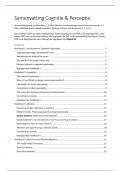
Pathology summary
(exam 1+2)
1
, Introduction to Pathology 3
Cell Injury, Cell Death, and Adaptations 4
In ammation and Repair 9
Hemodynamic Disorders, Thromboembolism, and Shock 14
Diseases of the Immune System 19
The Immune System, Organ Transplantations, and Cancer 25
Neoplasia 29
The Gastrointestinal Tract — Upper GI 33
The Gastrointestinal Tract — Lower GI 35
The Lung 37
The Hematopoietic System 43
The Lymphoid System 46
The Heart 49
The Female Genital System 54
The Nervous System — Neuropathology 59
The Nervous System — Neurodegenerative Diseases 63
2
fl
, Introduction to Pathology
PATHOLOGY — THE DEFINITION
- Pathology: the study of the causes and e ects of disease or injury
- The word ‘pathology’ also refers to the study of disease in general, incorporating a wide range
of biology research elds and medical practices
- However: when used in the context of modern medical treatment, the term is often
referred to the diagnosis of diseases, mostly through analysis of organs, tissues, cells, and
body uids
- Clinical pathology focuses on disease, whereas forensic pathology focuses on injury
DISEASE — THE DEFINITION
- Any abnormality that causes loss of health (‘ill health’)
- Characterized by a speci c set of features (signs, symptoms, functional and morphological
manifestations/alterations) that are not normal
- ‘Normal’: most frequent state in a population de ned by age distribution, gender, etc.
- Everything that is not normal (aka pathologic) is a disease
PATHOLOGY IS PART OF A DISEASE’S SYSTEMATIC DESCRIPTION
- Pathology has to do with:
- Epidemiology: distribution (prevalence) and determinants in general population
- Etiology (or ‘causa’): cause, why a disease arises
- Pathogenesis: disease mechanisms, how a disease develops
- Clinical signs and symptoms
- Morphologic (tissue, cellular, genetic) manifestations
- Complications and sequelae (=chronic complication of acute condition)
- Prognosis
- Mortality
- De ning the etiology and pathogenesis of disease is essential for understanding disease, and
developing rational treatments and e ective preventive measures
PATHOLOGY USES A GENERAL TERMINOLOGY
- Pre xes
- Hyper-: more/bigger/higher than normal
- Meta-: similar to
- Hypo-: less/smaller/lower than normal
- Su xes
- -itis: in ammation
- -oma: tumor
- -oid: resemblance to tumor
- Eponyms: when a disease is given the name of the person that described it
- E.g. Hodgkin’s disease
THE DEPARTMENT OF PATHOLOGY
- From the operation room to the diagnosis: pathology is no black box
- In total ~40,000 diagnoses per year
- Histology (~25,000): diagnosis made on tissue
- Biopsies, resections, frozen sections
- Cytology (~15,000): diagnosis made on cells (mostly body uid)
- Fine needle aspirations (lymph node), brushes (biliary tract), uids (ascites, pleural
uid), smears (uterine cervix), urine, cerebrospinal uid
- Additional: obtain as much information as possible from cells and tissues via molecular
diagnostics
- Pathology provides diagnosis, and suggestion on prognosis and treatment
3
fl ffi
fifi flfl fi fi ff ff fi fl flfl
, - Autoptic pathology: making diagnosis on whole body of the patient
- Not only cause of death, but also guring out disease mechanism
- E.g. provide researchers with tissue of rare disorders for better understanding, study and
practice
- E.g. look at the e ects of an experimental treatment
- Steps of pathology:
1. Registration of the material that arrives in the department
2. Specimen grossing in the cutting room
3. Documenting cut pieces
4. Specimen selection and embedding in cassettes (3-5 mm thick tissue sections)
5. Tissue processing: xation (formalin) -> dehydration -> embedding -> para n blocks
- Para n hardens the tissue, so that it can be cut into smaller sections, stained,
and studied under the microscope
6. Tissue cutting using the microtome: para n block -> cutting (3-4 μm sections) ->
slides -> H&E stain
7. Evaluation by residents and pathology specialists
PATHOLOGIC DIAGNOSIS: SOURCE OF RELEVANT INFORMATION
- Diagnosis
- Benign vs malignant?
- Type of tumor?
- Prognosis
- TNM classi cation?
- Radicality?
- Prediction
- Response to treatment?
Cell Injury, Cell Death, and Adaptations
WHAT IS DISEASE?
- Dysfunction of an organ or tissue, because of damage to the cells
- The damage can be of many causes: chemical, thermal, radiation, DNA damage, micro-
bacterial, etc.
- The damaging agent is the etiology, the in uence on and the changes in cellular
processes re ect the pathogenesis
- E.g. radiation (=etiology), causing mutation in DNA and thereby incorrect AA, which
may produce a malfunctioning protein (=pathogenesis, often a sequence)
- Etiology of cholera bacteria vs pathogenesis of diarrhea of cholera
- E.g. HeLa cells: derived from a cervical cancer
- E.g. Nicolo Paganini with Marfan’s syndrome: genetic disorder that a ects connective tissue
CELLS
- Everything that goes wrong with people can be tracked back to something that goes wrong
within their cell(s)
- Illustrated by Schleiden, Schwann and Virchow in ‘Cellular pathology’
- There are di erent cells with di erent functions: if one of these cells dysfunctions, it leads
to disease
- Lots of cells work together, forming communities
- (Almost) all organisms are multicellular, but some are multicellular by choice: this is dictated by
the circumstances
- E.g. social amoeba Dictyostelium discoideum: survives periods of food shortage by
organizing itself in a multicellular aggregate
4
ffi fifffl ff fi ff fi ffifl ff ffi
(exam 1+2)
1
, Introduction to Pathology 3
Cell Injury, Cell Death, and Adaptations 4
In ammation and Repair 9
Hemodynamic Disorders, Thromboembolism, and Shock 14
Diseases of the Immune System 19
The Immune System, Organ Transplantations, and Cancer 25
Neoplasia 29
The Gastrointestinal Tract — Upper GI 33
The Gastrointestinal Tract — Lower GI 35
The Lung 37
The Hematopoietic System 43
The Lymphoid System 46
The Heart 49
The Female Genital System 54
The Nervous System — Neuropathology 59
The Nervous System — Neurodegenerative Diseases 63
2
fl
, Introduction to Pathology
PATHOLOGY — THE DEFINITION
- Pathology: the study of the causes and e ects of disease or injury
- The word ‘pathology’ also refers to the study of disease in general, incorporating a wide range
of biology research elds and medical practices
- However: when used in the context of modern medical treatment, the term is often
referred to the diagnosis of diseases, mostly through analysis of organs, tissues, cells, and
body uids
- Clinical pathology focuses on disease, whereas forensic pathology focuses on injury
DISEASE — THE DEFINITION
- Any abnormality that causes loss of health (‘ill health’)
- Characterized by a speci c set of features (signs, symptoms, functional and morphological
manifestations/alterations) that are not normal
- ‘Normal’: most frequent state in a population de ned by age distribution, gender, etc.
- Everything that is not normal (aka pathologic) is a disease
PATHOLOGY IS PART OF A DISEASE’S SYSTEMATIC DESCRIPTION
- Pathology has to do with:
- Epidemiology: distribution (prevalence) and determinants in general population
- Etiology (or ‘causa’): cause, why a disease arises
- Pathogenesis: disease mechanisms, how a disease develops
- Clinical signs and symptoms
- Morphologic (tissue, cellular, genetic) manifestations
- Complications and sequelae (=chronic complication of acute condition)
- Prognosis
- Mortality
- De ning the etiology and pathogenesis of disease is essential for understanding disease, and
developing rational treatments and e ective preventive measures
PATHOLOGY USES A GENERAL TERMINOLOGY
- Pre xes
- Hyper-: more/bigger/higher than normal
- Meta-: similar to
- Hypo-: less/smaller/lower than normal
- Su xes
- -itis: in ammation
- -oma: tumor
- -oid: resemblance to tumor
- Eponyms: when a disease is given the name of the person that described it
- E.g. Hodgkin’s disease
THE DEPARTMENT OF PATHOLOGY
- From the operation room to the diagnosis: pathology is no black box
- In total ~40,000 diagnoses per year
- Histology (~25,000): diagnosis made on tissue
- Biopsies, resections, frozen sections
- Cytology (~15,000): diagnosis made on cells (mostly body uid)
- Fine needle aspirations (lymph node), brushes (biliary tract), uids (ascites, pleural
uid), smears (uterine cervix), urine, cerebrospinal uid
- Additional: obtain as much information as possible from cells and tissues via molecular
diagnostics
- Pathology provides diagnosis, and suggestion on prognosis and treatment
3
fl ffi
fifi flfl fi fi ff ff fi fl flfl
, - Autoptic pathology: making diagnosis on whole body of the patient
- Not only cause of death, but also guring out disease mechanism
- E.g. provide researchers with tissue of rare disorders for better understanding, study and
practice
- E.g. look at the e ects of an experimental treatment
- Steps of pathology:
1. Registration of the material that arrives in the department
2. Specimen grossing in the cutting room
3. Documenting cut pieces
4. Specimen selection and embedding in cassettes (3-5 mm thick tissue sections)
5. Tissue processing: xation (formalin) -> dehydration -> embedding -> para n blocks
- Para n hardens the tissue, so that it can be cut into smaller sections, stained,
and studied under the microscope
6. Tissue cutting using the microtome: para n block -> cutting (3-4 μm sections) ->
slides -> H&E stain
7. Evaluation by residents and pathology specialists
PATHOLOGIC DIAGNOSIS: SOURCE OF RELEVANT INFORMATION
- Diagnosis
- Benign vs malignant?
- Type of tumor?
- Prognosis
- TNM classi cation?
- Radicality?
- Prediction
- Response to treatment?
Cell Injury, Cell Death, and Adaptations
WHAT IS DISEASE?
- Dysfunction of an organ or tissue, because of damage to the cells
- The damage can be of many causes: chemical, thermal, radiation, DNA damage, micro-
bacterial, etc.
- The damaging agent is the etiology, the in uence on and the changes in cellular
processes re ect the pathogenesis
- E.g. radiation (=etiology), causing mutation in DNA and thereby incorrect AA, which
may produce a malfunctioning protein (=pathogenesis, often a sequence)
- Etiology of cholera bacteria vs pathogenesis of diarrhea of cholera
- E.g. HeLa cells: derived from a cervical cancer
- E.g. Nicolo Paganini with Marfan’s syndrome: genetic disorder that a ects connective tissue
CELLS
- Everything that goes wrong with people can be tracked back to something that goes wrong
within their cell(s)
- Illustrated by Schleiden, Schwann and Virchow in ‘Cellular pathology’
- There are di erent cells with di erent functions: if one of these cells dysfunctions, it leads
to disease
- Lots of cells work together, forming communities
- (Almost) all organisms are multicellular, but some are multicellular by choice: this is dictated by
the circumstances
- E.g. social amoeba Dictyostelium discoideum: survives periods of food shortage by
organizing itself in a multicellular aggregate
4
ffi fifffl ff fi ff fi ffifl ff ffi