Maternal Newborn ATI Remediation
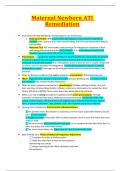
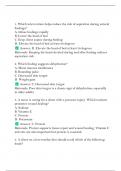
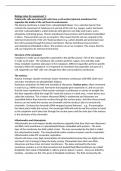
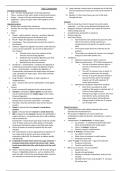
Maternal Newborn ATI Remediation • Assessment of Fetal Well-Being: Interdisciplinary Care Conference: o Biophysical Profile: BPP assesses fetal well-being by measuring the following five variables with a score of 2 for each normal finding, and 0 for each abnormal finding for each variable. o Nonstress Test: NST most widely used technique for antepartum evaluation of fetal well-being performed during the third trimester. It is a noninvasive procedure that monitors response of the FHR to fetal movement. • Preeclampsia: is a pregnancy-specific condition in which hypertension and proteinuria (protein in urine at or greater than 40 mg/dl concentration) develop after 20 weeks of gestation in a previously normotensive woman. It is a vasospastic, systemic disorder and is usually categorized as mild or sever for purposes of management. Usually with primiparous women or women having twins or more. Encourage use of antihypertensives (but can cause birth defects, and seizures). • What are the two conditions that need to present in preeclampsia? HTN and proteinuria. • HELLP: diagnosed when platelets drop below 100K (because bleeding risk). Considered severe pre-eclampsia that involves hepatic destruction • What are other symptoms we look for in preeclampsia? Sudden swelling of hands, face and feet, vomiting, increased deep tendon reflexes, proteinuria, decreased urine output (less than 30mL), HTN (over 140/90), Clonus, lates due to decreased placental perfusion. • What is our role in caring for patients hospitalized with severe preeclampsia? Through evaluation of maternal fetal status. Maternal assessments include monitoring of BP, urine output, cerebral status, and the presence of epigastric pain, abdominal tenderness, signs of labor, or placental abruption. Labs: platelet count, liver enzymes and serum creatinine. • Nursing Care of Newborns: Priority Action Following Delivery: 1. The greatest risk to the newborn is cold stress, the first nurse action after delivery should be to dry the newborn. 2. Weight the infant shortly after birth to obtain baseline, but it is not a first action the nurse needs to take. 3. The nurse should place identification bracelets on the newborn shortly after birth, but it is not a first action the nurse needs to take. 4. The nurse should obtain the Apgar score at 1 and 5 minutes after birth. • Baby-Friendly Care: Phases of Maternal Postpartum Adjustment: ◯ Considers the infant a family member ◯ Holds the infant face-to-face (en face position), maintaining eye contact ◯ Assigns meaning to the infant's behavior and views this positively Fetal Assessment ◯ Identifies the infant's unique characteristics and relates them to those of other family members. ◯ Names the infant, indicating bonding is occurring ◯ Touches the infant and maintains close physical proximity and contact ◯ Provides physical care for the infant, such as feeding and diapering ◯ Responds to the infant's cries ◯ Smiles at, talks to, and sings to the infan
Schule, Studium & Fach
- Hochschule
- Maternal Newborn
- Kurs
- Maternal Newborn
Dokument Information
- Hochgeladen auf
- 27. januar 2024
- Anzahl der Seiten
- 5
- geschrieben in
- 2023/2024
- Typ
- Prüfung
- Enthält
- Fragen & Antworten
Themen
-
maternal newborn ati remediati
-
maternal newborn ati remediation

Ebenfalls erhältlich im paket-deal