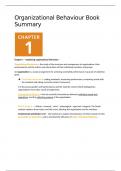
Organizational Behaviour Book
Summary
Chapter 1 – explaining organizational behaviour
Organizational behaviour = the study of the structure and management of organizations, their
environments and the actions and interactions of their individual members and groups
An organization is a social arrangement for achieving controlled performance in pursuit of collective
goals.
Controlled performance: setting standards, measuring performance, comparing actual with
the standard and taking corrective action if necessary.
It is the preoccupation with performance and the need for control which distinguishes
organizations from other social arrangements.
Organizational dilemma = how to reconcile inconsistency between individual needs and
aspirations, and the collective purpose of the organization.
PESTLE Analysis – Political, Economic, Social, Technological, Legal and Ecological. The Pestle
analysis explores these topics and the issues affecting the organization and its members.
Fundamental attribution error – the tendency to explain the behaviour of others based on their
personality or disposition, and to overlook the influence of wider contextual influences.
,The fundamental attribution error leads to false explanations of others behaviour. Their
behaviour can depend on diverse factors;
Context, individual, group, structural and management process factors
Organizational effectiveness – a multi-dimensional concept that can be defined differently by
different stakeholders. Stakeholders have different ideas about what counts as ‘effective’.
Balanced scorecard: an approach to defining organizational effectiveness using a combination of
quantitative and qualitative measures.
Quality of working life = an individual’s overall satisfaction with their job, working conditions,
pay, colleagues, management style, organization culture,, work-life balance, and training
development and career opportunities.
Positivism- a perspective which assumes the world can be understood in terms of causal
relationships between observable and measurable variables, and that these relationships can be
studied objectively using controlled experiments. A positivist uses the same research methods
found in natural sciences.
Operational definition: the method used to measure the incidence of a variable in practice
Variance theory = an approach to explaining organizational behaviour based on universal
relationships between independent and dependent variables which can be defined and measures
precisely. variance theory offers definitive explanations (links between causes and outcomes
do not change)
,Constructivism – a perspective which argues that our social and organisational worlds have no
ultimate objective truth or reality, but are instead determined by our shared experiences,
meanings and interpretations. A constructivist assumes that social science is different from
natural science.
The socially constructed version of events involves friendship, social interaction.
Process Theory : an approach to explaining organizational behaviour based on narratives which
show how several factors, combining and interacting over time in a particular context, are likely
to produce the outcomes of interest. Process theory offers probabilistic explanations
(combinations of factors are more or less likely to generate the outcomes of interest)
Evidence- based management – systematically using the best available research evidence to
inform decisions about how to manage people and organisations.
Human resource management: the function responsible for establishing integrated personnel
policies to support organisation strategy.
Employment cycle= the sequence of stages through which all employees pass in each working
position they hold, from recruitment and selection to termination
The Bath model of human resources management argues that discretionary behaviour going
beyond minimum requirements relies on having a combination of HR policies.
, AMO are the three factors that are the minimum requirements of a job; Ability, Motivation and
Opportunity.
Discretionary behaviour – freedom to decide how work is going to be performed; discretionary
behaviour can be positive, such as putting in extra time and effort, or it can be negative, such as
withholding information and cooperation.
A positive bundle of policies will have more impact than the sum of individual policies. A deadly
combination of other policies can compete with and weaken each other.
Big Data = information collected, often real-time, from sources such as internet clicks, mobile
transactions, user-generated content, social media, sensor networks, sales queries, purchases.
Data analytics – the use of powerful computational methods to reveal and to visualize patterns
and trends in very large sets of data
Human capital analytics: an HR practice enabled by computing technologies that use descriptive,
visual and statistical analyses of data related to HR processes, human capital, organizational
performance and external economic benchmarks to establish business impact and enable
evidence-based, data-driven decision-making
Chapter 4 - Culture
Organizational culture is the shared values, beliefs and norms which influence the way employees
think, feel and act towards others inside and outside the organization.
Organizational culture possesses four key attributes
1. Shared: shared behaviours, values and assumptions, and is experienced through their norms
and expectations (unwritten rules)
2. Pervasive: is manifested in surface manifestations such as collective behaviours, physical
environments, group ritual, physical symbols, stories and legends
3. Enduring: the thoughts and actions of employees over time
4. Implicit: individuals are hardwired to recognize and respond to culture instinctively as it acts
like a silent language.
Summary
Chapter 1 – explaining organizational behaviour
Organizational behaviour = the study of the structure and management of organizations, their
environments and the actions and interactions of their individual members and groups
An organization is a social arrangement for achieving controlled performance in pursuit of collective
goals.
Controlled performance: setting standards, measuring performance, comparing actual with
the standard and taking corrective action if necessary.
It is the preoccupation with performance and the need for control which distinguishes
organizations from other social arrangements.
Organizational dilemma = how to reconcile inconsistency between individual needs and
aspirations, and the collective purpose of the organization.
PESTLE Analysis – Political, Economic, Social, Technological, Legal and Ecological. The Pestle
analysis explores these topics and the issues affecting the organization and its members.
Fundamental attribution error – the tendency to explain the behaviour of others based on their
personality or disposition, and to overlook the influence of wider contextual influences.
,The fundamental attribution error leads to false explanations of others behaviour. Their
behaviour can depend on diverse factors;
Context, individual, group, structural and management process factors
Organizational effectiveness – a multi-dimensional concept that can be defined differently by
different stakeholders. Stakeholders have different ideas about what counts as ‘effective’.
Balanced scorecard: an approach to defining organizational effectiveness using a combination of
quantitative and qualitative measures.
Quality of working life = an individual’s overall satisfaction with their job, working conditions,
pay, colleagues, management style, organization culture,, work-life balance, and training
development and career opportunities.
Positivism- a perspective which assumes the world can be understood in terms of causal
relationships between observable and measurable variables, and that these relationships can be
studied objectively using controlled experiments. A positivist uses the same research methods
found in natural sciences.
Operational definition: the method used to measure the incidence of a variable in practice
Variance theory = an approach to explaining organizational behaviour based on universal
relationships between independent and dependent variables which can be defined and measures
precisely. variance theory offers definitive explanations (links between causes and outcomes
do not change)
,Constructivism – a perspective which argues that our social and organisational worlds have no
ultimate objective truth or reality, but are instead determined by our shared experiences,
meanings and interpretations. A constructivist assumes that social science is different from
natural science.
The socially constructed version of events involves friendship, social interaction.
Process Theory : an approach to explaining organizational behaviour based on narratives which
show how several factors, combining and interacting over time in a particular context, are likely
to produce the outcomes of interest. Process theory offers probabilistic explanations
(combinations of factors are more or less likely to generate the outcomes of interest)
Evidence- based management – systematically using the best available research evidence to
inform decisions about how to manage people and organisations.
Human resource management: the function responsible for establishing integrated personnel
policies to support organisation strategy.
Employment cycle= the sequence of stages through which all employees pass in each working
position they hold, from recruitment and selection to termination
The Bath model of human resources management argues that discretionary behaviour going
beyond minimum requirements relies on having a combination of HR policies.
, AMO are the three factors that are the minimum requirements of a job; Ability, Motivation and
Opportunity.
Discretionary behaviour – freedom to decide how work is going to be performed; discretionary
behaviour can be positive, such as putting in extra time and effort, or it can be negative, such as
withholding information and cooperation.
A positive bundle of policies will have more impact than the sum of individual policies. A deadly
combination of other policies can compete with and weaken each other.
Big Data = information collected, often real-time, from sources such as internet clicks, mobile
transactions, user-generated content, social media, sensor networks, sales queries, purchases.
Data analytics – the use of powerful computational methods to reveal and to visualize patterns
and trends in very large sets of data
Human capital analytics: an HR practice enabled by computing technologies that use descriptive,
visual and statistical analyses of data related to HR processes, human capital, organizational
performance and external economic benchmarks to establish business impact and enable
evidence-based, data-driven decision-making
Chapter 4 - Culture
Organizational culture is the shared values, beliefs and norms which influence the way employees
think, feel and act towards others inside and outside the organization.
Organizational culture possesses four key attributes
1. Shared: shared behaviours, values and assumptions, and is experienced through their norms
and expectations (unwritten rules)
2. Pervasive: is manifested in surface manifestations such as collective behaviours, physical
environments, group ritual, physical symbols, stories and legends
3. Enduring: the thoughts and actions of employees over time
4. Implicit: individuals are hardwired to recognize and respond to culture instinctively as it acts
like a silent language.