Task 1 (P8)
11053457
Iman B.Zamani
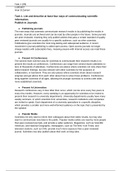
Task 1. List and describe at least four ways of communicating scientific
information.
Publish In Journals
● Publishing journals
The main ways that scientists communicate research results is by publishing the results in
journals. Journals are archived and can be read by other people in the future. Some journals
are peer-reviewed, meaning they only publish articles that pass a certain standard of quality
peer reviewed journals are usually for a specific audience, such as other scientists.
Publications give scientists the most long-lasting and widespread audience. A recent
movement in journal publishing is called open-access. Open-access journals no longer
charge readers with subscription fees, meaning anyone with Internet access can read these
journals.
● Present At Conferences
The second most common way for scientists to communicate their research results is to
present the results at conferences. Conferences can range from several dozen attendees to
tens of thousands of attendees. Conferences are places where scientists not only share their
latest research findings, but also network with other scientists for the purposes of
collaboration, or teamwork. They are also places where scientists share about research
enigmas and get advice from each other about how to solve those problems. Conferences
bring together scientists of all ages, allowing the younger scientists to connect with older,
more established scientists.
● Present At Universities
Research conferences vary in how often then occur, which can be once every few years to
every few months. However, every weekday is an opportunity for scientists to be invited to
present their research to university departments. University departments usually have many
weekly seminars, in which scientists from universities, research institutions and companies
are invited to speak. Each department of a university specializes in a specific discipline,
which provides a smaller and more well-informed audience on the topic that is presented by
the speaker.
● Popular Media
Scientists not only want to inform their colleagues about their latest results, but may also
want to communicate new data to the public. Popular media outlets are read by more people
than peer-reviewed journals, and provide a wider audience. Magazines, such as Scientific
American, and National Geographic; newspapers, such as The New York Times; and
television stations, such as CNN, provide much more exposure than a peer-reviewed
journal. Scientists now also publish about their work on blog sites.
11053457
Iman B.Zamani
Task 1. List and describe at least four ways of communicating scientific
information.
Publish In Journals
● Publishing journals
The main ways that scientists communicate research results is by publishing the results in
journals. Journals are archived and can be read by other people in the future. Some journals
are peer-reviewed, meaning they only publish articles that pass a certain standard of quality
peer reviewed journals are usually for a specific audience, such as other scientists.
Publications give scientists the most long-lasting and widespread audience. A recent
movement in journal publishing is called open-access. Open-access journals no longer
charge readers with subscription fees, meaning anyone with Internet access can read these
journals.
● Present At Conferences
The second most common way for scientists to communicate their research results is to
present the results at conferences. Conferences can range from several dozen attendees to
tens of thousands of attendees. Conferences are places where scientists not only share their
latest research findings, but also network with other scientists for the purposes of
collaboration, or teamwork. They are also places where scientists share about research
enigmas and get advice from each other about how to solve those problems. Conferences
bring together scientists of all ages, allowing the younger scientists to connect with older,
more established scientists.
● Present At Universities
Research conferences vary in how often then occur, which can be once every few years to
every few months. However, every weekday is an opportunity for scientists to be invited to
present their research to university departments. University departments usually have many
weekly seminars, in which scientists from universities, research institutions and companies
are invited to speak. Each department of a university specializes in a specific discipline,
which provides a smaller and more well-informed audience on the topic that is presented by
the speaker.
● Popular Media
Scientists not only want to inform their colleagues about their latest results, but may also
want to communicate new data to the public. Popular media outlets are read by more people
than peer-reviewed journals, and provide a wider audience. Magazines, such as Scientific
American, and National Geographic; newspapers, such as The New York Times; and
television stations, such as CNN, provide much more exposure than a peer-reviewed
journal. Scientists now also publish about their work on blog sites.