Being Human Essay – Personal Identity
Identify a central philosophical concept or philosophical issue in this picture that addresses
the question, “what is a human being? Investigate two different philosophical approaches to
the philosophical concept or philosophical issue you identified. Explain and evaluate the
philosophical concept or philosophical issue you identified.
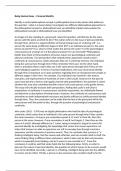
An image of a boy standing in a graveyard, raises the question, will that boy be the same
person until the point at which he dies? This notion refers to the issue of personal identity
through time, where it is argued whether all human beings have an ‘enduring self’. Is a
person the same being at different stages in their life? Is an individual at point A, the same
person at point B? If so, what is it that makes this person the same? Is it the psychological
consciousness of a being? Or is it the physical animal? Or can it be both? Philosophical
beliefs that relate to these positions of human nature are psychological continuity and
physical continuity. Two perspectives that embody these arguments include Locke’s
continuity of consciousness, which advocates that one is united by memory, the individual
being the same person through time if they remember their past. On the other hand,
Olson’s animalism theory claims that one is the same person through time if they are the
same biological organism. In terms of societal implications, this issue of personal identity
through time is important as it raises questions regarding how we should perceive people at
different stages in their lives. For example, if an individual was involved in the torture,
execution, and imprisonment of hundreds of Jews in their youth, however for the past 60
years have become a farmer and happily married with grandchildren, the question is raised
whether this man who committed horrible crimes is the same person as the gentle farmer.
This essay will critically evaluate both perspectives, finding that Locke’s and Olson’s
propositions of continuity in consciousness and body respectively, are individually flawed
and defective as descriptions of being human. However, the continuity of consciousness and
animalism are both independently necessary and jointly sufficient to justify personal identity
through time. Thus, the conclusion can be made that the boy at the graveyard will be the
same person until the point he dies, through the junction of psychological and physical
continuity.
John Locke (1632 – 1704) was an English philosopher who held the idea of psychological
continuity, which states that an individual is the same person through time if they contain
the same memories. As long as one remembers points A, B, and C in their life, then this
person is the same. However, if one remembers A and B, but forgets C, then they are the
same at A and B, although different at C. Locke, being an empiricist, began his search for
personal identity by investigating the knowledge that comes from sense experience. He
states that humans are able to experience our self in everyday lives through conscious
awareness and the memories of previous events. Thus, he concludes that a person is “a
thinking intelligent being, that has reason and reflection, and can consider itself as itself, the
same thinking thing in different times and places, which it does only by that consciousness,
which is inseparable from thinking, and as it seems to me essential to it”. From this
conclusion it could be said that Locke holds the five following ideas. Firstly, in order to
discover the nature of personal identity, the question of what it means to be a person would
have to be identified. Secondly, a person is a thinking, intelligent being who has the abilities
to reason and to reflect. Thirdly, a person is also someone who considers itself to be the
, same thing in different times and places. Fourthly, consciousness, being aware that we are
thinking, always accompanies thinking and is an essential part of the thinking process.
Lastly, consciousness is what makes possible our belief that we are the same identity in
different times and places. Further on Locke’s theory, to account for ‘interruptions’ in
consciousness such as sleep or forgetfulness, he claims that during these lapses we cannot
be sure that we were the same soul. He states that our personal identity is not in doubt
during interruptions as we are still aware of our self, however it is impossible to know
whether personal identity exists in one soul or many. To support his theory, Locke
formulates several analogies and scenarios to suggest that memory is the medium in which
humans endure over time. Firstly, he states that if one’s hand is cut off, it is separated from
the consciousness it had of heat, cold and other feelings, and is no longer a part of the
individual ‘any more than the remotest part of matter’. Thus, personal identity remains the
same regardless of physical changes to the body. Secondly, through the Nester and
Thersites thought experiment, Locke raises the question, if an individual had the same soul
as Nester or Thersites who participated in the Siege of Troy, but had no consciousness of
any previously performed actions by these men, how could he conceive himself as the same
person with either of them? This notion highlights how if one soul migrated to another body
and lost the memories that it formally had, we would not be the same person. Thirdly, the
prince and the cobbler thought experiment states that if the soul with the consciousness of
a prince entered the body of a cobbler whose soul had deserted him, this cobbler would be
perceived as the same person as the prince, however a different man. Here, Locke
introduces the concept that a ‘person’ refers to the memories and psychological part of a
human that associates with personal identity, whilst the ‘man’ is merely the physical,
biological organism. Lastly, Locke’s theory can be outlined by the pin and cushion analogy, in
which the cushion represents the substance or soul, whilst the pins represent the memories.
In addition to this analogy, Leibniz asks if we would be willing to have our soul (cushion)
switched into the body of the King of China. However, it is found that even with this
switching of souls, the memories and desires of the King would be the same, as the pins are
the same. Thus, it is concluded that the ‘same soul’ theory is not a sufficient condition for
personal identity, as it is the pins (memories) that are important. In making these
conclusions, Locke rejects the proposition by Descartes, in that the soul is what makes
personal identity possible through time. The soul theory follows on from cartesian dualism
(humans consist of a mind and body made from different substances), and suggests the
notion of ‘imago dei’, which states that God has created human beings in his image. The
appeal of this view is that life after death is rendered possible, and it also accounts for the
fact that we could imagine someone waking up in a different body. However, there are
several problems with this theory, including the vague definition of what the soul is, the
problem of interaction between the soul and the body, the neuroscience relationship
between the brain and identity, the problem of being unable to observe the soul and
determine if it is the same through time as well as the previous analogies and thought
experiments that render the soul as insignificant to personal identity. In summary, Locke’s
continuity of consciousness states that an individual is the same person through time if they
contain the same memories, interruptions in consciousness suggest a different soul and the
soul theory proposed by Descartes is rejected as a representation of personal identity.
Strengths of the theory include the Captain Kirk thought experiment, in which it is stated
that if the Captain’s original body were destroyed and created from new matter in another
location, this new creation would still be Captain Kirk. Even though the Captain Kirk in the
Identify a central philosophical concept or philosophical issue in this picture that addresses
the question, “what is a human being? Investigate two different philosophical approaches to
the philosophical concept or philosophical issue you identified. Explain and evaluate the
philosophical concept or philosophical issue you identified.
An image of a boy standing in a graveyard, raises the question, will that boy be the same
person until the point at which he dies? This notion refers to the issue of personal identity
through time, where it is argued whether all human beings have an ‘enduring self’. Is a
person the same being at different stages in their life? Is an individual at point A, the same
person at point B? If so, what is it that makes this person the same? Is it the psychological
consciousness of a being? Or is it the physical animal? Or can it be both? Philosophical
beliefs that relate to these positions of human nature are psychological continuity and
physical continuity. Two perspectives that embody these arguments include Locke’s
continuity of consciousness, which advocates that one is united by memory, the individual
being the same person through time if they remember their past. On the other hand,
Olson’s animalism theory claims that one is the same person through time if they are the
same biological organism. In terms of societal implications, this issue of personal identity
through time is important as it raises questions regarding how we should perceive people at
different stages in their lives. For example, if an individual was involved in the torture,
execution, and imprisonment of hundreds of Jews in their youth, however for the past 60
years have become a farmer and happily married with grandchildren, the question is raised
whether this man who committed horrible crimes is the same person as the gentle farmer.
This essay will critically evaluate both perspectives, finding that Locke’s and Olson’s
propositions of continuity in consciousness and body respectively, are individually flawed
and defective as descriptions of being human. However, the continuity of consciousness and
animalism are both independently necessary and jointly sufficient to justify personal identity
through time. Thus, the conclusion can be made that the boy at the graveyard will be the
same person until the point he dies, through the junction of psychological and physical
continuity.
John Locke (1632 – 1704) was an English philosopher who held the idea of psychological
continuity, which states that an individual is the same person through time if they contain
the same memories. As long as one remembers points A, B, and C in their life, then this
person is the same. However, if one remembers A and B, but forgets C, then they are the
same at A and B, although different at C. Locke, being an empiricist, began his search for
personal identity by investigating the knowledge that comes from sense experience. He
states that humans are able to experience our self in everyday lives through conscious
awareness and the memories of previous events. Thus, he concludes that a person is “a
thinking intelligent being, that has reason and reflection, and can consider itself as itself, the
same thinking thing in different times and places, which it does only by that consciousness,
which is inseparable from thinking, and as it seems to me essential to it”. From this
conclusion it could be said that Locke holds the five following ideas. Firstly, in order to
discover the nature of personal identity, the question of what it means to be a person would
have to be identified. Secondly, a person is a thinking, intelligent being who has the abilities
to reason and to reflect. Thirdly, a person is also someone who considers itself to be the
, same thing in different times and places. Fourthly, consciousness, being aware that we are
thinking, always accompanies thinking and is an essential part of the thinking process.
Lastly, consciousness is what makes possible our belief that we are the same identity in
different times and places. Further on Locke’s theory, to account for ‘interruptions’ in
consciousness such as sleep or forgetfulness, he claims that during these lapses we cannot
be sure that we were the same soul. He states that our personal identity is not in doubt
during interruptions as we are still aware of our self, however it is impossible to know
whether personal identity exists in one soul or many. To support his theory, Locke
formulates several analogies and scenarios to suggest that memory is the medium in which
humans endure over time. Firstly, he states that if one’s hand is cut off, it is separated from
the consciousness it had of heat, cold and other feelings, and is no longer a part of the
individual ‘any more than the remotest part of matter’. Thus, personal identity remains the
same regardless of physical changes to the body. Secondly, through the Nester and
Thersites thought experiment, Locke raises the question, if an individual had the same soul
as Nester or Thersites who participated in the Siege of Troy, but had no consciousness of
any previously performed actions by these men, how could he conceive himself as the same
person with either of them? This notion highlights how if one soul migrated to another body
and lost the memories that it formally had, we would not be the same person. Thirdly, the
prince and the cobbler thought experiment states that if the soul with the consciousness of
a prince entered the body of a cobbler whose soul had deserted him, this cobbler would be
perceived as the same person as the prince, however a different man. Here, Locke
introduces the concept that a ‘person’ refers to the memories and psychological part of a
human that associates with personal identity, whilst the ‘man’ is merely the physical,
biological organism. Lastly, Locke’s theory can be outlined by the pin and cushion analogy, in
which the cushion represents the substance or soul, whilst the pins represent the memories.
In addition to this analogy, Leibniz asks if we would be willing to have our soul (cushion)
switched into the body of the King of China. However, it is found that even with this
switching of souls, the memories and desires of the King would be the same, as the pins are
the same. Thus, it is concluded that the ‘same soul’ theory is not a sufficient condition for
personal identity, as it is the pins (memories) that are important. In making these
conclusions, Locke rejects the proposition by Descartes, in that the soul is what makes
personal identity possible through time. The soul theory follows on from cartesian dualism
(humans consist of a mind and body made from different substances), and suggests the
notion of ‘imago dei’, which states that God has created human beings in his image. The
appeal of this view is that life after death is rendered possible, and it also accounts for the
fact that we could imagine someone waking up in a different body. However, there are
several problems with this theory, including the vague definition of what the soul is, the
problem of interaction between the soul and the body, the neuroscience relationship
between the brain and identity, the problem of being unable to observe the soul and
determine if it is the same through time as well as the previous analogies and thought
experiments that render the soul as insignificant to personal identity. In summary, Locke’s
continuity of consciousness states that an individual is the same person through time if they
contain the same memories, interruptions in consciousness suggest a different soul and the
soul theory proposed by Descartes is rejected as a representation of personal identity.
Strengths of the theory include the Captain Kirk thought experiment, in which it is stated
that if the Captain’s original body were destroyed and created from new matter in another
location, this new creation would still be Captain Kirk. Even though the Captain Kirk in the