Operations Management
9. Tutorial: Operations Scheduling – Exercises
Task 1: Order planning (one station)
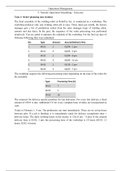
The final assembly of the welding robot at RoboTec Inc. is conducted in a workshop. The
workshop produces only one welding robot job at once. Three times per month, the factory
manager gets a list of production orders from the sales manager (type of welding robot,
amount and due date). In the past, the sequence of the order processing was performed
intuitively. You are asked to optimize the schedule of the workshop. For the first ten days of
February following files were submitted:
No. Type Amount Assured Delivery Time
1 SR-01 2 02/04 – 1 pm
2 SR-01 3 02/03 – 3 pm
3 SR-02 2 02/04 – 8 pm
4 SR-02 3 02/05 – 11 am
5 SR-03 2 02/10 – 2 pm
6 SR-03 3 02/07 – 7 pm
The workshop requires the following processing times depending on the type of the robot for
the assembly:
Type Processing Time [h]
SR-01 7
SR-02 5
SR-03 10
The contracts for delivery specify penalties for late deliveries. For every late delivery a fixed
amount of 250 € is due. Additional 5 € for every complete hour of delay are incorporated as
well.
Today is February 1, 8 am. The production can start immediately. There are no set-up times
between jobs. If a job is finished, it is immediately ready for delivery (completion time =
delivery time). The daily working hours in the factory is 12h (8 am – 8 pm). If the assured
delivery time is 02/02, 2 pm, the processing time of the workshop is 18 hours (02/01: 12
hours, 02/02: 6 hours).
, a) Please illustrate the sequence of jobs graphically in a Gantt chart. Please calculate the
average completion time, the maximum tardiness, the number of delayed jobs and the costs of
tardiness, if the order of arrival determines the processing sequence.
Sequences (FCFS-Rule):
Processing Time Due Date Starting Time Completion Time Tardiness
No. [h] [h] [h] [h] [h]
Gantt-Diagram (FCFS):
2
9. Tutorial: Operations Scheduling – Exercises
Task 1: Order planning (one station)
The final assembly of the welding robot at RoboTec Inc. is conducted in a workshop. The
workshop produces only one welding robot job at once. Three times per month, the factory
manager gets a list of production orders from the sales manager (type of welding robot,
amount and due date). In the past, the sequence of the order processing was performed
intuitively. You are asked to optimize the schedule of the workshop. For the first ten days of
February following files were submitted:
No. Type Amount Assured Delivery Time
1 SR-01 2 02/04 – 1 pm
2 SR-01 3 02/03 – 3 pm
3 SR-02 2 02/04 – 8 pm
4 SR-02 3 02/05 – 11 am
5 SR-03 2 02/10 – 2 pm
6 SR-03 3 02/07 – 7 pm
The workshop requires the following processing times depending on the type of the robot for
the assembly:
Type Processing Time [h]
SR-01 7
SR-02 5
SR-03 10
The contracts for delivery specify penalties for late deliveries. For every late delivery a fixed
amount of 250 € is due. Additional 5 € for every complete hour of delay are incorporated as
well.
Today is February 1, 8 am. The production can start immediately. There are no set-up times
between jobs. If a job is finished, it is immediately ready for delivery (completion time =
delivery time). The daily working hours in the factory is 12h (8 am – 8 pm). If the assured
delivery time is 02/02, 2 pm, the processing time of the workshop is 18 hours (02/01: 12
hours, 02/02: 6 hours).
, a) Please illustrate the sequence of jobs graphically in a Gantt chart. Please calculate the
average completion time, the maximum tardiness, the number of delayed jobs and the costs of
tardiness, if the order of arrival determines the processing sequence.
Sequences (FCFS-Rule):
Processing Time Due Date Starting Time Completion Time Tardiness
No. [h] [h] [h] [h] [h]
Gantt-Diagram (FCFS):
2