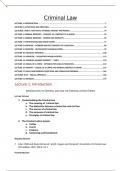
Criminal Law
LECTURE 1: INTRODUCTION.......................................................................................................................... 1
LECTURE 2: ACTUS REUS AND MENS REA..................................................................................................... 14
LECTURES 3 AND 4: NON-FATAL OFFENCES AGAINST THE PERSON...............................................................34
LECTURE 5: GENERAL DEFENCES – CONSENT AS A DEFENCE TO A NFAOP.....................................................56
LECTURE 6: GENERAL DEFENCES – DURESS AND NECESSITY..........................................................................65
LECTURE 7: PARTICIPATION AND GROUP CRIME.......................................................................................... 71
LECTURE 8: HOMICIDE – MURDER AND KEY CONCEPTS OF CAUSATION.......................................................80
LECTURE 9: HOMICIDE – INVOLUNTARY MANSLAUGHTER...........................................................................90
LECTURE 10: INCHOATE OFFENCES............................................................................................................ 100
LECTURE 11: HOMICIDE – VOLUNTARY MANSLAUGHTER...........................................................................113
LECTURE 13: OFFENCES AGAINST PROPERTY – THEFT.................................................................................133
LECTURE 14: DENIAL OF A CRIME – INTOXICATION AND AUTOMATION.....................................................143
LECTURE 16: INSANITY – DENIAL OF A CRIME AND GENERAL DEFENCE TO CRIME.......................................159
LECTURE 17: ESSAY AND PROBLEM QUESTIONS AND FORMATIVE FEEDBACK.............................................164
LECTURES 18-19 – SEXUAL OFFENCES........................................................................................................ 166
LECTURE 21: REVISION.............................................................................................................................. 194
Lecture 1: Introduction
INTRODUCTION TO CRIMINAL LAW AND THE CRIMINAL JUSTICE SYSTEM
LECTURE OUTLINE
1. Contextualising the Criminal Law
a. The meaning of ‘criminal law’
b. The distinction between criminal law and civil law
c. The sources of criminal law
d. The purposes of criminal law
e. Principles of criminal law
2. The Criminal Justice System
a. Parties
b. Courts
c. Evidence
d. Sentencing and Punishment
REQUIRED READING
John Child and David Ormerod, Smith, Hogan and Ormerod’s Essentials of Criminal Law
(4th edition, OUP, 2021), Ch 1
FURTHER READING
, Janet Loveless, Mischa Allen, and Caroline Derry, Complete Criminal Law (8th edn., OUP,
2022), Ch 1
A P Simester et al, Simester and Sullivan’s Criminal Law – Theory and Doctrine (7th edn.,
Hart Publishing, 2019), Ch 1-3
David Ormerod and Karl Laird, Smith, Hogan, and Ormerod’s Criminal Law (15th edn.,
OUP, 2018), Ch 1
Andrew Ashworth, ‘Is the Criminal Law a Lost Cause?’ (2000) 116 LQR 225
Andrew Ashworth and Mike Redmayne, The Criminal Process (2010), Ch 1
James Chalmers and Fiona Leverick, ‘Fair labelling’ [2008] MLR 217
Ian Dennis, ‘Reverse onuses and the presumption of innocence: in search of principle’
[2005] Crim LR 901
1. Contextualising the Criminal Law
a. The meaning of ‘criminal law’
Criminal law can be characterised as a law of wrongs. It sets rules for citizens to follow and the
conditions under which breaches of these rules may be punished. In essence, it is the law that
determines what is and is not a crime. Criminal law doctrine can be divided along these lines:
• The “special part”: defines particular criminal offences, e.g. murder, assault, theft
• The “general part”: the doctrines governing liability for offences, e.g. definitions of
key concepts; rules of criminal responsibility; defences
Criminal law is a ‘social normative space’ – a system which sets down standard of conduct, and
infringes these norms (Lacey, Wells, and Quick, Reconstructing Criminal Law (4th edition, 2010), 5)
b. The distinction between criminal law and civil law
CRIMINAL LAW CIVIL LAW
Public wrong (state v citizen) Private wrong (citizen v citizen)
Blame and stigma Regulation
Public prosecutions Private claims
Strong procedural protections Weak procedural protections
Punishment Compensation
c. The sources of criminal law
Common law
There are a number of ‘common law offences’; offences which are derived from judicial
pronouncements, such as the examples below:
Manley [1933] 1 KB 529 (creation of the offence of “public mischief”)
Withers [1975] AC 842 (offence of public mischief abolished)
Shaw v DPP [1962] AC 220 (conspiracy to corrupt public morals)
Knuller v DPP [1973] AC 435 (conspiracy to corrupt public morals abolished)
, Criminal Law Act 1977, s 5 (statutory offence created)
R v R (Rape: Marital Exemption) [1992] 1 AC 599
Ireland and Burstow [1998] AC 147 (causing psychological harm)
Dica [2004] QB 1257 (reckless transmission of HIV as biological harm)
Hinks [2000] 2 Cr App R 1 (extending theft to include consensual transfers of property)
However, it is now firmly accepted that the courts can no longer make new offences or
defences. Instead, this is the role of Parliament. See:
Jones [2006] UKHL 16 - common law power to create new offences all but abolished
Statute law
Most criminal offences are now contained in statute. See, for example:
Offences Against the Person Act 1861
Theft Act 1968
Sexual Offences Act 2003
You can find the text of statutes at: legislation.gov.uk/
Codification
Law Com No 177, A Criminal Code for England and Wales (1989): the need for ‘accessibility,
comprehensibility, consistency and certainty’.
Compare the 2003 Draft Criminal Code for Scotland:
www.scotlawcom.gov.uk/downloads/cp_criminal_code.pdf
‘Law in the books’ v ‘Law in Practice’
Criminal law – like all forms of law – is a social practice that exists in a particular social context. How
the law operates is not just a product of what cases and statute books say. The courts (and police,
and prosecutors) possess some discretion in their interpretation and application of the law. Although
not a formal source of law, this discretion has a real impact on the outcome of criminal cases. See
e.g. R (Purdy) v DPP [2010] 1 AC 345.
d. The purposes of criminal law
There is significant disagreement about the purpose of criminal law – and hence about what justifies
its existence. Possibilities include:
• Deterrence (general and special)
• Retribution
• Incapacitation of dangerous people
• Condemnation of offenders
• Affirmation of the rights of victims
• Rehabilitation / restoration
• Discouraging ‘mob justice’
• Maintaining social structure and social order
e. Principles of criminal law
There are commonly held ideals or aims of the criminal law that underpin the substantive rules.
These are ideal qualities of the criminal law – points of reference that can be used to evaluate
, offences and defences. The principles of criminal law affect the substance of the law by influencing
the manner of its interpretation, and the effect the reform of the law through evaluation.
Throughout this module, think about these principles in relation to the offences and defences which
you study and ask yourself how well you think that these principles are reflected in the substantive
criminal law
Fair Warning
This is the principle that if the criminal law is to be a deterrent and punish those who choose to
break the law, then the public need to know what is and is not illegal. The law must be
communicated to the public.
• How should the criminal law be communicated to the public?
• Should common law crimes be codified?
• How should they be codified?
• How detailed should statute be?
• Complicated and detailed (but possibly confusing)?
• Clear and concise (but possibly vague)?
Minimum criminalisation
Conduct should be criminalised only when absolutely necessary. Why?
• Liberalism and individual autonomy
• Ensure the potency of criminal censure
• Superiority of alternative forms of social control
Criminal sanctions are the most severe sanctions that the state imposes on its citizens. It is therefore
sometimes said that criminal law should be a ‘last resort’ for dealing with problematic behaviour.
Possible alternatives to criminal law include:
• Non-criminal regulation
• Civil law (injunctions)
• Alternative dispute resolution
• Licensing
• Taxation
• Public education strategies
• Doing nothing (but the 'moral coercion of public opinion')
The harm principle
[T]he only purpose for which power can be rightfully exercised over any member of a
civilized community, against his will, is to prevent harm to others. (JS Mill, On Liberty
(1859))
Mill’s principle has been central to discussion about the limits of the criminal law for over 150 years.
It appeals to many political liberals: conduct should not be criminalised just because the majority of
people think that it is immoral or bad. Arguably, it has also been influential in terms of law reform,
such as in the decriminalisation of homosexual conduct.
The usefulness of the harm principle as a constraint on criminal law can, however, be questioned.
The concept of 'harm' is highly contestable. Consider the following, all of which are targeted by
criminal prohibitions:
• ‘Harms’ to which consent is given
LECTURE 1: INTRODUCTION.......................................................................................................................... 1
LECTURE 2: ACTUS REUS AND MENS REA..................................................................................................... 14
LECTURES 3 AND 4: NON-FATAL OFFENCES AGAINST THE PERSON...............................................................34
LECTURE 5: GENERAL DEFENCES – CONSENT AS A DEFENCE TO A NFAOP.....................................................56
LECTURE 6: GENERAL DEFENCES – DURESS AND NECESSITY..........................................................................65
LECTURE 7: PARTICIPATION AND GROUP CRIME.......................................................................................... 71
LECTURE 8: HOMICIDE – MURDER AND KEY CONCEPTS OF CAUSATION.......................................................80
LECTURE 9: HOMICIDE – INVOLUNTARY MANSLAUGHTER...........................................................................90
LECTURE 10: INCHOATE OFFENCES............................................................................................................ 100
LECTURE 11: HOMICIDE – VOLUNTARY MANSLAUGHTER...........................................................................113
LECTURE 13: OFFENCES AGAINST PROPERTY – THEFT.................................................................................133
LECTURE 14: DENIAL OF A CRIME – INTOXICATION AND AUTOMATION.....................................................143
LECTURE 16: INSANITY – DENIAL OF A CRIME AND GENERAL DEFENCE TO CRIME.......................................159
LECTURE 17: ESSAY AND PROBLEM QUESTIONS AND FORMATIVE FEEDBACK.............................................164
LECTURES 18-19 – SEXUAL OFFENCES........................................................................................................ 166
LECTURE 21: REVISION.............................................................................................................................. 194
Lecture 1: Introduction
INTRODUCTION TO CRIMINAL LAW AND THE CRIMINAL JUSTICE SYSTEM
LECTURE OUTLINE
1. Contextualising the Criminal Law
a. The meaning of ‘criminal law’
b. The distinction between criminal law and civil law
c. The sources of criminal law
d. The purposes of criminal law
e. Principles of criminal law
2. The Criminal Justice System
a. Parties
b. Courts
c. Evidence
d. Sentencing and Punishment
REQUIRED READING
John Child and David Ormerod, Smith, Hogan and Ormerod’s Essentials of Criminal Law
(4th edition, OUP, 2021), Ch 1
FURTHER READING
, Janet Loveless, Mischa Allen, and Caroline Derry, Complete Criminal Law (8th edn., OUP,
2022), Ch 1
A P Simester et al, Simester and Sullivan’s Criminal Law – Theory and Doctrine (7th edn.,
Hart Publishing, 2019), Ch 1-3
David Ormerod and Karl Laird, Smith, Hogan, and Ormerod’s Criminal Law (15th edn.,
OUP, 2018), Ch 1
Andrew Ashworth, ‘Is the Criminal Law a Lost Cause?’ (2000) 116 LQR 225
Andrew Ashworth and Mike Redmayne, The Criminal Process (2010), Ch 1
James Chalmers and Fiona Leverick, ‘Fair labelling’ [2008] MLR 217
Ian Dennis, ‘Reverse onuses and the presumption of innocence: in search of principle’
[2005] Crim LR 901
1. Contextualising the Criminal Law
a. The meaning of ‘criminal law’
Criminal law can be characterised as a law of wrongs. It sets rules for citizens to follow and the
conditions under which breaches of these rules may be punished. In essence, it is the law that
determines what is and is not a crime. Criminal law doctrine can be divided along these lines:
• The “special part”: defines particular criminal offences, e.g. murder, assault, theft
• The “general part”: the doctrines governing liability for offences, e.g. definitions of
key concepts; rules of criminal responsibility; defences
Criminal law is a ‘social normative space’ – a system which sets down standard of conduct, and
infringes these norms (Lacey, Wells, and Quick, Reconstructing Criminal Law (4th edition, 2010), 5)
b. The distinction between criminal law and civil law
CRIMINAL LAW CIVIL LAW
Public wrong (state v citizen) Private wrong (citizen v citizen)
Blame and stigma Regulation
Public prosecutions Private claims
Strong procedural protections Weak procedural protections
Punishment Compensation
c. The sources of criminal law
Common law
There are a number of ‘common law offences’; offences which are derived from judicial
pronouncements, such as the examples below:
Manley [1933] 1 KB 529 (creation of the offence of “public mischief”)
Withers [1975] AC 842 (offence of public mischief abolished)
Shaw v DPP [1962] AC 220 (conspiracy to corrupt public morals)
Knuller v DPP [1973] AC 435 (conspiracy to corrupt public morals abolished)
, Criminal Law Act 1977, s 5 (statutory offence created)
R v R (Rape: Marital Exemption) [1992] 1 AC 599
Ireland and Burstow [1998] AC 147 (causing psychological harm)
Dica [2004] QB 1257 (reckless transmission of HIV as biological harm)
Hinks [2000] 2 Cr App R 1 (extending theft to include consensual transfers of property)
However, it is now firmly accepted that the courts can no longer make new offences or
defences. Instead, this is the role of Parliament. See:
Jones [2006] UKHL 16 - common law power to create new offences all but abolished
Statute law
Most criminal offences are now contained in statute. See, for example:
Offences Against the Person Act 1861
Theft Act 1968
Sexual Offences Act 2003
You can find the text of statutes at: legislation.gov.uk/
Codification
Law Com No 177, A Criminal Code for England and Wales (1989): the need for ‘accessibility,
comprehensibility, consistency and certainty’.
Compare the 2003 Draft Criminal Code for Scotland:
www.scotlawcom.gov.uk/downloads/cp_criminal_code.pdf
‘Law in the books’ v ‘Law in Practice’
Criminal law – like all forms of law – is a social practice that exists in a particular social context. How
the law operates is not just a product of what cases and statute books say. The courts (and police,
and prosecutors) possess some discretion in their interpretation and application of the law. Although
not a formal source of law, this discretion has a real impact on the outcome of criminal cases. See
e.g. R (Purdy) v DPP [2010] 1 AC 345.
d. The purposes of criminal law
There is significant disagreement about the purpose of criminal law – and hence about what justifies
its existence. Possibilities include:
• Deterrence (general and special)
• Retribution
• Incapacitation of dangerous people
• Condemnation of offenders
• Affirmation of the rights of victims
• Rehabilitation / restoration
• Discouraging ‘mob justice’
• Maintaining social structure and social order
e. Principles of criminal law
There are commonly held ideals or aims of the criminal law that underpin the substantive rules.
These are ideal qualities of the criminal law – points of reference that can be used to evaluate
, offences and defences. The principles of criminal law affect the substance of the law by influencing
the manner of its interpretation, and the effect the reform of the law through evaluation.
Throughout this module, think about these principles in relation to the offences and defences which
you study and ask yourself how well you think that these principles are reflected in the substantive
criminal law
Fair Warning
This is the principle that if the criminal law is to be a deterrent and punish those who choose to
break the law, then the public need to know what is and is not illegal. The law must be
communicated to the public.
• How should the criminal law be communicated to the public?
• Should common law crimes be codified?
• How should they be codified?
• How detailed should statute be?
• Complicated and detailed (but possibly confusing)?
• Clear and concise (but possibly vague)?
Minimum criminalisation
Conduct should be criminalised only when absolutely necessary. Why?
• Liberalism and individual autonomy
• Ensure the potency of criminal censure
• Superiority of alternative forms of social control
Criminal sanctions are the most severe sanctions that the state imposes on its citizens. It is therefore
sometimes said that criminal law should be a ‘last resort’ for dealing with problematic behaviour.
Possible alternatives to criminal law include:
• Non-criminal regulation
• Civil law (injunctions)
• Alternative dispute resolution
• Licensing
• Taxation
• Public education strategies
• Doing nothing (but the 'moral coercion of public opinion')
The harm principle
[T]he only purpose for which power can be rightfully exercised over any member of a
civilized community, against his will, is to prevent harm to others. (JS Mill, On Liberty
(1859))
Mill’s principle has been central to discussion about the limits of the criminal law for over 150 years.
It appeals to many political liberals: conduct should not be criminalised just because the majority of
people think that it is immoral or bad. Arguably, it has also been influential in terms of law reform,
such as in the decriminalisation of homosexual conduct.
The usefulness of the harm principle as a constraint on criminal law can, however, be questioned.
The concept of 'harm' is highly contestable. Consider the following, all of which are targeted by
criminal prohibitions:
• ‘Harms’ to which consent is given